

OpenAI strengthens its content provenance system, meeting the guidelines of the EU AI Act for transparency requirements. For this purpose, the company has announced it will introduce an invisible watermarking system, textGrain, in eligible ChatGPT and Codex text generated in the European Union. Global API users can also opt in to text watermarking for select models, which will remain off by default.
OpenAI announced textGrain on October 5, 2026, and will make AI-generated text identifiable through machine-readable signals. The new system is a statistical text watermarking system that embeds a statistical signal in the model’s word choices.
Initial access to the text watermark detector is limited to approved researchers and expert organizations. Moreover, primary access will selectively support testing and improvements through real-world use. The feature will roll out in phases because of current limitations and the need for responsible implementation.
How does OpenAI’s textGrain Technology work?
textGrain does not include special characters or unusual spacing in AI-generated text like visible labels or watermarks. Instead, it precisely analyzes the randomness involved when the model selects words or word pieces. These choices create a statistical pattern that a detector can examine for an OpenAI watermark.
Assessments found that textGrain matched or outperformed other watermarking approaches, including Google DeepMind’s SynthID for text. However, the results do not guarantee dependable detection in everyday situations. Detection accuracy can differ depending on passage length, language, and how much the original text changes. Additionally, edits and reedits can also weaken the watermark signal.
The technology aims to make the origin of AI-generated text easier to assess. However, a watermark does not establish whether a passage is accurate, who owns it, or how much a human contributed. It also cannot prove that a person did not write the text.
Persisting Challenges to the Detection Capabilities of textGrain:
OpenAI acknowledges that text watermarking can produce false positives and false negatives. A false positive occurs when a detector identifies a watermark that is not present. Whereas a false negative occurs when the detector misses an existing watermark. These limitations make the technology unsuitable as conclusive proof of AI authorship.
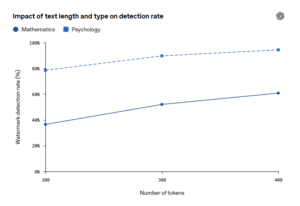
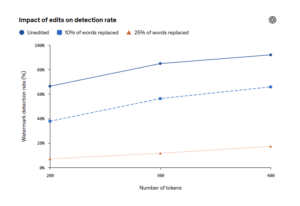
As mentioned earlier, text length, type, and editing can also affect detection in OpenAI’s textGrain. Significant editing, rewriting, paraphrasing, or translation may weaken the watermark signal. OpenAI’s guidance notes that the EU transparency framework does not require watermarks for outputs shorter than 200 tokens, approximately 150 English words, or for code snippets. Here is how text length, type, and edits impact the detection rate:
OpenAI will initially restrict detector access to approved research and academic organizations for the reasons above. textGrain will only report whether it finds an OpenAI watermark. Furthermore, the system will not identify users or disclose their prompts and conversations.
What textGrain Watermark Does Not Include?
- A watermark can only specify if a content piece is generated with an OpenAI model. It cannot measure the human judgment, editing, or creativity involved in it.
- A watermark does not reveal who owns the text and does not establish ownership even after the lawful use of a content piece.
- A watermark cannot identify users and associate a person, prompt, or account with the text.
- A watermark does not verify the accuracy of a text, indicating whether it is true, misleading, harmful, or offers the right context.
Additionally, unwatermarked text does not necessarily indicate human authorship. OpenAI’s textGrain applies watermarks only to content generated by its own models. Therefore, the absence of a watermark does not confirm that the text was human-written, as it may have been generated using other AI tools.
OpenAI’s textGrain to Improve Its Content Provenance System:
The announcement of textGrain expands OpenAI’s existing work on identifying AI-generated content, including Content Credentials for images and SynthID watermarks for supported images and audio. The company also provides verification tools for checking supported media files.
The announcement of the text watermarking system marks another step toward improving transparency around generative AI. Nevertheless, watermarking remains one signal, not a universal AI detection solution. Its successful implementation and impact will depend on detection reliability, language coverage, and how the technology performs when people edit or reuse AI-generated text.
OpenAI has decided to make the new system available in the EU only in the coming weeks for eligible ChatGPT and Codex users. However, OpenAI has not announced a global rollout yet. According to OpenAI, a regional launch will offer opportunities for further improvement in the feature through real-world use and user feedback.
Keep track of the changing AI regulations across the globe, with HiTechNectar!
Also Read:
Meet OpenAI’s GPT-5.5: Features, Pricing, Benchmarks & Real-World Use Cases Explained