


Data is the most important asset in any organization today. The analysis of this data and the insights it yields help businesses grow. Including a big data strategy is fundamental to managing your organization’s big data.
A recent study found that among companies that make decisions using data management tools, 58% are more likely to beat their revenue benchmarks than companies that don’t implement big data strategies.
Let us discuss what a data-driven strategy is, why implementing it is crucial for your business, its key components, and the steps to building effective big data strategies for your organization.
What is a Big Data Strategy?
Big data strategy refers to the methods organizations use to acquire, process, and store massive volumes of structured, unstructured, and semi-structured data. It ensures that the collected data is utilized to its full potential to make informed decisions and increase productivity and growth.
Features like data governance, business intelligence, artificial intelligence, data analytics, and data platforms come together to form a data ecosystem.
Why Businesses Should Adopt Big Data Strategies?
Incorporating big data strategies helps organizations stay competitive, innovative, and relevant in an era of constantly evolving trends. Here are the advantages of adopting these strategies:
- Better Integration: Managing big data can be a complex process. Big data strategies help organize big data so that data driven strategies can be implemented productively. Businesses that leverage data-driven strategies gain an advantage over organizations that don’t.
- Operational Efficiency: Automating data and data analytics are two segments of big data strategies that cut costs while increasing efficiency.
- Enhanced Decision Making: Better integration of big data provides real-time data that can be used to make faster and more informed decisions.
- Competitive Advantage: Adopting big data strategies makes it easier to understand and adapt to market changes.
Key Aspects that Operationalize Big Data in Businesses
Before making a big data strategy functional, businesses need to form a proper structure. This structure comprises of interconnected components that determine how data is gathered, processed, managed, and leveraged to generate business value. Let us discuss these aspects in detail-
Data Vision and Business Goals
Every company should be clear on its data vision. This means it should know what it wants to achieve and how data will support that goal. Teams will continuously collect information without turning it into something productive if their objectives are not defined. Most importantly, business goals determine which data is important and when it should be updated to support growth.
The data vision aligns data collection with the business’s purpose. This ensures that data analytics don’t just create reports but also contribute to improvements.
Data Infrastructure and Architecture
Huge volumes of data can be effectively stored and processed through data lakes, lakehouse technology, and cloud data warehouses.
Companies should leverage cloud migration for scalability, a hybrid data structure for flexibility, and real-time data processing for immediate insights.
Data Governance and Compliance
Data governance involves setting rules. This includes answers to questions such as who owns which data, who can access it, and how to maintain its accuracy and privacy.
Companies enforce governance systems to automate data validation, access control, and be prepared for audits. These systems uphold privacy, ensure all records are accurate and traceable, and clarify ownership.
Technology Stack and Incorporation
A durable technology stack ensures that data processing, analysis, and transformation remain efficient and scalable across the entire system. It is also important to integrate internal data layers with external systems.
Organizations often utilize a mix of modern and legacy platforms, including CRM, ERP, and BI tools. Incorporating API and microservices bridges these systems. This ensures constant data exchange and reduces the need for manual syncing. It also helps the right information reach the right place.
Machine Learning and Analytics Facilities
This aspect ensures that both human and automated data convert into decisions, including dashboards, system integration, reporting, and machine learning models.
In machine learning, data scientists use carefully selected datasets to train predictive and classification models. The training is for tasks such as fraud detection, demand forecasting, etc. These models depend on well-defined, consistent data pipelines.
Expertise and Business Alignment
Running advanced data stacks requires specific expertise that can only be provided by people who possess the required skills. To make this happen, data analytics should be a shared language that all departments are fluent in. Upskilling is important to make data beneficial across teams.
When skills, culture, and leadership come together, data becomes the foundation upon which an organization functions efficiently.
Steps to Build a Big Data Strategy for Your Organization
Adopting a big data strategy may initially seem intimidating because of the lack of relevant expertise. It may also be challenging to align new business strategies with existing goals and systems. Understanding these five steps will simplify the implementation of the big data strategy.
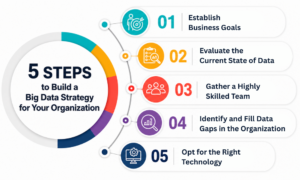
Step 1: Establish Business Goals
Before adopting big data across the organization, establish business goals. This includes answering questions such as where it is needed, how it helps solve problems, and whether it contributes to business goals.
Big data leverages data to deliver productivity. So, the strategy should address primary business problems.
Step 2: Evaluate the Current State of Data
Before adding new strategies, it is important to understand which assets, sources, policies, processes, and capabilities the organization already has in place. The data-driven strategy roadmap should include the company’s goals and report on the current state of the data in the organization.
Step 3: Gather a Highly Skilled Team
Implementing big data strategies requires a team that is highly skilled. It is better to start by reskilling and upskilling existing employees. Then, if needed, BI consultants can be brought in to leverage the full potential of data.
Step 4: Identify and Fill Data Gaps in the Organization
Evaluating the current state of data in the organization will reveal blind spots in the business. For example, this might include a lack of full understanding of the customer audience when launching customized campaigns.
Different departments will have various use cases, information, and questions based on clientele and revenue costs.
Step 5: Opt for the Right Technology
It is important to find the right technology for all steps of the data-driven strategy roadmap. The roadmap includes collecting, storing, processing, and communicating insights from data.
Organizations collect data from various sources such as business transactions, social media, industrial gear, IoT devices, etc. This makes finding the right technology even more important while gathering data. When storing data, integrating big data technologies with cloud computing is a cost-effective way to manage all data.
Increasing Work Efficiency with Big Data Strategies
Your organization’s success depends upon how well you manage and utilize your business data. Creating and implementing a big data strategy will give you a competitive edge in the industry. Incorporate the strategy and make faster, smarter, and more strategic decisions for your company.
Head over to HiTechNectar for more insightful blogs.
FAQs
Q1. What are the four big data strategies?
Answer: The four big data strategies include:
- Descriptive Analytics – Summarizes historical data to identify trends and patterns.
- Diagnostic Analytics – Helps understand the causes of past outcomes.
- Predictive Analytics – Uses historical data to predict future outcomes.
- Prescriptive Analytics – Suggests solutions and action plans by assessing future scenarios and outcomes.
Q2. What are the three Vs of big data?
Answer: The three Vs of big data are Volume (amount of data), Velocity (growth of data), and Variety (types of data).
Q3. Why are big data strategies important?
Answer: Big data strategies help organizations enhance decision-making, improve customer experience, increase operational efficiency, etc.
Also Read:
Big Data- How can it Benefit Your Business
The Role of AI in Big Data: Unlocking New Possibilities
Why Big Data Is Important for Businesses: Pros and Cons Explained
Data Lakehouse vs. Data Lake: Choosing the Right Architecture for Your Big Data Needs