
Demand for AI applications is growing today. They serve different purposes. AI applications can process large amounts of information. However, they can’t process infinite information at once. To address this, every AI model has a context window, which refers to the amount of text a model can consider at a time when generating a response. It even matters a lot when designing an AI application. Alongside, affects how conversations are managed, how information is used, and more.
Understanding technical terms such as context windows and token limits is essential for navigating the evolving world of AI app design. In this blog, we will explore context windows in AI, why they matter, and more. Let’s get started.
What is a Context Window?
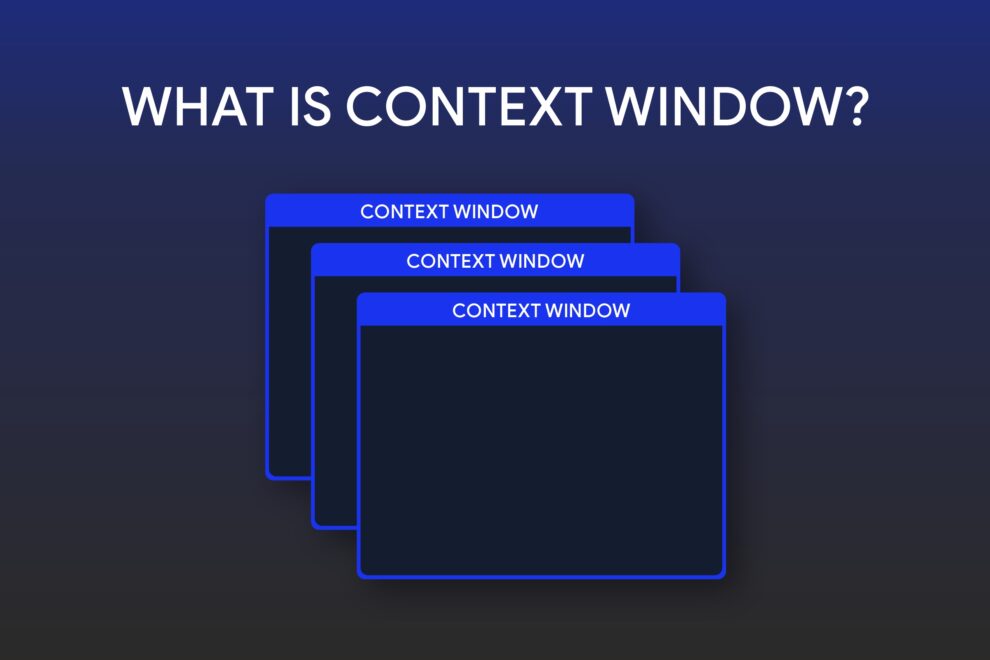
A context window is basically the amount of information a large language model (LLM) can hold and refer to while generating a response. In simple terms, a context window is like an LLM’s working memory. This is a key part of context window AI design, where larger windows let a model consider more information at a time. However, it has some specific token limits. As of September 24, 2026, the largest LLM context window monitored by BenchLM is 10M tokens.
LLMs use context windows to consider relevant tokens when generating text. Large context windows provide more information; however, they are limited to a specific number of tokens. Once the window is full, earlier information gets lost; this is what context window length means.
Tokens: The Building Blocks of Context
A token is a unit of text produced by a tokenizer. This text is used by an AI model to process language. When you enter text, the tokenizer splits it into smaller parts, which can be a word, part of a word, a characters, a whitespace, or other symbols. For example: in the word fulfilling”, the word can be broken down into two parts such as “full” and “fill”, whereas “welcome” can be considered as a single token.
The rule is that one token represents about four characters of English text, or about three-quarters of a word. One important distinction is that tokens vs words AI count and word count are not the same.
Why Are Token Limits Important in AI?
Suppose you are building an AI agent for a company. A user can ask questions about hundreds of internal documents. Initially, the application may seem simple:
- Send the user’s questions to the AI.
- Include the right company information.
- Generate an answer.
But what happens when the user has a long conversation? The application could be handling:
- Large PDF documents
- API responses
- System instructions
- Database results
- User preferences
- Previous AI responses
Adding all this information to one request may exceed the model’s context window. This means developers must decide what information the AI needs at the moment.
How to Design AI Applications Around Context Limits?
- Focus on relevant information: Not every piece of information needs to be included in the request. AI applications should identify what is most appropriate to the current task.
- Split short-term and long-term information: Fresh conversations can be used temporarily, while important projects can be stored separately or retrieved when needed.
- Track token usage: Applications should track how many tokens are consumed by prompts, retrieved information, conversation history, and generated responses.
- Design context reduction: When context reaches its limit, the application needs to have a strategy. It can summarize older messages, remove repetitive information, or only get the most relevant content.
How to Work within Context Window Limits?
Working within the given context window limits takes thoughtful design, as the parameters below come into play.
1] Starting a new conversation resets the window completely. If you want to switch to a new task, start a new chat instead of continuing an old one.
2] AI models suffer from the “Lost in the Middle” effect, wherein information lies in the middle of a long conversation and can be forgotten easily. Place important instructions at the start of your prompt.
Main Reasons for Context Window Length Limits
- Computational resources: Processing a huge amount of text needs significant computational power and memory. As context windows increase, the resources required to analyze and generate text grow, making it inefficient for many applications.
- Training constraints: During training, models learn to predict the next token based on limited context. If the model is trained in short sequences, it may not perform well with longer inputs.
Large context length helps to improve certain applications such as:
- Summarizing documents
- Generating long-form content
Context Window AI Sizes in Popular LLMs
Below are the context window sizes of popular LLMs.
| Model | Context Window | Identical |
| Claude Sonnet 5 | 1M tokens | ~750K words / ~2750 pages |
| GPT-5.1 Thinking | 196K tokens | ~147K words / ~535 pages |
| Gemini 3 | 1M tokens | ~750K words / ~2,750 pages |
Wrapping It Up!
Context windows are a key constraint for building modern AI applications. They determine how much information a model can consider at a given time and impact the application’s architecture, speed, cost, memory, and user experience.
Developers who understand context windows can build applications that use AI resources efficiently. Instead of treating the context window as a fixed limit, they can design systems that dynamically select the information the model needs.
For more such informative blog posts around the tech world, visit our site now.
FAQs
Q1. Why do context windows matter in AI applications?
Answer: Context windows determine the amount of information an AI application can provide to a model during an interaction. They can affect application performance, cost, response quality, and more.
Q2. What happens when an AI model reaches its context limit?
Answer: Depending on the application, older information may need to be removed, summarized, or replaced with more relevant content.
You May Also Like:
New Trending Foundation Models in AI
Welcome to the Gemini 3.0 Intelligence Revolution
Inside Claude AI: How 14 Steps and Millions of Parameters Create Instant Answers
Transformer Inference Techniques for Scalable AI Models