

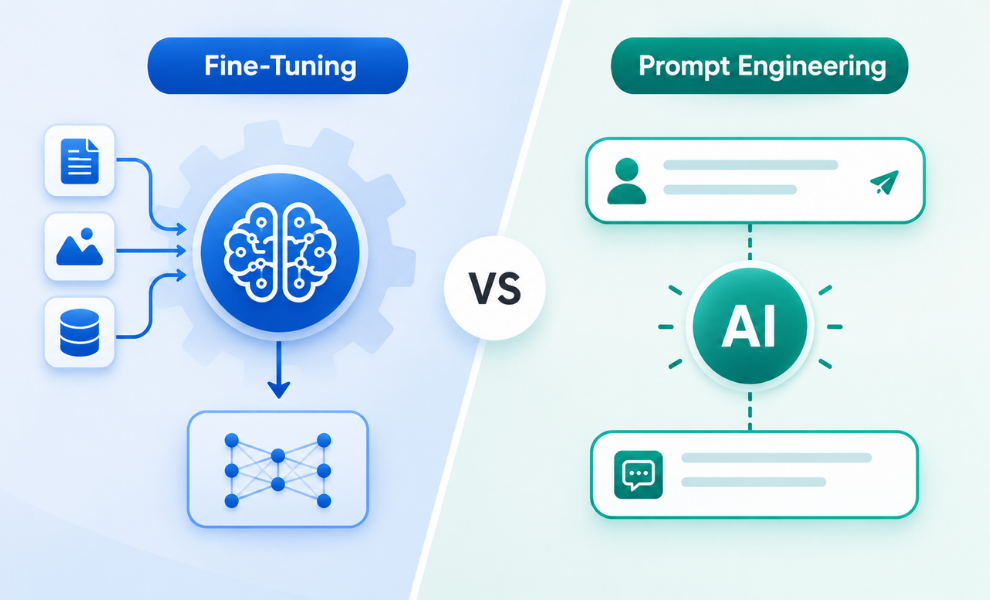
Large Language Models (LLMs) are more than just a buzzword today. From writing emails and summarizing documents to powering chatbots, LLMs are driving innovation today. They are creating a new pace in the industries, revolutionizing content creation, customer service, and more. But here comes the real point. Should we fine-tune LLM or use prompt engineering to optimize AI results?
But again, here comes the topic of debate: prompt engineering vs. fine-tuning. Even though both approaches help to improve AI model performance, they differ in scalability, flexibility, methodology, and ideal use cases. So, which is best for your business?
This blog breaks down the differences in fine-tuning vs prompt engineering, along with their pros, cons, use cases, and guidance on choosing the right approach. Let’s get started.
What is Fine-Tuning AI?
Fine-tuning is a specific approach to optimizing an already-trained AI model to perform a specific task or produce results in a more focused way. Fine-tuning, as the name suggests, is making an LLM an expert in a particular domain. This process updates the weights through supervised learning and represents a form of custom AI model training for completing tasks or requirements. The LLM, which has been trained on a diverse set of information, is given domain-specific data related to the task you need to perform best.
For example: If you want an LLM to excel in legal matters, you need to fine-tune the model by providing it with legal cases, documents, and more.
Pros and Cons of Fine-Tuning
Pros:
- The model can understand your business structure and tone and share accurate responses.
- Once properly fine-tuned, the model delivers high accuracy and performance on domain-related tasks.
- It gives organizations more control over how a model performs a particular scenario.
Cons:
- Fine-tuning needs high computational resources and training time.
- It needs high-quality data sets.
- This approach takes longer than writing prompts.
Fine-Tuning Use Cases:
Fine-tuning is the right approach for enterprises that require state-of-the-art performance for their AI tasks. These include:
- Medical knowledge bots: Helping clinicians by providing answers in domain-specific medical datasets.
- Legal document parsing: Knowing the legal clauses, reviewing contracts, or summarizing case law.
- Sentiment analysis: Train models to classify customer feedback, reviews, or social media content based on specific industry or business context.
- Content generation: Train models to produce content that follows a brand voice, tone, or writing style.
Market Size of Fine-Tuning Market
The global fine-tuning services market size was valued at $1.9B in 2025 and is projected to grow from $2.3B in 2026 to $9.0B by 2035.
What is Prompt Engineering?
Prompt engineering is the process of creating specific instructions to guide an LLM model to generate accurate and relevant responses to users’ queries. Rather than retraining the model, developers modify the input prompts to enhance the output. The main goal of prompt engineering is to structure prompts, commands, scenarios, and more in a way that the model produces a helpful answer to a particular question. There are different prompt engineering techniques; these include:
- Zero-shot prompting
- Few-shot prompting
- Chain-of-thought (CoT) prompting
- Meta prompting
- Self-Consistency prompting
- Tree-of-Thought prompting
- Structural prompting
For example: Instead of asking: What is SEO, you might prompt the LLM to “Share what is SEO and the fundamentals with best practices.” This additional information ensures that the model output is more accurate and relevant.
Prompts to use:
- Summary Prompt: “Summarize the email and share important points focusing on the meeting notes.”
- Scoring Prompt: “Evaluate the student scorecard based on the skills, percentage, and attendance. Give a score out of 20.”
Pros and Cons of Prompt Engineering
Pros:
- Prompt engineering can be mastered in hours, not weeks.
- Can be easily modified in minutes by tweaking the prompts.
- Works across multiple model types
- The same model can perform different tasks by changing prompts.
Cons:
- Different prompts can generate inconsistent responses.
- There are context limitations. Lengthy prompts can exceed model context limits.
- The output quality can be unpredictable, mainly for complex multi-step tasks.
Prompt Engineering Use Cases:
- Sales and marketing: Generating emails, promotional content, and marketing material for sales.
- Rapid prototyping: Quick prototyping of AI features before committing a fine-tuning investment.
- Software development: Used in code generation, debugging errors, and creating technical documents.
Growth of the Prompt Engineering Market
According to reports, the global prompt engineering market was valued at $221.1 million in 2023 and is expected to grow from $893.7 million in 2026 to $2060.8 million by 2030.
Fine-Tuning vs Prompt Engineering: A Comparison to Choosing the Right Approach
Making the right decision between prompt engineering vs fine-tuning is not easy; it’s a bit challenging. Understanding the differences will help you make a well-informed decision.
Parameter |
Fine Tuning |
Prompt Engineering |
| Definition | Training the model on custom data sets to adjust its parameters for domain specific tasks. |
Designing and building input prompts, so they govern the output action of large language models (LLMs). |
| Consistency | Consistent once it is trained on examples | Can be inconsistent due to the changing inputs |
| Data requirement | Needs high-quality data sets | Data sets are not required. |
| Setup | Needs a fine-tuned pipeline and dataset preparation |
Quick simply write prompts |
| Development cost | Higher | Lower |
| Performance | Significant improvement, mainly for complex tasks |
Moderate improvement |
| Ideal for | Highly complex tasks | General to moderate tasks |
When to Choose Prompt Engineering and Fine-Tuning Technique?
Choose prompt engineering when:
- You want to test ideas and execute a task with less investment.
- You need to complete tasks such as summarizing content or answering basic Q&A.
- Domain-specific training is not available.
- Requirements change continuously.
Knowing when to fine-tune an LLM is important. Choose the technique when:
- High accuracy is important.
- Reliable and consistent outputs are required.
- Prompt engineering is not sufficient for results.
Does a Hybrid Approach Work?
A hybrid approach is one of the most effective LLM customization methods that allows training models for deeper understanding while controlling outputs through prompts. Fine-tuning builds domain knowledge, while prompt engineering is about how knowledge is delivered across different scenarios.
Wrapping It Up on Fine-Tuning vs Prompt Engineering!
Fine-tuning and prompt engineering both play important roles in enhancing generative AI applications. It is essential to choose the right approach that closely aligns with the AI tasks, goals, resources, and operations. Prompt engineering is usually the best starting point because it is faster, more flexible, and less expensive to experiment with.
On the other hand, fine-tuning is appropriate when you need specialized behavior, have high-quality training data, and have analyzed that prompting alone cannot deliver the results. I hope the blog on fine-tuning vs. prompt engineering has clarified both approaches and made the decision-making process a little easier.
Check out our website to read more informative blog posts around the tech landscape.
FAQs
1] Can we combine prompt engineering vs. fine-tuning?
Answer: Yes. Many AI systems use fine-tuning to build core domain capabilities, then apply prompt engineering for user-specific customizations. For example: You can fine-tune a model for analyzing documents and then use prompts going forward to specify contract types or jurisdictions per query.
2] Is fine-tuning better than prompt engineering?
Answer: Not always. Fine-tuning is ideal for specialized domains and consistent output; however, prompt engineering is often sufficient for common tasks that require flexibility and speed.
Recommended For You:
Prompt Engineering for Multimodal Large Language Models: Why It Matters and How It Works