

Graphical Neural Networks fall under deep learning models capable of handling massive amounts of data represented as graphs. Unlike traditional neural networks that can work on Euclidean structures such as text or images, GNNs can handle non-Euclidean or irregular structures. It makes it ideal for several tasks such as recommendations in social networks, molecule chemistry, and more.
In this blog, we will break down everything about the Graph Neural Network (GNN), including its benefits, applications, and implementations.
So, let’s get started!
What is a Graph?
Graphs are nothing but the statistical representation of data. Think of a graph depicting the city’s wise population of a particular state. It is represented in pictorial formats such as bar, lines, or slices, and forms a strong foundation for showing comparisons, patterns, and relationships in the data.
Alongside, to explain technically, a graph has relations called as ‘edges,’ and collection of entities called as ‘nodes.’ In mathematics, it is described as a data structure with two components – nodes (vertices) and edges.
Here Graph (G) = (V, E) where V is the set of nodes and E is the set of edges between them.
A graph can be directed or undirected.
- Directed Graph: Here, edges have a particular direction from one vertex to another.
- Undirected Graph: Here, edges have no direction; however, they just connect the two vertices.
What is a Graph Neural Network?
Graph Neural Network (GNN) is a class of deep learning methods that work with a graph data structure. They follow a graph-in-graph-out architecture. This means these models take graphs as input, with information stored on their edges, notes, etc. In contrast to images and text that follow a grid-like structure, graphs are complex.
Graph Neural Networks (GNNs) are used to make node-, edge-, and graph-level predictions on graph-structured data.
GNNs, just like CNNs Convolutional Neural Network, can learn by being trained on graphs to predict relationships and classes. GNNs came into the picture to promote the shortcomings of CNNs and RNNs in handling arbitrary-size, non-Euclidean, and complex relationship data.
GNN mainly works on message passing mechanisms, where nodes change their representation by transferring information with their neighbors. PyTorch, a popular deep learning framework, used to build GNNs.
Types of Graph Neural Networks
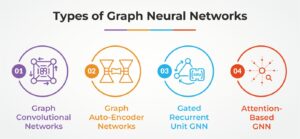
The following are the most popular types of Graph Neural Networks (GNN). Each of them has some changes in terms of Convolutional Neural Networks (CNN).
1] Graph Convolutional Networks (GCNs)
Graph Convolutional Network (GCN) operates similarly to CNNs on graphs. They learn node features by looking at neighboring nodes. s. GCNs take the information of neighbors, combine it, and feed it through a linear layer followed by an activation function.
2] Graph Auto-Encoder Networks
This model learns a graph representation with the help of an encoder and reconstructs the input graph with a decoder. Both are joined by a bottleneck layer. They are mainly used in predicting links, such as Auto-Encoders.
3] Gated Recurrent Unit Graph Neural Network (GRU GNN)
The model initiates the extension of GRUs (a form of RNN) to graphs so that the GNN is able to process the information of a broader region, instead of looking at immediate neighbors. This helps the model learn about long-range relationships in the graph.
4] Attention-Based GNN
Attention-based GNNs focus on the most significant neighboring nodes and are useful when some nodes are more important than others.
What are the Benefits of Graph Neural Networks?
1] Flexible: GNN (Graph Neural Networks) can work with a range of graphs, including directed, undirected, and weighted graphs.
2] Scalability: GNN can process a vast number of graphs efficiently by sharing parameters across nodes and edges. GNN can scale real-world datasets with millions of nodes without compromising performance.
3] Contextual Understanding: Can capture global and local patterns and understand how features influence their neighbors.
4] Perform Multiple Tasks: Key benefits of GNN are link prediction, node classification, and more.
Implementation of Graph Neural Network (GNN)
- A Graph Neural Network is a variant of geometric deep learning that aims to learn non-Euclidean data in a structured form. They are trained on data in the form of graphs, where nodes and connections are used to convey information.
- Geometric deep learning is also applicable to data stored in the form of grid-based, such as images, with data having a regular structure. It can serve as support to some type of data, i.e. group based like data of the spherical or earth related data which has been recorded in various parts.
- GNNs are under development but are readily available as tools and libraries in Python, such as TensorFlow and PyTorch.
Applications of Graph Neural Networks
The following are a few real-world applications of GNNs
Traffic Predictions
The flow of transportation network traffic can be predicted using GNNs trained on road connectivity and real-time sensor data.
Social Network Analysis
Graph Neural Network is widely used in social networking analysis. It helps to create communities of people with similar interests, suggest connections, influence predictions, and more.
Drug Discovery
In the field of drug discovery, Graph Neural Networks are used to analyze molecular structures. GNNs can predict the properties of these molecules and help discover new drugs or chemicals.
Wrapping it Up!
GNNs are potent tools that unleash the full potential of graph-structured data. I hope the above blog provides an in-depth understanding of GNNs and how they can be implemented widely across various applications.
Visit our site to stay updated with more informative blog topics!
FAQs
Q1] How can you graph a neural network?
Answer: GNNs are beyond neural networks. They help to do node-level, graph-level, and edge-level tasks more easily. Alongside, it can be used directly on the graphs.
Q2] What are GNN and CNN?
Answer: GNN and CNN are both deep learning models that you can use to create inference on data as described in graphs.
Recommended For You:
The Impact of Artificial Neural Networks on Machine Learning