

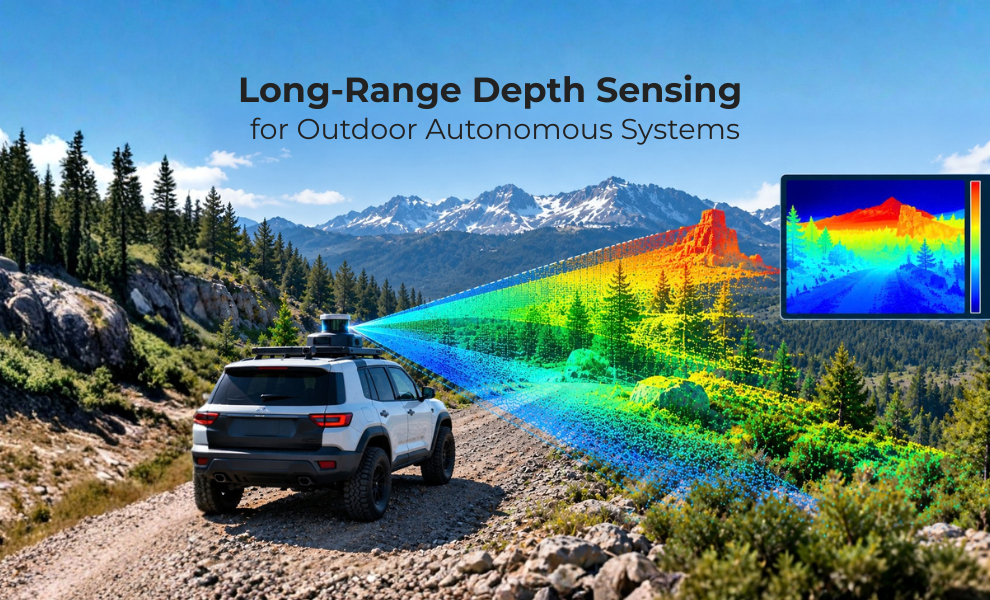
Most stereo depth cameras are tuned for a 0.3 to 3 meter working envelope, which covers robotic arms, tabletop scanning, and indoor mobile robots working in tight quarters. That range falls apart fast for inspection drones, outdoor AMRs, and agricultural robots that need reliable depth data at 5, 10, or 20 meters. For those systems, a long-range stereo camera for autonomous systems has to solve a different set of problems than a short-range sensor does, starting with the geometry of triangulation itself.
This article walks through what actually changes as working range extends past the typical 3-meter ceiling and where active stereo, passive stereo, and LiDAR each hold up or fall short once distance becomes the primary design constraint.
Why most stereo cameras run out of precision past a few meters
Stereo depth cameras calculate distance by measuring the disparity, the pixel shift, between two camera views of the same point. That disparity shrinks as distance increases, and depth error grows roughly with the square of distance for a fixed baseline and pixel resolution. A camera tuned for close-range precision, where disparity is large and easy to measure accurately, simply runs out of usable disparity resolution once the scene moves far enough away. This is a geometry problem before it is anything else, and it is the reason a camera built for 0.3 to 3-meter arm-mounted work cannot simply be pointed at a target 15 meters away and expected to hold accuracy.
What has to change to reach reliable depth at 10 or 20 meters
Baseline geometry
The baseline, the physical distance between the two stereo sensors, sets the geometric limit on how far a stereo camera can resolve depth with useful precision. A wider baseline increases the disparity produced by a given distance, which preserves measurable precision farther out. This is why close-range cameras built for arm-mounted or handheld work use narrow baselines. The Gemini 305 uses a compact form factor suited to a 4cm minimum working distance, while cameras built for longer working ranges use a wider baseline. The tradeoff runs in both directions. A wider baseline that helps at long range also pushes out the minimum working distance and can introduce more occlusion near the camera, since the two sensors see a more different view of close objects. Choosing a baseline is a matter of matching the geometry to the working range the application actually needs, not maximizing one spec in isolation.
IR projector strength and active plus passive operation
Active stereo cameras project an infrared pattern onto the scene to add texture that the stereo algorithm can match between the two camera views, which matters most on flat, low-texture, or repetitive surfaces where passive stereo alone struggles to find reliable correspondence points. At longer range, that projected pattern has to cover more area with enough intensity to remain usable, which is a harder engineering problem than illuminating a scene a few meters away. Orbbec’s active stereo cameras, including cameras built for longer working ranges, run active and passive stereo simultaneously rather than switching between the two modes. The passive stereo path handles well-lit, well-textured scenes using ambient light alone, while the active IR pattern reinforces depth calculation on low-texture surfaces or in dim conditions, and the two run together rather than the camera choosing one mode over the other frame to frame.
Ambient light interference
Outdoor and long-range working environments introduce ambient IR interference that indoor short-range cameras rarely have to deal with. Sunlight contains a broad IR component that can wash out a camera’s own projected IR pattern, and reflective or high-glare surfaces at a distance compound the problem. Cameras built for long-range or semi-outdoor working environments need enough IR projector strength and enough signal processing headroom to separate their own pattern from ambient IR noise, which is a different design problem than an indoor camera operating under a controlled fluorescent light source ever has to solve.
How active stereo, passive stereo, and LiDAR compare at long range
Active stereo, as described above, adds a projected IR pattern to assist correspondence matching, which helps most on featureless surfaces and in low light, and it produces a dense depth map, meaning depth values across most pixels in the frame rather than a sparse point set.
Passive stereo relies entirely on natural scene texture and ambient light, without projecting anything. It holds up well outdoors in bright conditions where an active IR pattern would compete with sunlight, but it degrades on flat or repetitive surfaces, like a plain concrete floor or a featureless wall, where the two camera views don’t have enough distinguishing detail to match reliably.
LiDAR measures distance directly through time-of-flight or phase-shift principles rather than triangulating between two camera views, which gives it range and accuracy characteristics that don’t degrade with distance the way stereo triangulation does. That makes LiDAR a strong choice for long-range mapping and localization tasks. The tradeoff is that LiDAR typically produces a sparser point cloud than a dense stereo depth map, and it is usually a distinct sensing modality from vision-based perception rather than a drop-in substitute, meaning many outdoor autonomous systems end up running LiDAR and stereo vision together rather than choosing one over the other.
A camera built for long-range working environments
The Gemini 435Le is an example of a stereo vision camera engineered specifically for these longer working ranges. According to its published specifications, it runs a 95mm baseline with an 850nm laser dot matrix projector, an ideal working range of 0.31 to 10 meters, and a stated working range extending to 20 meters and beyond under favorable reflectivity conditions. Spatial precision is rated at 0.4 percent or better at 2 meters and 0.8 percent or better at 4 meters, with depth accuracy of 1 percent at 2 meters and 2 percent at 4 meters, using a 90 by 90 percent region of interest at the closer distance and 80 by 80 percent at 4 meters. Depth resolution reaches 1280 by 800 at 10fps, with a depth field of view of 90 by 65 degrees. You can review the full specification table on the Gemini 435Le product page.
The camera includes multiple depth presets, including an AMR perception preset tuned for navigation and obstacle detection and a dimensioning preset tuned for measuring object size and shape in logistics settings, along with support for custom presets through direct consultation. This preset structure lets a system integrator switch the camera’s depth processing profile to match the task without re-engineering the perception pipeline from scratch.
Robust design for demanding working environments
Cameras intended for long-range working environments, whether that means an inspection robot on outdoor terrain or an AMR working an unheated warehouse dock, need housing and connectivity built for conditions a desk-mounted camera never encounters. The Gemini 435Le carries an IP67 rating for dust and water resistance, an operating temperature range of negative 10 to 50 degrees Celsius, and is built to withstand industrial vibration, shock, and electromagnetic interference. Data and power run over Gigabit Ethernet with Power over Ethernet support through an M12 connector, which is a more rugged and cable-friendly interface for mobile robotic platforms than the USB connections common on shorter-range indoor cameras. Multi-camera synchronization and hardware timestamping are supported as well, which matters for systems running more than one camera and needing depth, RGB, and IMU data aligned to a common clock.
SDK and integration path
The Gemini 435Le runs on Orbbec’s open-source SDK v2, with native support for ROS1, ROS2, and NVIDIA Isaac ROS, and comes pre-integrated with NVIDIA Jetson AGX Orin, Orin NX, and Orin Nano platforms. For teams already building on the ROS ecosystem or NVIDIA’s Jetson hardware line, that pre-integration removes a meaningful chunk of the driver and calibration work that otherwise goes into bringing a new depth sensor onto a robotic platform. Cross-platform SDK support and hardware-level depth-to-color alignment reduce the amount of custom processing the host system has to do, which matters more as working range increases and depth data volume grows.
Frequently asked questions
Why can’t a short-range stereo camera just be recalibrated for longer distances?
Calibration adjusts how a camera interprets disparity, but it can’t change the physical baseline or the amount of usable disparity resolution available at a given distance. A camera built with a narrow baseline for close-range precision runs out of measurable disparity well before it reaches 10 or 20 meters, regardless of how it’s calibrated. Reaching reliable long-range depth requires a camera designed around a wider baseline and stronger IR projection from the start.
Does active stereo stop working well in bright outdoor light?
Not entirely, but ambient IR from sunlight does compete with a camera’s projected pattern, which is why cameras built for outdoor or long-range working environments run active and passive stereo simultaneously rather than relying on the active pattern alone. The passive stereo path picks up the slack in bright, well-textured outdoor scenes where the projected pattern has more competition from ambient light.
Is LiDAR a replacement for a long-range stereo camera or a complement to it?
Generally a complement rather than a replacement. LiDAR’s distance measurement doesn’t degrade with range the way stereo triangulation does, which makes it strong for long-range mapping and localization. But it typically produces a sparser point cloud than a dense stereo depth map, so many outdoor autonomous systems run both sensing modalities together, using LiDAR for range and mapping and stereo vision for dense object-level perception.
What’s the practical difference between working range and ideal range on a camera spec sheet?
Working range describes the outer bound of distances a camera can return usable depth data at under favorable conditions, like higher-reflectivity surfaces. Ideal range describes the distances where the camera delivers its stated accuracy and precision figures consistently. A system integrator planning a deployment should design around the ideal range figure, not the outer working range number, since that’s where the published accuracy specs actually apply.
How much does a wider field of view matter for long-range perception compared to raw depth range?
Both matter, but for different reasons. A wide field of view lets a single camera cover more of a scene per frame, which reduces blind spots and can reduce the number of cameras needed on a platform. Depth range determines how far out the camera can resolve distance at all. A robot navigating a wide open outdoor space typically needs both, since a narrow field of view forces more cameras or more panning to cover the same area, even if each individual reading extends far enough out.
Recommended Reads:
What is Internet of Autonomous Things?
IoT Solutions for the Automotive Industry