


Software testing is the backbone of successful software development and deployment, alongside its seamless operations. Testing helps developers identify shortcomings and potential vulnerabilities early in the software lifecycle, ensuring smoother operations and reduced risks. In short, testing is what transforms working software into high‑quality software.
Over the years, software testing has observed significant transformations, sustaining a shift from manual to automated processes. This has also been a key driver of the rapid growth of the software testing industry. In 2025, the industry was valued at $48 billion, which is expected to surpass $93 billion by 2030.
Though testing has become necessary for software development, developers often get confused about which to adopt between manual testing and automated testing. Here is a guide to assess the software testing methods and help you choose the best one.
Understanding Manual Testing and Automated Testing:
Software testing generally involves multiple stages, including test planning, test case development, environment setup, test execution, and test closure. In manual testing, human testers manually perform all the steps and execute the testing process.
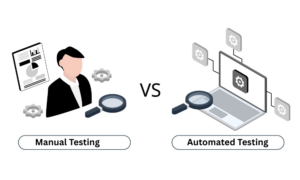
On the other hand, automated testing includes tools and scripts that execute these stages with minimal human intervention. Software testing, in simple terms, is a quality assurance technique for software. Manual and automated testing are two different methods of testing software and ensuring its quality.
Benefits of Manual Testing-
Cost-efficiency: Manual testing is highly recommended for small-scale projects as it saves cost. It eliminates the need to invest in costly automated tools and scripts.
Flexibility and adaptability: Software testing is becoming increasingly dynamic, primarily due to the multifaceted operations of a single application. Manual testing preserves flexibility and adaptability in this regard, allowing testers to adapt to sudden changes in the testing process.
Immediate feedback: Manual testing unlocks real-time software assurance with immediate feedback. Testers can evaluate an application and its features while fixing bugs and share immediate feedback with developers that will ultimately contribute to the quality enhancement of the software.
Drawbacks of Manual Testing-
Prone to human error: Human testers can possibly make mistakes and cause errors, such as overlooking certain defects, missing testing steps, and others. While human testers manually test software, there are possibilities of unwanted errors.
Requires advanced skillset: A specialized skillset is necessary for successful manual software testing. Lack of knowledge can impact the quality of software.
Time-consuming: Manual testing consumes significant time and effort as human testers perform all the activities manually. This often makes the testing cycle lengthy, causing a delay in software launch.
Limited reusability: Manual testing efforts are rarely reusable while testing across future versions of the software. Human testers need to make a fresh effort for upcoming releases.
Benefits of Automated Testing:
Fast execution and testing: Automated testing tools enable faster bug detection, fixing, and a feedback loop. It helps in faster testing cycles and contributes to quicker software release.
Opportunities for reusability and scalability: Test scripts from automated processes are reusable and can be reused in upcoming versions of the software. This also preserves scalability in the software testing and development process.
Enhanced accuracy and cost savings in the long run: Automated testing offers high accuracy, eliminating the possibility of human errors. Such errors can create risks in the long run, resulting in high costs to fix. An automated approach saves costs in the long run, allowing developers to develop software with limited risks.
24/7 availability: Automated testing can operate round-the-clock and offer automated tests without major hindrances.
Drawbacks of Automated Testing:
High initial costs: Adopting automated testing can be costly in the initial period since it requires specific tools and environments. Additionally, creating the primary test scripts also needs significant investment.
Requires timely maintenance: Automated testing processes require timely maintenance and management of existing as well as new tests. It often becomes a challenge for developers while launching their software without delay.
Limited predefined scenarios and flexibility: Automated test environments depend on predefined scenarios and use cases. These scenarios are limited, and certain bugs or errors may not be included in the test environment. While addressing such incidents, automated testing tools can face challenges. It also limits flexibility.
Security Concerns: Automated testing tools are often third-party solutions that developers integrate. Hence, while running tests, the script and data security become a concern.
Differences Between Manual Testing and Automated Testing:
| Manual Testing | VS | Automated Testing |
| Human testers execute testing manually | Execution | Automated tools and scripts automate the testing process |
| Human resources with appropriate knowledge | Resource requirements | Automation tools and trained human resource to monitor the tools |
| High flexibility and quick-change adaptability | Flexibility | Less flexible, good for repetitive tasks |
| Time and effort consuming in repetitive tasks | Speed | Faster and efficient for repetitive tasks |
| Prone to human error | Consistency | Offers consistent performance |
| Limited scalability and reusability | Scalability | High scalability and reusability |
| Not possible | Batch testing | Multiple batch testing is possible |
| Lower initial investment but higher long-term cost |
Cost | Significant initial investment but lower long-term cost |
When to Adopt Manual Testing – Use Cases
Manual testing is convenient for software evaluation that needs intuitiveness, human knowledge, creativity, and expertise. Exploratory testing, usability testing, ad-hoc testing, and visual testing are major processes in this regard. Here are the use cases-
- Exploratory testing: It denotes a method of unscripted testing that requires creativity and domain knowledge. Manual testing helps human testers go beyond predefined testing stages and discover edge cases in software during exploratory testing.
- Ad-hoc testing: It is a planned form of software testing that doesn’t require initial test case documentation. This method is adopted to explore a software more intuitively to detect bugs and errors. Since ad-hoc doesn’t include documentation to detect bugs, it needs manual testing.
When to Adopt Automated Testing – Use Cases
Automated testing is generally adopted for software with repetitive evaluations. Regression testing, unit testing, end-to-end testing, and integration testing are significant areas where automated testing is essential. Major use cases include-
- End-to-End testing: It is adopted to evaluate the complete flow of a software, from the initial phases to the last phases. The test method validates software flow with real-world user scenarios. It includes several repetitive tasks that are automated.
- Unit testing: With this, developers test units of code, even the smallest ones, in a software. Automating it allows the execution of the testing process in isolation without human intervention. It also helps in the early detection of bugs.
Concluding Remarks!
Effective software testing is unavoidable in software development. However, adopting manual or automated testing depends on the software you are building and its specific needs. Manual testing can add creativity, human expertise, and flexibility. In contrast, automated testing offers speed, scalability, and accuracy in the testing process.
Manual testing and automated testing are both effective when adopted in the right scenario. If your software requires intuitive and creative evaluation, choose manual testing. But if it includes repetitive tasks; choosing automated testing will be highly beneficial.
Read our in-depth blogs to understand how the tech world is changing and which trends are making an impact!
FAQs:
Q1. What are the five software testing methods?
Answer: Five software testing methods are-
- Localization Testing
- Regression Testing
- Automated Testing
- Crowdsourced Testing
- Exploratory Testing
Q2. What are the 4 pillars of software testing?
Answer: Functional, usability, security, and performance are the four pillars of software testing.
You Might Like:
4 Best Practices for DevSecOps
Best Practices for secure remote work access