Search is no longer just a list of blue links.
Today, people ask full questions into Google, speak to voice assistants, and increasingly turn to AI-powered tools that generate direct responses instead of sending them off to ten different websites. For brands, that shift changes the rules. Visibility still matters, but visibility now depends on whether your content can be understood, trusted, and surfaced as an answer.
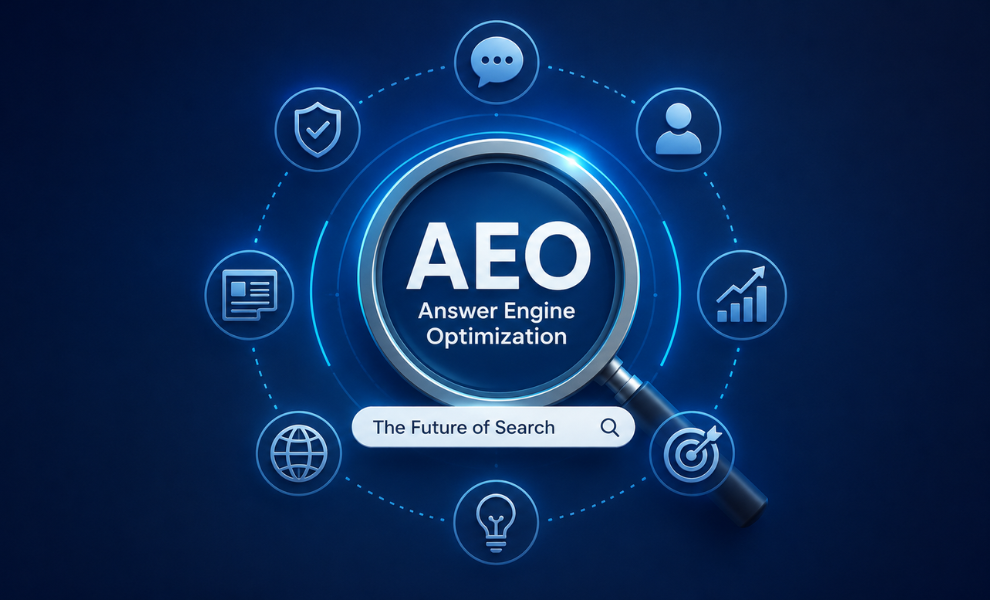
That is where AEO, or Answer Engine Optimisation, comes in.
AEO is not a replacement for SEO so much as its next evolution. Traditional search optimisation focused heavily on rankings, traffic, and keywords. AEO asks a slightly different question: when someone asks for information, can your brand become the source of the answer?
Why Search Behaviour Is Changing
People have become more specific in the way they search. They do not just type “running shoes” anymore. They ask, “What are the best running shoes for flat feet under £100?” They want a useful response immediately, not a scavenger hunt.
At the same time, search platforms are responding to that demand. Featured snippets, People Also Ask boxes, voice search results, AI overviews, and chatbot-style interfaces all favour content that is structured clearly and written with direct intent. In other words, search engines are becoming answer engines.
From ranking pages to winning responses
This changes how authority works online. It is no longer enough to publish a page that includes the right keywords and a few backlinks. If your content is vague, buried under jargon, or poorly structured, it may never be selected as the response users actually see.
Brands that adapt early gain an advantage. They become the source that platforms quote, summarise, and elevate. Those that do not risk losing visibility even if their site still ranks reasonably well in a conventional sense.
What AEO Actually Looks Like in Practice
At its core, AEO is about making your expertise easier for machines to interpret and easier for humans to trust.
That means answering real questions clearly. It means structuring content so that the key point is easy to extract. It means building topical depth rather than relying on one-off blog posts. And it means understanding that your audience may encounter your brand through a generated answer before they ever land on your website.
For businesses trying to understand the operational side of this shift, resources on search optimisation for answer-based platforms can help frame what modern visibility requires across AI-led and conversational search environments.
The signals answer engines are looking for
While every platform uses its own systems, the broad signals are becoming easier to spot:
- Clear, concise answers to specific questions
- Strong topical authority across a subject area
- Structured content with headings, schema, and logical flow
- Trust signals such as expert authorship, citations, and up-to-date information
None of that is especially gimmicky. In fact, the most effective AEO strategy often looks a lot like good publishing discipline.
How to Prepare Your Brand Now
The brands best positioned for the future of search are not necessarily the ones producing the most content. They are the ones producing the most useful content in the most accessible format.
Start with audience questions, not internal messaging
A surprising number of websites are still built around what the business wants to say rather than what the customer wants to know. AEO flips that. Your content strategy should begin with actual questions from buyers, clients, and prospects.
Look at customer support logs, sales calls, review language, search console queries, and community forums. What keeps coming up? Where is there confusion, hesitation, or curiosity? Those are the openings where answer-led content performs best.
Structure matters more than ever
A wall of text is hard for readers and even harder for search systems to parse. Pages should be organised so the main answer appears early, supported by clear headings and useful elaboration underneath.
A simple pattern works well: ask the question in a heading, answer it immediately in two or three sentences, then expand with detail, examples, or caveats. That format serves both human readers and automated systems looking for extractable answers.
Build topic clusters, not isolated articles
Answer engines tend to favour sources that demonstrate real depth. One decent article on a topic can help, but a connected set of resources is much stronger.
If you are in financial services, for example, do not stop at “What is mortgage refinancing?” Build supporting content around rates, eligibility, timelines, risks, and common misconceptions. The goal is to show that your brand understands the wider subject, not just a single keyword target.
Trust Will Be the Deciding Factor
As AI-generated content floods the web, trust becomes more valuable, not less.
That means accuracy matters. Freshness matters. Attribution matters. If your brand publishes thin, generic content, it may still exist online, but it is less likely to be cited or surfaced as a reliable answer.
Expertise needs to be visible
Many organisations do have expertise, but they hide it. Anonymous blog posts, vague claims, and outdated articles do not inspire confidence. If your content reflects genuine subject knowledge, show that clearly. Use named authors where appropriate, reference credible sources, and revisit older pages before they go stale.
This is especially important in sectors where bad information carries real risk, such as health, finance, legal services, or technical B2B categories. In those spaces, answer engines are likely to be even more selective.
Measuring Success Beyond Clicks
One of the more uncomfortable parts of AEO is that success may not always look like a website visit. If a user gets the answer they need from a search feature or AI interface, they may never click through at all.
That does not make the effort pointless. Brand exposure, authority, and assisted conversion still matter. If your business becomes the trusted source users repeatedly encounter, that familiarity compounds over time.
So yes, track rankings and traffic. But also pay attention to visibility in featured snippets, branded search growth, engagement on high-intent pages, and how often your content is designed to satisfy informational queries cleanly.
The Future of Search Is More Human Than It Looks
There is a paradox at the heart of AEO. The more search becomes automated, the more brands need to communicate like real people.
Not louder. Not longer. Just clearer.
The winners will be the brands that understand what their audience is actually asking and answer with precision, credibility, and relevance. That is what search platforms increasingly reward, whether the interface is a search bar, a voice assistant, or an AI-generated response.
AEO is not about chasing the latest acronym. It is about preparing for a world where being findable depends on being genuinely useful. And that is a future worth building for now.
Recommended Reads:
How to Get Your Brand Appear in AI Answers?
ChatGPT Search vs. Google Search: How do they differ?
LLM SEO: The Fastest Way to Get Your Brand Noticed by AI
An Evolution and Enhancement of SEO: Topic Clusters Model