A robot can recognize a USB cable through a camera. Yet inserting it into a USB port requires more than identifying its position. The robot must respond to contact and correct its movement when the connection does not align.
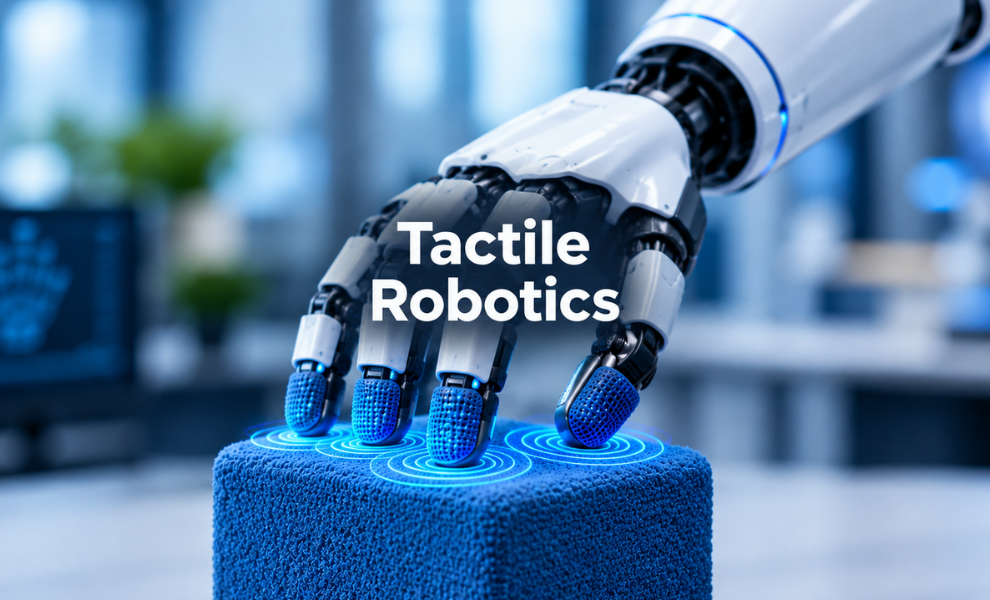
This is where tactile robotics advances physical AI. Robots use tactile sensors and intelligent control systems to find out pressure and adjust their grip accordingly. This helps them handle objects that differ in shape, texture, and fragility.
The real value comes when a robot uses that information to change what it does next. As robots take on more complex physical tasks, touch is becoming an important part of robotic perception. In this blog we will explore more about tactile robots. So, let’s get started.
What is Tactile Robotics?
Tactile robotics allows robots to sense and interpret physical contact with objects. A gripper may lose traction on a smooth surface, or a flexible object may deform under pressure. It can detect these changes by measuring force and surface deformation. Some systems can also detect vibrations and changes in surface contact.
Cameras help robots find objects before touching them. After contact is made, tactile sensors provide extra information about the object and the interaction that vision alone cannot capture.
Consider a robot picking up a plastic bottle. Vision can estimate the bottle’s position. But the robot also needs to know whether its grip is stable. Tactile feedback can help detect slipping and signal when the grip needs adjustments.
This information matters because a robot can recognize an object and still fail to manipulate it.
What Tactile Sensors Actually Measure
Tactile sensors convert physical contact into signals that a robot can process. Different technologies capture different interaction properties.
- Resistive sensors detect changes in electrical resistance under pressure.
- Capacitive sensors measure changes in capacitance.
- Piezoelectric sensors respond to mechanical stress.
- Optical tactile sensors use changes in images to reveal contact patterns and surface deformation.
These technologies provide different types of information. Some are suited to measuring pressure throughout the surface. Others are useful for capturing rapid contact or detailed deformation.
Sensor choice therefore affects what a robot can learn from an interaction. A system designed to detect grip pressure may not provide all the information needed to reconstruct an object’s contact shape.
How Touch Data Changes Robotic Control
Measurements become useful when they influence the robot’s next action.
A tactile control system typically connects three functions:
- Signal processing
- State estimation
- Movement control
Signal processing extracts useful information from sensor readings. State estimation helps the robot assess what is happening during contact. The controller uses that assessment to select or adjust a movement.
Consider a robot plugging a cable into a socket. Even if the plug looks correctly aligned, it may meet resistance as it is pushed in. Tactile feedback helps it decide. The robot needs to know whether to continue or make a small adjustment.
Tactile feedback can help the robot distinguish between normal contact and misalignment. Based on that information, the robot may adjust its position or stop the movement. What it does depends on what the sensors detect and how the task is programmed.
This highlights a challenge in physical AI: translating sensory information into actions that work in real-world physical conditions.
What Research Reveals About Contact-Rich Tasks
ResTacVLA delivers a useful example of how tactile feedback can support robotic manipulation tasks that require precise physical interaction.
Researchers evaluated it on five types of contact-rich tasks, including plug insertion, threaded screwing, peg transfer, and wiping. On average, ResTacVLA succeeded in 62.8% of tasks, compared with 28.2% for a vision-only baseline.
These results come from a specific benchmark. They do not mean adding tactile sensors will produce the same improvement on every robot or in every application.
Tactile sensing also has a role in applications that require gentle handling. The 2026 FruitTouch study explores vision-based tactile sensing for fruit harvesting. Its approach uses contact information to support force estimation and slip detection while handling produce.
The robot must maintain a secure grip without applying excessive pressure.
Together, these examples show why touch is useful across different manipulation problems. The relevant measurements and control responses depend on the task.
Why Tactile Skills Do Not Easily Transfer Between Robots
A model trained on one robotic gripper may perform differently when deployed on another. Hardware can have different sensor layouts, mechanical properties, and measurement ranges.
These differences change the data that the model receives. A learned pattern indicating a stable grasp on one device may not mean the same thing on another.
This creates a problem for scaling tactile intelligence. If every new gripper requires extensive data collection and retraining, development becomes more expensive.
Researchers are exploring simulation, shared tactile representations, and broader training datasets to improve transfer between tasks and hardware. However, successful transfer must be demonstrated experimentally. It cannot be assumed from performance on the original robot.
When Is Tactile Sensing Worth the Cost?
Tactile sensors add hardware, integration, and data-processing requirements. They are not necessary for every robotic task. The decision should depend on the type of uncertainty the robot needs to manage.
| Robotic Task | Suitable sensing approach |
| Locating an object before grasping | Vision |
| Detecting pressure or surface deformation | Tactile sensing |
| Handling objects with uncertain contact or slip risk | Combined vision and tactile sensing |
| Deploying a learned skill on different grippers | Validate sensor compatibility and skill transfer |
For simple pick-and-place tasks involving predictable objects, vision may provide enough information. Tactile sensing becomes more valuable when contact changes the outcome, such as inserting components, handling delicate materials, or maintaining grip on slippery objects.
Engineers must also consider sensor durability, response time, and the impact of a failed manipulation. These factors help determine whether tactile feedback provides enough practical value to justify its added complexity.
Bottom Line
Tactile robotics gives physical AI access to information about physical contact. Its value depends on how well robots can interpret those measurements and respond appropriately. Research in contact-rich tasks and delicate handling shows the range of challenges this technology can handle. As robots take on more demanding physical tasks, combining touch with vision and responsive control can help bridge the gap between recognizing an object and handling it successfully.
Please do visit our official website for more such information.
FAQs
Q1. Can robots develop a sense of touch similar to humans?
Answer: Yes, robots can develop a basic sense of touch using tactile sensors. These sensors can detect pressure, temperature, vibration, texture, and slipping. But they are still far less sensitive and adaptable than human skin.
Q2. Will tactile sensing make humanoid robots more independent?
Answer: Yes. Tactile sensing can help humanoid robots perform tasks more independently by improving how they interact with objects. The robot must maintain a secure grip without applying excessive pressure.
Also Read:
Top 7 Robotic Process Automation Tools
Robotic Service Orchestration Explained in Detail
Industrial Robot Examples: A new era of Manufacturing!


