

Organizations invest a lot in AI infrastructure, GPUs, processors, and high-speed networks. However, for many, GPUs or computing power is not the issue; it’s the delay in getting the data they need. AI factory is the answer to this concern. It’s a specialized infrastructure that can manage the complete AI lifecycle at the production scale.
Unlike traditional data centers, AI factories are optimized for continuous intelligence, allowing organizations to process large volumes of data, train AI models, and deliver faster results while making use of their computing resources. The global AI factory infrastructure market was valued at $18.4 billion in 2025 and is expected to reach $31.2 billion by 2033, with a CAGR of 6.8% from 2026 to 2033.
But AI factories are driven by the storage architecture behind them. In this blog, we will understand the AI factory storage architecture, alongside the way storage architecture supports AI lifecycle, its key components, benefits of storage architecture, and more. So, let’s dive in..
What Does an AI Factory Mean?
An AI factory is a high-performance, purpose-built environment that enables enterprises to industrialize AI. Instead of simply storing and retrieving data, it constantly ingests raw data, processes it, trains complex models, and generates outputs measured as “tokens” at scale.
AI factories offer everything you need to thrive in today’s complex data-driven world. From training models to data pipelines, inference, and real-time insights, an AI factory can handle large volumes of datasets and complex workloads while delivering seamless performance and boosting operational efficiency.
While data centers can handle general computing tasks, an AI factory is specially optimized for AI-powered workloads. They can be deployed in the cloud, on-premises, or in a hybrid environment, depending on requirements.
What are the Significant Benefits of AI Factory Storage Architecture?
Below are some key benefits of an AI factory storage architecture for keeping AI factory workloads running smoothly.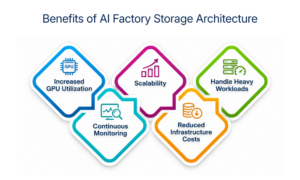
- Increased GPU Utilization: High-performance storage delivers data to GPUs faster, reducing time and helping organizations maximize computing resources.
- Scalability: Scalable data storage allows more teams and use cases to manage growing data sets without compromising performance.
- Handle heavy workloads: AI factory storage architectures are designed to handle highly intensive workloads, offering high-performance improvements for AI reasoning.
- Continuous Monitoring: Monitoring and retraining help models maintain data patterns and real-world conditions evolve.
- Reduced Infrastructure Costs: A combination of NVMe storage, object storage, and parallel file systems helps to balance performance and reduce storage expenses.
Some of the Critical AI Factory Storage Characteristics
- Power and Space Efficiency: Data centers have limits on power and cooling. Flash storage consumes about 80% less power per terabyte than spinning disks and occupies less rack space. For power-efficient facilities, this efficiency allows for GPU capacity expansion.
- Low Latency: AI factories can run multiple workloads simultaneously, such as inference, training models, and data preprocessing. AI-optimized storage helps to deliver maximum performance across these workloads through its parallel architectures, intelligent caching, and more.
- Scale without Limits: AI data grows at a large scale. Storage systems should scale without compromising performance.
- Parallelism: Continuously feed high throughput accelerators (GPUs) and prevent training or inference stalls.
What are the Key Components of AI Factory Storage Architecture?
An AI factory architecture brings together:
1. Factory Layers:
- Data and storage: The data foundation for trusted, protected, governed, and accessible data, with storage and data movement that support performance and scale.
- Compute and networking: The processing and connectivity foundation provides the capacity, bandwidth, latency, and observability AI workloads need.
- Operations and facilities: The physical and operational environment includes power, space, support, incident response, and cost allocation.
2. Storage Technologies
- Object Storage: Object storage is an effective approach for storing large amounts of unstructured data. Unlike other architectures, it treats each piece of data as distinct, with its own metadata.
- Parallel file systems: A parallel file system is a high-performance storage architecture that lets different compute nodes or clients read and write the same files simultaneously through coordinated I/O paths.
- High-Performance NVMe Storage: NVMe (Non-Volatile Memory Express) is a storage protocol designed for solid-state drives. It provides fast data access and comes with lower latency. It is mainly helpful for workloads that require frequent data retrieval, fine-tuning, and inference. AI factories make use of NVMe storage to carry out several data-related tasks.
How Storage Architecture of AI Factories Supports the AI Lifecycle?
Storage requirements change throughout the complete AI lifecycle. A well-designed architecture should support different data access patterns at every stage:
- Input: Raw data collection and management: Storage systems ingest raw data from sources such as databases, edge devices, or sensors. This data can be structured (e.g., tables) or unstructured, such as images, text, or video.
- Training and tuning: Use historical and synthetic data to train models and fine-tune the foundation models. Once the data is prepared, it is processed through AI models.
- Model validation and evaluation: Storage maintains model versions, training outputs, and evaluation datasets. It allows teams to compare performance and refine models.
- Deployment and inference: After training and testing, the system retrieves supporting datasets from storage to deploy into production environments, generating real-time insights and predictions.
- Archiving and recovery: Older datasets, model versions, and backups are stored in cost-efficient storage systems for future reference and recovery.
Best Practices for Building an Efficient Data Storage Architecture
- Adopt a tiered storage strategy: Combine NVMe storage, object storage, and parallel file systems to balance speed, cost, and scalability.
- Prioritize security and compliance: Protecting stored data is essential for both trust and legal compliance. Use strong encryption and ensure compliance with regulations such as HIPAA and GDPR.
- Monitor performance: Track key performance metrics such as GPU utilization, inference latency, and overall costs to understand what’s working and what needs improvement.
- Cost Control: By saving computing resources and making efficient utilization, data storage to lower-cost storage to avoid unnecessary spending.
Final Thoughts!
Storage is becoming a key component of AI infrastructure. As AI models expand in size and complexity, organizations require more than powerful GPUs to achieve high performance. They need storage systems that can deliver large datasets, maintain data availability, and more.
An AI-factory storage architecture brings together NVMe storage, object storage, high-speed networking, and intelligent data management. Together, these components reduce bottlenecks, enhance GPU utilization, and support the complete AI lifecycle. Businesses can build a reliable infrastructure and drive good results.
Read more informative blog posts on our website.
FAQs
Q1. Which hardware powers an AI factory?
Answer: High-performance GPUs, CPUs, accelerators, high-performance storage, and advanced coding.
Q2. Is powerful hardware enough to build an AI factory?
Answer: No. It becomes a factory when it includes automation, repetitive processes, and governance.
Q3. What does an AI factory produce?
Answer: An AI factory generates trained AI models, insights, and intelligent applications by processing huge amounts of data with advanced computing infrastructure.
You May Also Like:
Everything You Need to Know About Corporate Data Center
RAG (Retrieval-Augmented Generation) Pipeline: Overview, Examples, Benefits & Challenges


