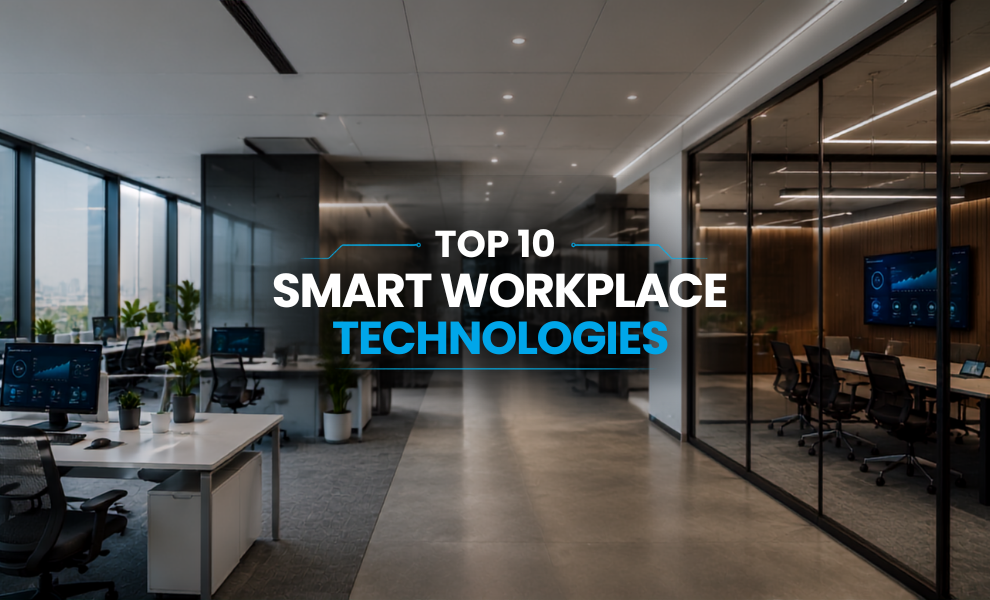
Workplace technologies are advancing at the fastest pace. The “return-to-office” mandate has accelerated the need for smarter, flexible, and technology-driven workplaces. This is driving demand for a smart workplace, a strategic approach for transforming the office into a dynamic environment. It refers to the sensors, software, hardware, and AI tools that make the workplace efficient, responsive, and a place where employees can work with ease.
How about adjusting lighting and temperature, managing tasks, and so much more, all autonomously? The potential is endless. All thanks to the emergence of technologies that make a workplace “Smart.” For entrepreneurs, leaders, and dedicated professionals looking for their workplace transformation, keeping sight of which innovations matter is essential. This blog takes you through the top 10 smart workplace technologies.
What Actually Makes a Workplace Smart?
A smart workplace is basically an office space that is equipped with all the innovative workplace technologies that aim to improve employee experience and collaboration, increase energy efficiency, reduce costs, and boost productivity.
Certain technologies play a key role in powering smart office technology, including IoT devices, automation, smart thermostats, meeting rooms, desk bookings, and more. The worldwide smart workplace market is expected to reach $162.8 billion by 2035, indicating how quickly businesses are adopting smarter, more connected office technology.
10 Smart Workplace Technologies Transforming Offices in 2026
1. AI in the Workplace
AI in the workplace is more than just a trend. It’s one of the key contributors to smart workplace technology. AI makes work easy by working beyond chatbots. It can schedule meetings, handle notes, draft emails for you, summarize them, prepare sales decks and presentations, and so much more. According to reports, over half of the employees in organizations use AI frequently. For employees, this means spending less time on routine tasks and more time on strategic, high-value activities.
Examples: Some popular AI workplace assistants include ChatGPT, Gemini, Claude, and others.
2. Desk Booking Systems
Booking technology is a key aspect of the smart workplace. Through this technology, seat booking is made simple and convenient for employees. This gives a clear idea of how to find an empty meeting room, check whether your teammates are visiting the office on a particular day, or book a desk near your teammates. Desk booking systems are among the top digital workplace solutions for 2026, enhancing convenience and employee experience.
Examples: Some popular desk booking software includes Kadence, OfficeSpaces, and Eden.
3. Unified Employee Experience Apps (Super Apps)
Employees usually shift between five to ten different applications. Logging on to one application to fill out timesheets somewhere, submitting leave requests through another system, booking a desk in the portal, or submitting a ticket. The result is not productive. It’s a waste of time and leaves the workforce feeling overwhelmed.
A frictionless solution is an employee with a Super App that directly addresses these concerns. It’s a unified mobile application that brings together all the services, tools, workforce needs, and HR management into one app accessible on a smartphone. Say goodbye to the fragmented issues with this digital workplace solution.
4. Meeting Room Technology
Meeting rooms are the busiest place in the office. With different teams, it becomes difficult to manage availability. Double bookings and interruptions for people looking for open space to create friction. One of the ideal solutions is the smart meeting rooms display that shows real-time availability, allows immediate bookings, and releases reservations to avoid meeting interruptions.
Alongside, smart meeting rooms bring innovative conference room technology, such as smart video conferencing cameras, software, hardware, and collaboration tools, that allow employees to join meetings from the office or remotely.
5. Intelligent Smart Offices Powered by IoT
Smart offices are in a buzz today. All thanks to the technology that has made this possible. IoT devices can now monitor occupancy patterns, temperature, smart lighting systems, air quality, and energy consumption throughout the entire day. This real-time data makes it easier for office buildings to adjust automatically without much human intervention.
In addition, security cameras and smart locks help businesses improve security and access controls. There are smart thermostats, such as Nest, that maintain optimal room temperatures, so employees feel comfortable working—IoT in the workplace results in safer and more efficient office operations.
6. Digital Collaboration and Communication Tools
Communication and collaboration have become the key to workplace productivity. Modern workplaces need reliable technologies to stay connected and in sync with the shift towards employees working from different locations. The right collaboration platforms bring together different features for internal communications, including messaging, file sharing, video conferencing, project management, and more in one place. This stands as an essential aspect of smart office technology, where AI automation is taking center stage. The main goal is to boost productivity regardless of where employees work.
Examples of collaboration and communication tools: Slack, Microsoft Teams, Asana, Zoom, and Dropbox.
7. Workplace Automation
Another key aspect of smart workplace technology is workplace automation. Organizations can automate repetitive tasks such as approvals, scheduling, data entry, reporting, attendance, and more. This reduces manual effort to complete tasks, which could otherwise waste employees’ time.
For example, an automated workflow can send an approval request to the manager and update it in the database once it is approved, without anyone having to mark each step individually. With a major focus on boosting productivity, automation plays a vital role in workplace transformation.
8. Visitor Management
Visitor management is often overlooked, but it is important for maintaining security in an organization. The smart office incorporates visitor systems that handle self-service check-ins, badge printing, and host notifications during sign-in. Yet many offices use manual entries for visitors, exposing sensitive data. Thus, upgrading to a smart Visitor Management System VMS transforms your front desk into a secure and welcoming entry.
9. Space and Occupancy Intelligence
Space and occupancy intelligence are critical for tracking how offices are used and for aligning with environmental goals. It uses IoT sensors, AI analytics, and data feeds to improve space utilization, reduce energy consumption by automating HVAC and lighting, and create a sustainable workplace. Collecting occupancy data is just one step; the results come from turning data into decisions.
10. Cloud-based Workplace Platforms
Cloud has become the driver of modern and smart workplace operations. It offers the required scalability, flexibility, and features employees need to carry out their day-to-day work tasks efficiently. Cloud-based platforms allow employees to access documents, applications, and communication tools from anywhere. This mainly works great for teams working remotely. With cloud-based technology, employees can focus on productivity while eliminating the need for constant IT maintenance and infrastructure management.
The Future of Smart Workspace Technology and Beyond!
With technologies advancing at a rapid pace, there is a significant shift in workplace systems. It’s called the ‘smart workplace’. Today, the workplace is not defined just by the number of devices or applications a company owns. However, it is defined by how effectively technology connects, processes data, and physical spaces. The next stage will involve deeper integration between these technologies. The above-mentioned workplace technology trends are surely a gamechanger in today’s digital world. Organizations that adapt to them effectively will go a long way.
Read more about trending blog posts around the tech landscape on our website.
FAQs
Q1. How much does smart workplace technology save on energy cost?
Answer: The costs vary according to the systems. Smart HVAC systems can reduce energy consumption by up to 50%, and offices using lighting systems have observed a 25% reduction in lighting energy costs.
Q2. What is an example of a smart office?
Answer: Some of the common examples of smart office are smart lighting systems, automated climate and temperature control, app-based desk bookings, access controls, and more.
Q3. What is smart office software?
Answer: Smart office software is basically a digital platform that uses connected sensors, devices, and automation to manage physical and digital workplaces.
Recommended For You:
Adopting Remote Work Technology – Transforming the Future of the Workplace