


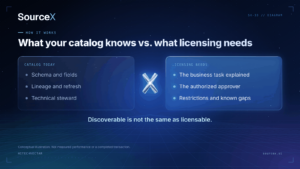
A modern data catalog can tell you a table’s schema, lineage, refresh schedule and steward. Those fields make it easier to find and operate the data.
Now ask it two different questions. What real business activity does this table explain? And who has the authority to approve its use outside the company?
If the catalog cannot answer, add that context. It matters for internal governance as well as for any proposal to license records for AI training.
AI data management for licensing needs more than discoverability. A reviewer has to connect selected records to their source, their transformations, their intended use and an authorized decision-maker. Until those links exist, a catalog entry is a description, not the start of a transaction.
THE SHORT VERSION
- A catalog that describes fields and refresh schedules still can’t answer the two licensing questions: what business activity does this explain, and who can approve its use?
- Separate three roles that are often confused: the person who can extract the data, the person who understands it and the person who can authorize a license.
- Record every transformation and every known gap. An unanswered question in the catalog is more useful than a confident guess.
Why isn’t a well-cataloged dataset ready to license?
Because technical completeness and business meaning are different things.
A support table can record every status change without showing whether a customer’s problem was actually solved. A CRM export can list every deal without preserving the sequence of decisions that moved it. AI developers want the second kind of record: work with its context and outcome attached.
So ask the operational owner to walk through one complete example. Which records give the initial context? Where are the actions captured? What evidence supports the outcome? Their answers separate a potentially valuable collection from a convenient export, and they reveal which related systems need to be in scope.
Who owns the data, and who can approve its use?
Name the people or teams responsible for three distinct roles. One person may hold more than one:
- The administrator knows how to extract the records.
- The business owner understands what they mean.
- The executive has authority to approve a license.
Write all three into the catalog. The most technically accessible person should never become the presumed commercial approver by default.
Then add what a schema can’t show. Customer-supplied content, third-party material and contractual limits all affect what the company is actually permitted to grant. A clean schema is not a clean title.
A clean schema is not a clean title. Catalog the authority, not just the attributes.
How do you document what changed during preparation?
A dataset prepared for licensing can look very different from its source. Identifiers are removed, attachments excluded, related cases restructured.
Record those steps so a reviewer knows exactly what the delivery represents. The W3C PROV standard offers a useful vocabulary for describing relationships among data, the activities that produced it and the people or systems responsible. A provenance record explains where the data came from; it doesn’t grant a license.
Version the description with the artifact. If preparation changes the collection, update the entry. An attractive but outdated catalog listing is worse than none.
Why should a catalog show a dataset’s limitations?
Every collection has edges. Some years are missing. A migration dropped relationships. Old outcome labels meant something different from today’s.
Put those limits right next to the intended use, in plain language rather than a footnote, so a reviewer can decide whether the collection supports a narrower task or needs more work. Resist the urge to fill gaps with assumptions to hit a data-readiness score. The unresolved question is often the most useful line in the inventory.
How does a catalog feed a licensing assessment?
SourceX licenses approved company data for AI training and evaluation. After qualification, a signed Master Supplier Licensing Agreement starts an inventory assessment, initially up to 30 days. Each Dataset Deal Confirmation fixes the dataset, payout, rights, processing route and deadlines. Extraction and delivery require both signed documents and SourceX’s go-ahead. The company contracts with SourceX, not an AI lab.
A well-kept catalog shortens that path. Qualifying companies list at least five systems, so an accurate system inventory earns its place on day one. SourceX looks first at organizations that peaked at 50 or more full-time employees and have several years of operating history. The ‘up to $4 million’ it advertises describes the largest enterprise datasets, not what a catalog entry is worth; the binding number comes only from signed deal terms.
What should change in your catalog tomorrow?
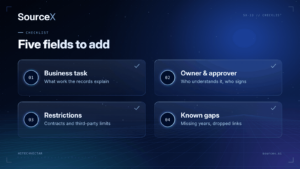
Pick one candidate collection and add five fields: the business task it explains, the operational owner, the licensing decision-maker, known restrictions and unresolved gaps. That small change gives your technical and commercial teams a shared object to discuss, instead of two separate conversations that never quite meet. It also tells you quickly whether a licensing conversation is premature or overdue.
A dataset with a clear explanation is easy to assess. A dataset with only a price tag is easy to dismiss.
Use the improved catalog entry to brief the authorized business owner. If a licensing review makes sense, SourceX starts with an upload-free company fit check. Bring the system inventory and known limitations; keep individual records out of the first step.
About the founder
Noah Loul is a four-time founder and the founder and CEO of SourceX, which licenses business data directly from companies for AI training and evaluation. He previously founded B2B Rocket, acquired by Blackpearl Group. His work focuses on building permission-based data infrastructure for AI.
Related Reads:
AI Data Management – Beginner’s Guide
Data Governance Guiding Principles Explained


