

As the demand for urban mobility is rising, the major issue faced by transportation infrastructure is traffic congestion and long daily commutes. It affects both time and your productivity. Alongside, the world is facing excessive noise and air pollution.
Thus, there is a need for transformative technology that would be the best solution to setbacks. Here comes Hyperloop, proposed by Elon Musk in 2013, a super-fast transportation system for passengers and freight. Is the future of travel? Read the blog to understand how hyperloop transportation technology (HTT) is transforming travel.
What is Hyperloop?
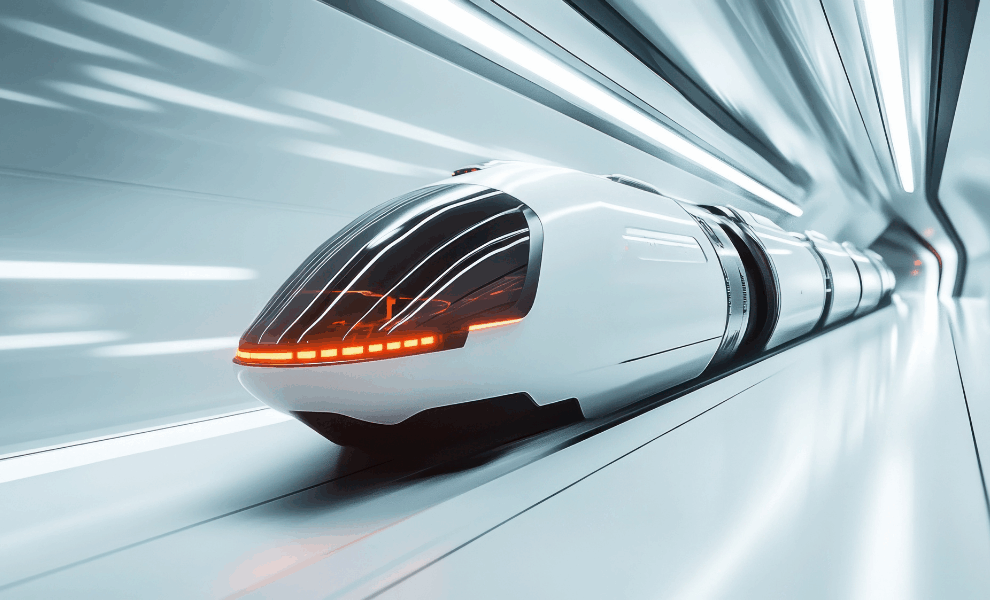
In simple terms, Hyperloop is the process of transporting passengers or freight pods through a near-vacuum tube at the fastest possible speed, using electric propulsion and magnetic levitation. It aims to revolutionize the travelling experience by cutting down the journey times between cities from long hours to just minutes.
One thing to note is that all this is done with zero emissions. It differs from traditional transportation, which relies on friction and air resistance and thus limits its speed. In the hyperloop scenario, magnetic levitation and lower air resistance allow the pods to travel at speeds beyond 600 miles/hour.
Listing the Key Benefits of Hyperloop Transportation Technology
1] A Safe Travel Way
Human errors cause most road accidents. This fact cannot be ignored, as a single mistake can cause severe loss. As hyperloop is an automated technology, it will remove the burden of human-prone accidents and stand as a safe alternative to these journeys.
2] Speed that’s Beyond Limits
Among the main advantages of hyperloop transportation innovation, one can note the ability to accelerate passengers to more than 600 miles/hour. The discussion above will reduce commuting time and lead to new ways to spend leisure time.
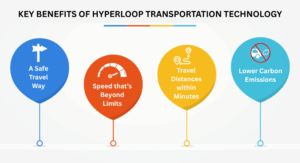
3] Travel Distances within Minutes
At higher speeds, the hyperloop can cover long distances in a few minutes. This approach reduces door-to-door travel time by offering direct connections between mobility hubs.
4] Lower Carbon Emissions
Hyperloop is environmentally friendly, as it consumes low energy for long-distance travel. It runs on electricity and solar energy. Solar panels, which are installed on the roof-above ground hyperloops, have the capacity to generate additional energy. Alongside, the tubes can also store electricity within batteries supporting sustainable future of travel.
Challenges in Hyperloop Transportation
With the benefits, hyperloop transportation technology comes with a few challenges that need to be considered.
Acceptance from Public
The first and foremost point is that new technology must be accepted by the public. People may be confused about switching from traditional transport to this modern concept. It’s necessary to create awareness and build confidence thereby.
Initial Cost Investment
Cost for building the hyperloop technology systems is high, which mainly underestimates the total cost of an unprecedented infrastructure undertaking. Thus, it becomes difficult for private companies to invest in a huge amount.
Regulatory and Compliance
As Hyperloop is a new form of transportation, it should abide by government regulations and safety standards.
Global Projects and Innovations
Around the globe, hyperloop technology is rapidly expanding through versions from multiple companies, including HyperloopTT, Virgin Hyperloop, and others. The United States, Europe, and Asia all have pilot projects that seek to prove that ultra-fast, environmentally friendly transport is technically viable.
The Future of Travel with Hyperloop
Hyperloop is a radically different travel method that is changing how people move around the world. It offers a high-speed, low-energy-use, and hence environmentally friendly mode of transport, which can connect people with businesses, tourists, and suppliers. Furthermore, the hyperloop is a game-changer in the business sector, as it will significantly reduce the time it takes for products to reach markets.
In the future, when the technology is mature and the rules are clarified, hyperloop will not replace existing transportation systems but will be an additional layer on top of our transit networks, enabling passengers to travel smoothly from one mode to another while still keeping their journey eco-friendly.
Conclusion
Hope the above blog has been your go-to-way for the future of travel. The new era of hyperloop transformation technology is indeed the best option to reduce travel time, offering high-speed while maintaining sustainability, and innovation. People should switch over from traditional transportation and opt for the new technological innovation that is here to transform how we travel across the globe.
Stay in the know of all the trending blogs, right here with us!
Frequently Asked Questions
1. Is Hyperloop the future of travel?
Ans: Yes! It is even though it changes the way we travel. The Hyperloop runs on renewable electricity, which causes less pollution. Alongside this, it keeps the air clean and, in a nutshell, keeps the environment and the planet safe.
2. What is the key importance of Hyperloop transportation?
Ans: Hyperloop claims the potential to reduce greenhouse gas emissions compared to other transportation modes, thereby helping reduce energy consumption.
You might also like:
Unveiling A Transformative Technology: Edge AI
Future Nanotechnology Inventions are Life Savers – Read to Know
8 Future Technology Inventions that Could Boost Your Business by 2050