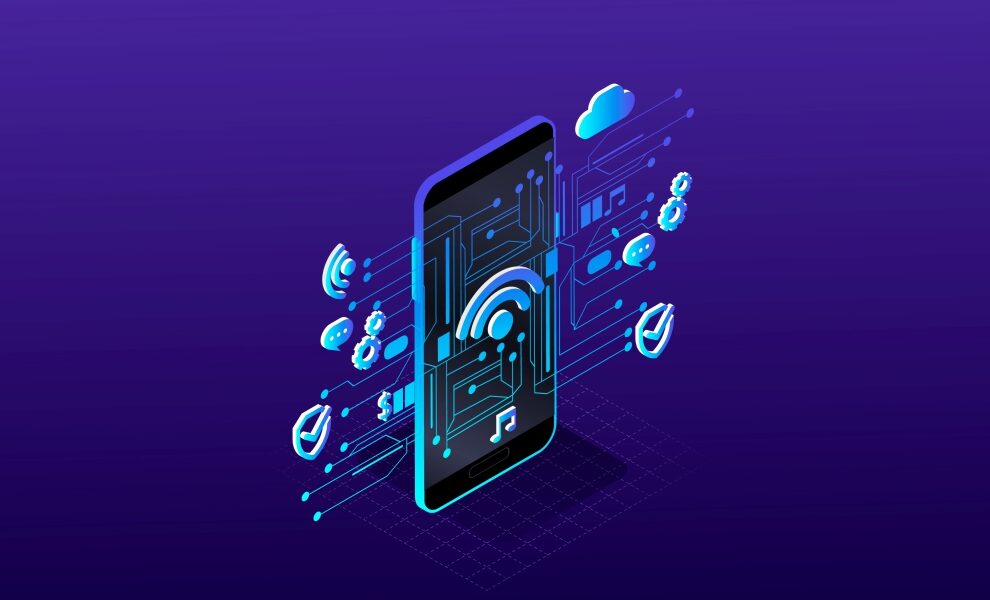
Mobile phones have become an integral part of our lives. We can hardly imagine life without mobile phones. What once started as a simple communication medium has transformed into a digital powerhouse. Today, mobile computing is no longer optional; it is the central medium of how we shop, communicate, work, and do more. As per data, the global mobile computing market is expected to reach $428,120 M by 2033, up from $303,502 M in 2023.
This standout technology has transformed contemporary society, enabling people to access information and services at any time and place. In this blog, we shall discuss its evolution alongside the technological advancements, applications, and threats associated with mobile computing.
Evolution of Mobile Computing
Mobile computing has a long history. It started way back in the early 1970s. The first cellular phone, a large, bulky machine weighing almost 2 kg, was developed and invented by John F. Mitchell and Martin Cooper of Motorola in 1973. Over time, advancements in wireless technology, from 2G and 3G, 4G, and now 5G, have unlocked faster data speeds, lower latency, and connectivity.
This allowed the use of high-speed internet, video streaming, and app-based ecosystems. In modern , 5G technology is transforming wireless computing systems with ultra-low latency, high speeds, and compatibility with new technologies such as IoT, AR/VR, and autonomous systems.
Mobile devices are no longer just communication tools; they are highly effective in computing centers that combine connectivity, processing power, and innovative applications.
What Is Mobile Computing?
Mobile computing is basically a technology that allows transmission of data, voice, and video to carry out computing activities anytime, anywhere, without being connected to a specific physical point. Mobile devices can store data locally and do not require an internet connection to do so. It relies on cloud services, wireless networks, and mobile applications to allow real-time communication and connectivity. The advancements in mobile technology have transformed how people use mobile devices in their day-to-day activities, from personal communication to conducting business to entertainment.
There are many benefits of mobile technology that we should know:
- Offers the highest level of convenience
- Allows communication, shopping, working, and more
- Create and edit information simultaneously.
Significant Technological Advancements
- Touchscreen interfaces have changed the way people use gadgets.
- A successful developer economy was made possible by App Ecosystems (Apple App Store, Google Play).
- GPS Technology revolutionized navigation and location services.
- The sensors and Accelerometers supported fitness tracking, motion detection, and AR experiences.
- High-Speed Connectivity enabled real-time communication and cloud access.
Real-World Applications
The following are a few popular and typical applications:
Healthcare Applications: Mobile computing is widely used in healthcare, enabling doctors, patients, and other staff to access information, book appointments, monitor heart rate, and more.
Entertainment: Mobile devices are ideal for streaming content, entertainment purposes, and communication with friends, family, and colleagues.
Education: Mobile computing has made learning easier for all students. And learners.
Finance: This technology has brought significant changes in how we handle finances by giving us access to various apps on mobile phones.
Risks and Challenges in Mobile Systems
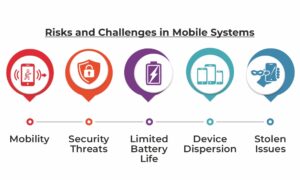
Mobility: It is a critical aspect of mobile computing; however, it comes with certain challenges, including auto-configuration, location management, and spectrum range.
Security Threats: Mobile phones are prone to malware, phishing, and data breaches.
Limited Battery Life: High-performance apps and connectivity drain batteries quickly, reducing usability.
Device Fragmentation: Different screen sizes, operating systems, and hardware configurations make app development and testing more challenging.
Stolen Issues: Mobile devices can be easily stolen by thieves, leading to data loss and damage.
The Future of Mobile Computing: The Paradigms
Mobile computing is reaching new heights with innovations and technologies standing at the forefront. It is here to offer an innovative, secure, and hassle-free communication experience to everyone around.
Following are a few wireless computing trends:
- AI is deeply integrated into mobile apps and devices
- The emergence of 5G connectivity offers faster speeds
- AR and VR are transforming mobile gaming
- Advanced security and authentication
- Expansion of 5G and beyond
These changes require designers and organizations to evolve as users’ expectations continue to rise to produce meaningful mobile experiences.
Final Words
Mobile computing has come a long way, transforming our everyday life. Alongside, it is shaping all the spheres of modern life, standing as a backbone in today’s digital world.
Despite the security and privacy concerns, it still stands as an emerging paradigm with massive potential. Hope this blog has helped you understand the clear context of such powerful technology!
Stay updated with all the tech trending blog updates with us!
FAQs
Q1. What are the three main components of mobile computing?
Answer: The three main components of mobile computing are: wireless networks, infrastructure, and cloud computing platforms.
Q2. What are the common applications of mobile computing?
Answer: Finance, healthcare apps, navigation, e-commerce, and social media platforms.
Recommended For You: