AI systems have become a cornerstone of every business operation. From small-scale to high-stakes environments, AI plays a key role. However, given the widespread use of this technology, have you ever wondered how to discover and fix AI vulnerabilities before attackers exploit them? Let us tell you…
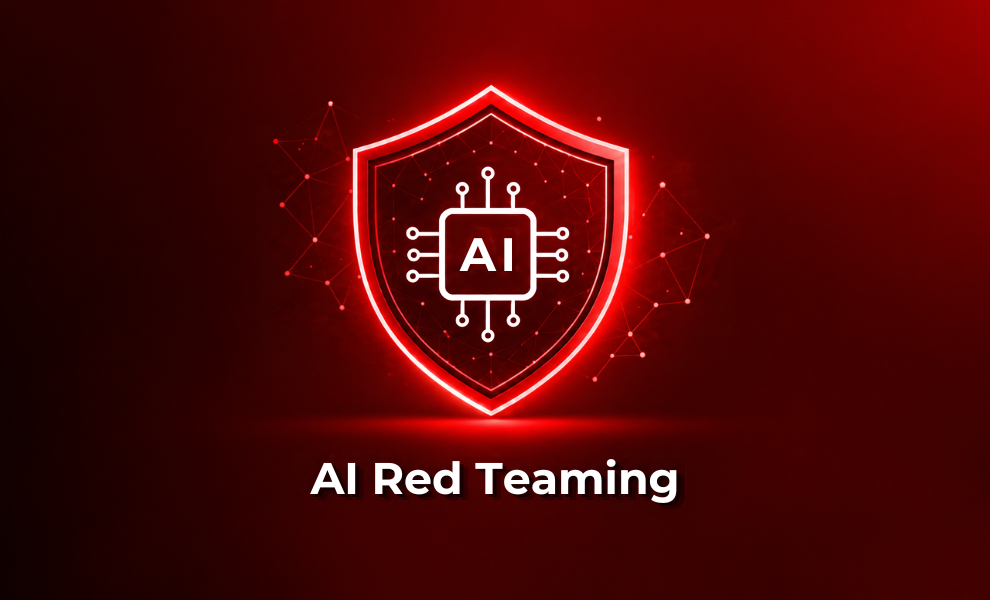
The answer is AI red teaming, a stress-testing approach that identifies vulnerabilities, flaws, biases, and security weaknesses in large language models (LLMs) and generative AI applications. To prevent unsafe system behavior, businesses must ensure their models perform well not only in reality but also under stress. According to reports, the AI red teaming services market size has grown immensely in recent years. It is expected to reach around $18.6 billion by 2035, from $1.3 billion in 2025. In this blog, we will understand everything about AI red teaming.
What is AI Red Teaming?
AI red teaming is structured, adversarial testing of AI models (LLMs) to identify weaknesses, test fairness, and strengthen security posture before attackers exploit them. The approach involves stress testing LLMs by simulating real-world attack scenarios to expose vulnerabilities such as prompt injection, jailbreaks, and more.
AI red teaming involves data scientists, ethical hackers, and other security teams who conduct stress testing. In this scenario, testing isn’t just about checking the model’s accuracy and fairness, or catching invalid output; it also covers regulatory requirements like the EU AI Act, false responses, and other risks. This approach has become important for businesses as AI models scale at the fastest pace, making it hard to stay ahead without a practical, proactive testing framework.
Why is AI Model Stress Testing Important for Businesses? Key Reasons
- Identify security vulnerabilities: Helps identify the security flaws and unexpected behaviors in AI models that bad actors could exploit.
- Enhances model safety: Stops the generation of inappropriate or sensitive content.
- Improves reliability: Ensures the model performs well across noisy data and improper input, not just clean or reliable data.
- Detect bias and fairness issues: AI model stress testing can surface hidden biases and help ensure outputs are fair across different user groups.
Traditional vs AI Red Teaming Compared
| Parameter | Traditional | AI Red Teaming |
| Objective | Find and fix vulnerabilities in network or systems |
Uncover unsafe AI behavior, bias, and security flaws |
| Techniques | Penetration testing, social engineering | Adversarial testing AI, prompt injection, AI vulnerability testing |
| Approach | Human-led | AI assisted |
| Scalability | Limited scalability | Higher scalability |
| Attack surface | Systems and infrastructure | AI models, training data, APIs, and output |
| Team | Security engineers | ML experts, security experts |
| Focus | Vulnerability-focused | Exposure-focused, identifies unsafe AI behavior |
Red Teaming LLMs in Action: Quick Example
Back in 2023, a red team discovered that an AI chatbot was vulnerable to prompt injection. It allowed users to bypass content filters. Fixing these vulnerabilities before releasing publicly prevented further hassle and regulatory fines.
Also, some of the leading companies have integrated this approach into their deployment process to reduce prompt injection and other related risks.
How Are Leading Market Players Red Teaming Their AI?
OpenAI: OpenAI uses manual, automated, and hybrid red teaming to test its frontier models. The company also coordinates with security experts to identify AI model risks and uses these insights to boost its safety.
Google: Google’s AI Red Team simulates real-world hackers, bad actors, and insiders to test the weaknesses in AI models. They identify issues like model theft, prompt injection, and more.
Microsoft: Microsoft has focused on targeting system-level vulnerabilities. Their red team has uncovered vulnerabilities across different inputs, not just text. By applying red teaming to vision-language models, the team successfully blocked image-based jailbreak attempts.
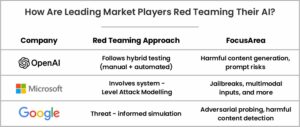
These examples showcase how red teaming is applied across the major LLM models.
What are the Benefits of AI Model Stress Testing for Businesses?
Below are some of the common benefits of AI safety testing:
- Safe AI deployment: This approach ensures AI models are thoroughly tested before businesses release them to users.
- Build user trust: It helps build user trust by ensuring AI systems behave responsibly and securely.
- Strengthen AI resilience: Red teaming optimizes and strengthens AI security posture to keep up with cybersecurity threats.
- Regulatory compliance: Red teaming AI apps ensures their security posture meets regulatory requirements.
- Safety risks: LLMs and multimodal AI models can produce harmful suggestions or create toxic content under adversarial pressure. AI model stress testing addresses these risks by testing policy regulations and unsafe content generation.
Compliance and Regulatory Frameworks that Support AI Red Teaming
- EU AI Act 2024: Requires adversarial testing of high-risk models before they are released to the market.
- NIST AI RMF: Suggests red teaming as part of AI security testing. Helps organizations manage all the security risks related to AI systems.
- ISO 42001: Focuses on AI governance guidelines, including stress testing AI models and continuously improving AI systems.
The Bottom Line: Red Teaming Isn’t Optional Anymore!
So, to wrap up, red teaming is not just a cybersecurity practice; it is an approach to security, compliance, and AI fairness. As demand for LLM and generative AI applications accelerates, AI red teaming is evolving rapidly.
It gives businesses a strategic way to understand how their AI systems behave under stress. From niche experiments to deployment in complex workflows, AI model stress testing is becoming a critical part of AI security and governance. The goal isn’t to make AI impossible to break. The goal is to find weaknesses before they become extremely costly.
To stay ahead of the rapid advancements in AI, tech, cybersecurity, and beyond, visit our website where you can explore diverse topics and boost your learning curve.
Frequently Asked Questions
Q1. What is red teaming in the context of generative AI?
Answer: Red teaming in generative AI is an interactive testing process in which security teams act like malicious actors to disrupt an AI system and expose security issues before release.
Q2. What is the difference between adversarial testing and red teaming?
Answer: Adversarial testing is an approach to inserting negative data to break a system. Red teaming, by contrast, is a broad approach that simulates an adversary aiming to achieve a specific goal against an AI system or organization.
Also Read:
Manual Testing and Automated Testing: Core Differences and Use Cases