Suppose you are working on a monthly sales report, and your system starts lagging. Reports that normally take a few minutes take hours. So, you need to manually fix everything to get the report ready, all because of outdated legacy systems. This costs both time and money, from maintenance overhead to lost productivity.
But do you know AI can help in this scenario to automate workflows, predict issues, and speed up the work? However, one challenge still remains is how to modernize your legacy system. The answer is integrating AI into legacy systems.
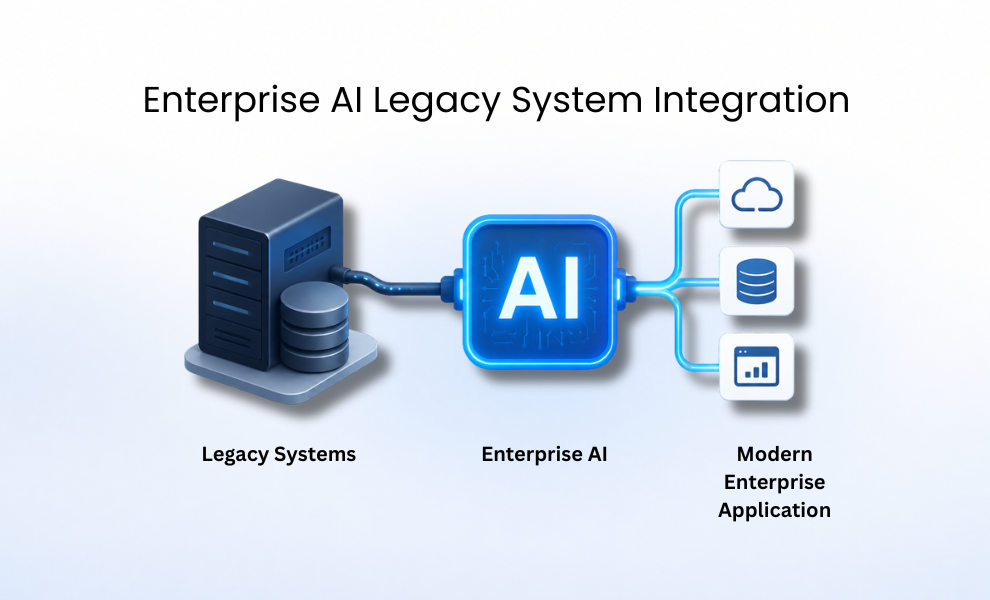
Enterprise AI legacy system integration helps enterprises use AI-led modernization to automate workflows, improve decision-making, and boost overall business growth.
This blog covers everything about integrating AI into legacy systems, including the key challenges and strategies to overcome them, and more.
Do Legacy Systems Still Matter Today?
Many organizations rely on legacy systems to support their operations. They are essential for key processes in industries such as banking, healthcare, government, and manufacturing. Regardless of age, these systems contain years of valuable operational and customer data.
Some of the common examples include Enterprise Resource Planning (ERP) systems, Customer Relationship Management (CRM) solutions, financial and accounting systems, and supply chain management.
These platforms are good enough, but they have not been built for AI workloads, machine learning models, or modern cloud native architectures. This is where the need to integrate AI with legacy infrastructure comes into picture.
What is Enterprise AI Legacy Integration?
Enterprise AI legacy integration refers to the process of incorporating AI throughout the software modernization process. It is all about integrating AI capabilities in the existing system without replacing them. Integrating AI into legacy systems makes it modern, scalable, and future-ready.
Furthermore, it helps to deliver operational efficiency, automate repetitive workflows, and provide personalized customer experience. With legacy AI transformation, companies can access real-time information from legacy data, add intelligence to their decision-making process, and maximize the life cycle of the legacy system without a huge impact on modernization expenses or business disruption.
Key Challenges in Enterprise AI Modernization and Strategies to Solve Them
Integrating AI into legacy systems comes with a set of challenges. The following are some common challenges in integrating legacy systems into enterprises, alongside the strategies to tackle them.
Challenge 1: Data Silos Limiting AI Integration
Even the advanced models fail if there is no high-quality, well-structured, or accessible data in place. Further, legacy systems work in isolation, which creates data silos, limits AI integration, and reduces model effectiveness. Without clean data in place, achieving trustworthy output from AI tools is impossible. These silos compromise the accuracy and even the speed of predictions.
Strategy: An effective AI modernization strategy begins with a centralized, unified data infrastructure. Make sure to build enterprise-wide data governance frameworks, data lakes, or adopt modern data warehouses before deploying AI applications. Alongside using consistent metadata and tracking where data comes from improves AI transparency and supports regulatory compliance.
Challenge 2: Legacy Systems and Integration Complexity
One of the key roadblocks in AI integration is the technical gap between modern AI infrastructure and traditional infrastructure. Legacy systems are generally designed for structured transactions and do not support unstructured data or real-time workloads. They lack the computing capacity, scalability, and modularity that AI demands.
Strategy: To overcome these challenges, enterprises should focus on modernizing infrastructure with API-driven interoperability and cloud migration. Adopt a hybrid approach to gradually integrating AI modules with legacy systems, minimizing business disruption.
Challenge 3: Legacy Systems are not API-Ready
Lack of API support and real-time capabilities can restrict enterprise AI transformation. Legacy systems do not contain documented APIs, nor do they have standard authentication or authorization. Without API-level access, you cannot compose services or plug AI agents into processes.
Strategy: Rather than replacing the legacy systems, establish an API integration layer which serves as a bridge between the traditional applications and the AI systems. Make key business processes accessible to secure APIs, API gateways or middleware for seamless communication between legacy platforms and AI models. For legacy systems without direct APIs, use integration platforms and robotic process automation (RPA).
Challenge 4: Skill Gap
There is a significant skills gap in organizations that use legacy systems. It is challenging for employees who are experts in legacy technologies to adapt to new skills to implement and manage AI solutions.
Strategy: Make sure to launch AI training programs for employees. Partner with educational institutions and training platforms. Promote AI as a partner that supports employees rather than replacing them to reduce resistance.
Challenge 5: Ethical, Regulatory and Governance Challenges
Legacy systems lack current security and privacy standards. This can expose businesses to threats such as malware, data breaches, or ransomware. Modernization becomes challenging for organizations as it involves enabling encryption to safeguard sensitive data, updating protocols, and more.
Strategy: To overcome it, establish a strong AI governance framework by creating an ethics board, implementing AI for critical decisions, and robust security and privacy controls. Alongside this, align AI initiatives with regulations such as GDPR and other governance frameworks to ensure trust, compliance, and transparency.
Enterprise AI Legacy System Integration: Market Growth & Key Stats
- The legacy modernization market is estimated to reach USD 29.39 billion in 2026, up from USD 24.98 billion in 2025. It is projected to grow to USD 66.21 billion by 2031, registering a CAGR of 17.64% during the 2026–2031 forecast period.
- According to McKinsey, the legacy modernization market has reached $24.98 billion in 2025, yet 70% of Fortune 500 companies still operate two decades old software.
Some Unignorable Benefits of AI-Led Modernization Strategy
- Reduced Costs: Legacy systems are expensive to maintain. Automation reduces costs by lowering maintenance expenses and minimizing manual development efforts.
- Improved Operational Efficiency: AI automates routine tasks such as data entry and report generation, reducing errors and freeing employees to focus on high-value work rather than repetitive processes.
- Enhanced Customer Experience: By integrating AI into existing ERP and CRM data, enterprises can deliver personalized recommendations and faster query resolution without replacing old systems that hold years of customer history.
- Improved Application Performance: Automation, cleaner code, microservices, and cloud-native architectures give modernized applications faster response times, better scalability, higher reliability, and superior user experiences.
Real-World Applications of Integrating AI with Legacy Infrastructure
- Banking: AI-powered fraud detection analyzes transaction patterns while integrating with core banking systems.
- Retail: Leverages data from ERP and POS (point-of-sale) systems to help improve demand forecasts, inventory management, and personalized recommendations through the power of AI.
- Healthcare: Ensures that more urgent patients are seen; AI assists with medical imaging and clinical decision support while maintaining electronic health record (EHR) platforms.
- Industry Supply Chains: Supply chain companies combine AI with legacy warehouse management systems to keep inventory in control, route planning, and delivery schedules.
The Future of Enterprise AI Transformation & Legacy Systems
Legacy systems are impossible to disappear anytime soon. Emerging technologies such as agentic AI, digital twins, RAG, edge AI, and intelligent automation will be integrated with legacy environments through APIs, middleware, and cloud services.
The future lies completely in modernization through integration rather than replacement. Organizations that invest in scalable data architectures and phased AI adoption will be better positioned to innovate while preserving the stability of their existing system.
In Summary!
The integration of AI into legacy systems is a key requirement today. Following a well-structured approach that focuses on careful planning, and a phased implementation strategy can help.
Alongside assessing existing infrastructure, modernizing data, building integration layers, and establishing robust AI governance, enterprises can unlock the full value of AI without replacing the systems that run their core operations. Organizations can turn their “legacy systems” into a modern “asset.”
Read all the technology-related blogs covering diverse domains on our website.
FAQs
Q1. What is the difference between AI and enterprise AI?
Answer: Standard AI mainly focuses on generic tasks or individual productivity. On the other hand, enterprise AI refers to the deployment of AI across the organization.
Q2. Can AI work with old enterprise software?
Answer: Yes. AI can work with legacy enterprise software by using middleware, API integration platforms, robotic process automation (RPA), or hybrid cloud communication that allows communication between older systems and modern AI apps.
Related Blogs:
Strategic Frameworks for Enterprise Architecture
BigCommerce Enterprise: Custom Solutions for Scaling Your Online Store