
There is a lot of buzz about autonomous AI agents that would read, write, and execute tasks simultaneously, which would normally require human input. This just feels like an imaginary story. But wait, there is a plot twist!
OpenClaw, a powerful, autonomous AI agent, can do it all. It’s in a big hype today in the AI industry, by turning simple vision into reality. But yes, this popularity doesn’t mean it’s the right option for everyone. It does come with some tradeoffs!
So, what next? To make it easy for you, let’s run through the blog and explore the best 5 OpenClaw alternatives for 2026. Whether you’re migrating or just checking out options, here’s everything you need to make a smarter choice. Here we go!
A Short Overview of OpenClaw
OpenClaw is a popular, open-source autonomous AI agent framework designed to automate workloads using LLM models. It goes beyond simple chat responses and connects AI agents to perform a range of actions, from automation to advanced integrations.
OpenClaw can even send messages, manage files, and monitor your booking while interacting with other services. The system is built on a local agent architecture that connects the LLM model to system-level capabilities, such as browser control, an I/O shell, and more.
Key Highlights of OpenClaw:
- Open-source autonomous AI agent for task automation.
- Has the capability to connect LLMs to APIs, browsers, files, and more.
- Uses the local gateway to complete real-world actions.
Why are People Looking for OpenClaw Alternatives?
OpenClaw is one of the local, autonomous AI agent frameworks with major benefits. While it has gained significant popularity for rapid prototyping, it comes with several limitations, so users look for alternatives to OpenClaw.
Security Risks: The OpenClaw model has access to your tools and services; this unrestricted system can expose sensitive data and create compliance issues.
Unreliable Performance: Workflows can fail due to dependency concerns and inconsistent outputs.
MacOS-native workers: OpenClaw is not ideal for users whose workflow is in Mac apps; thus, an assistant is needed to control them.
Maintenance burden: OpenClaw has 430,000 lines of code, making it difficult to maintain and audit.
Complex Integrations: It’s difficult to connect with enterprise tools and APIs.
Listing the Top 5 OpenClaw Alternatives
As the AI landscape is changing at the fastest pace, new frameworks are emerging. Similarly, there are secure, feature-rich, and best alternatives to OpenClaw users should be aware of. Here’s a rundown of the top 5 alternatives.
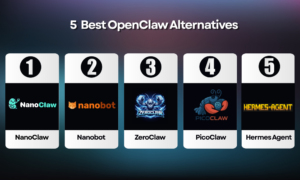
1] NanoClaw
NanoClaw stands as the top OpenClaw alternative for teams that put security first. It’s one of the powerful and strong autonomous agents that is known for its simplicity, security, and control. Unlike larger AI agents, it runs as a single Node.js process that handles queues, messaging, and more. The agents operate in an isolated container, having their own memory, file system, storage, and execution environment.
NanoClaw can efficiently address security vulnerabilities in local system access, making it ideal for teams handling sensitive information. Alongside, there is no complex structure, dashboards, or other features.
Key Highlights:
- Supports messaging like Telegram and WhatsApp
- Container-based isolation for every agent group
- Built-in scheduling for automated tasks
- Greater security through centonization and sandboxing
Best Used For:
- Developers who need complete control over an AI agent
- Security-focused organizations and industries.
Why NanoClaw is the best OpenClaw alternative?
NanoClaw provides container-based isolation and sandboxing for enhanced security. While OpenClaw provides local access, it lacks security. NanoClaw is safer, more controlled, and compliance focused.
2] Nanobot
Nanobot is a lightweight and user-friendly AI agent framework in Python. It runs on the MCP architecture and turns MCP servers into fully functional AI agents. The source code is about 4000 lines, allowing developers to understand, customize, and extend, while retaining the context-sensitive memory for automation. Nanobot allows constant interactions without losing the flow of past decisions.
Nanobot comes with high reasoning, interaction, and orchestration capabilities.
Key Highlights
- Built on MCP architecture
- Python-based with a small codebase
- Easy to set up and integrate with other applications
Best Used For:
- For individual developers
- Context-aware automation
- MCP-based tool orchestration
How Does it Compare with OpenClaw?
Nanobot is smaller and has a compact, flexible architecture, compared to OpenClaw, which has a larger, more complex architecture.
3] ZeroClaw
ZeroClaw is a popular Rust-based AI assistant framework. This agent is super-fast and minimalist in design. The agent is safe, more efficient, and uses fewer resources. ZeroClaw supports a modular, trait-driven architecture that allows developers to change AI providers, communication methods, tools, and more without vendor lock-in. Alongside, integrates with platforms such as Telegram and Slack.
ZeroClaw has a three-layer structure, core logic, AI provider integration, and communication channels. This makes it easy to control how AI agents interact with models and other systems.
Key Highlights
- Binary size of 3.4MB with less resource usage
- Rust trait system with a pluggable architecture
- Zero runtime overhead, higher performance
- Supports 22+ AI providers
How Does it Compare with OpenClaw?
ZeroClaw would be like OpenClaw if rewritten in Rust. It is lightweight, resource-efficient, and ideal for performance-heavy environments.
4] PicoClaw
PicoClaw is a lightweight AI agent with a strong focus on high speed and is rebuilt through the “self-bootstrapping process”. The agent is efficient enough to run $10 hardware, making it a cost-effective alternative to OpenClaw.
It can be deployed on any Linux device. Users can get a fully functional AI assistant that uses less than 10MB of RAM and starts up in 1 second. It supports 16+ chat channels. From being your personal assistant to boosting your productivity, PicoClaw works best in all scenarios.
Key Highlights:
- Multi-LLM support
- It is lightweight and comes with a faster speed
- Reduces memory consumption
- Get complete control over your AI environment
Best Used For:
- Ideal for developers and teams
- Performance-heavy applications
- Helps in content creation and coding
How Does it Compare with OpenClaw?
PicoClaw is lightweight and can be deployed on cheap, memory-constrained hardware. PicoClaw will start up quicker than OpenClaw and has lower infrastructure requirements.
5] Hermes Agent
Hermes Agent is one of the self-improving AI agents built by Nous Research. Here is their tagline: “An Agent that Grows with You.” This model learns from your skills and experience and is the only one with these standout capabilities. Hermes Agent can connect with where you live, including Telegram, WhatsApp, Slack, and more. It comes with scheduled automation with delivery to any platform.
For security reasons, Hermes Agent comes with five sandbox backends, including SSH, Docker, local, Modal, and Singularity, giving higher flexibility than OpenClaw and NanoClaw.
Key Highlights:
- Multi-platform support
- Can run anywhere
- Continued memory and auto-generated skills
- Complete web and browser control
- Text-to-speech, image generation
Best Used for:
- Developers who need a self-hosted agent
- Teams that require sandboxing options
How Does it Compare with OpenClaw?
Hermes offers lower infrastructure costs and customization. On the other hand, OpenClaw offers a simpler, more guided setup for autonomous task automation.
OpenClaw Alternatives Comparison Table
| Tool Name | Technology | Key Strengths | Best Uses |
| NanoClaw | Node.js | Higher security, built-in messaging support |
Developers, security-focused organizations |
| Nanobot | Python (MCP architecture) | Lightweight, easy-to-customize |
Individual developers |
| ZeroClaw | Rust | Ultra-fast, low resource usage |
High-performance environments |
| PicoClaw | Lightweight Linux agent | Low memory, multi-LLM support |
Helps in content creation |
| Hermes Agent | AI Agent Nous Research | Self-improving, multi-platform support |
Helps in advanced automation, self-hosted platforms |
Wrapping it Up on Choosing the Best Alternative to OpenClaw!
Here we wrap up the best OpenClaw alternative. OpenAI is a key pillar for local AI agents, but it lacks security, reliability, and scalability, underscoring the need for a different approach. But one thing to note is that you will have many options; however, the right one depends on your needs. The emerging tools are not just an alternative, however, but a move towards specialization.
Be it coding, automation, managed-agent platforms, or more. So, make sure you pick the right AI agent for your workflow and get the best desired output!
For all the latest blog posts spanning the tech world, head over to our website now!
FAQs
1] What is the difference between NanoClaw and OpenClaw?
Answer: NanoClaw is a lightweight, secure, and containerized framework. On the other hand, OpenClaw is a feature-rich, and popular AI agent.
2] Is NanoClaw free?
Answer: Yes, NanoClaw is a free and open-source platform under the MIT license.
3] How do I choose the right alternative to OpenClaw?
Answer: The best choice depends on your needs. Each tool has its own specifications and uniqueness. Choose one that meets all your requirements and fits your budget.
Recommended Reading:
Meet the New Moltbook: A Social Network Platform for AI Assistants