

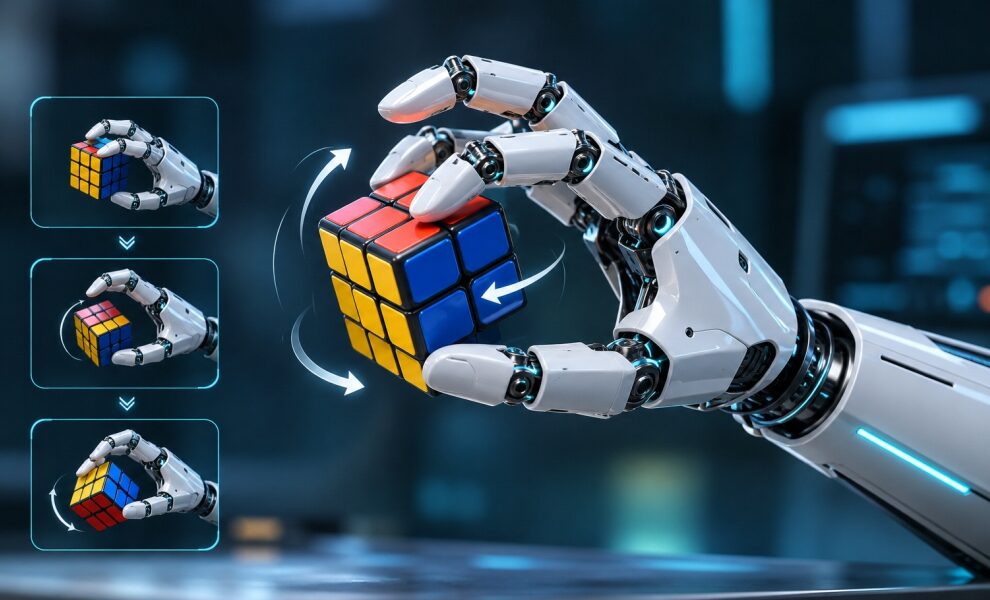
A human hand can hold an object while several fingers can move independently to change its position. One finger may support the object while another adjusts its angle. The thumb helps maintain control as the other fingers complete the movement. Reproducing this coordination is a major challenge in robotics.
This is where dexterous robotic manipulation becomes important. It focuses on how robotic hands coordinate their fingers and joints to perform complex movements. Instead of relying on a single gripping action, these systems can reposition objects, change their orientation, and carry out multiple steps within a task.
What Is Dexterous Robotic Manipulation?
Dexterous robotic manipulation is a robot’s ability to handle and control objects through coordinated movements of multiple fingers or joints.
A basic gripper usually has two opposing surfaces that open and close around an object. It works well for many pick-and-place operations. However, tasks that require changing an object’s position or orientation need more advanced movement capabilities.
For example, a robotic hand may need to turn a small component before placing it into an assembly. It must coordinate its fingers to rotate the component and position it correctly without dropping it.
One important capability is in-hand manipulation. This allows a robot to reposition an object while continuing to hold it.
How Robotic Hand Design Determines Dexterity
A robotic hand’s mechanical design determines the range of movements it can perform. Three factors are particularly important.
Degrees of freedom (DoF): Each degree of freedom represents an independent movement available to a joint. More degrees of freedom can provide greater flexibility, but they also increase the complexity of controlling the hand.
Finger configuration: The number, length, and arrangement of fingers affect how a hand handles different objects. Thumb opposition is especially important because it allows the thumb to work against the other fingers.
Actuation systems: Motors, tendons, and other mechanisms move the fingers. Some robotic hands use an actuator for each joint, while underactuated designs use fewer actuators to control several joints. This can simplify the mechanical system while allowing fingers to adapt to different object shapes.
Human hand models commonly use around 20–25 degrees of freedom. This provides a useful reference for understanding hand complexity, but robotic hands do not need to reproduce every human joint to perform useful tasks.
A 2025 review in Frontiers in Robotics and AI examines these design choices and the challenges involved in developing learning methods for dexterous robotic hands.
How Robotic Hands Reposition Objects Without Releasing Them
In-hand manipulation involves several types of movement. These actions allow a robotic hand to change an object’s position while maintaining control.
- Rolling: The object rotates across the fingers’ contact points.
- Pivoting: The hand turns the object around a selected point or edge.
- Sliding: The object moves across a finger’s surface to reach a new position.
- Finger gaiting: The fingers take turns changing their positions to move the object within the hand.
These movements can be combined to complete more complex operations. For example, a robot may first pivot a component, then slide it into a better position, then rotate it for the next assembly step.
Why Tactile sensing Matters for dexterity
Coordinated finger movements alone are not enough for reliable manipulation. A robotic hand also needs information about the contact it makes with an object.
Tactile sensing helps a robot identify whether its fingers have made the contact, whether an object has shifted, and when a movement needs adjustments. This information supports better control during tasks that involve repositioning or rotating objects.
Dexterity depends not only on how a robotic hand moves but also on how well it interprets physical contact.
How Robots Learn Coordinated Hand Movements
Programming every possible finger movement is difficult. A robotic hand may have many joints, and a small change in one finger can affect the others. Researchers therefore use learning-based methods to help robots develop coordinated actions.
Three approaches are widely studied:
Imitation learning: A robot learns from task demonstrations. These demonstrations may come from human hand movements, teleoperation, or recorded robotic actions. The system uses them to learn how to perform similar movements.
Reinforcement learning: The robot learns through repeated attempts. It receives rewards for successful actions and adjusts its movements based on the results. This can help it discover movement strategies that are difficult to program manually.
Simulation-based training: Researchers use virtual environments to train robotic hands before testing them in physical settings. Simulation allows systems to practice many movement combinations without relying entirely on real-world experiments.
These approaches can also be combined. For example, a robot may learn an initial movement from a demonstration and then refine it through reinforcement learning.
A 2026 study called HandsOn: A Large-Scale Simulation Benchmark for Generalizable Dexterous Manipulation demonstrates how challenging this learning process remains. The benchmark includes 66 human-verified tasks and 18,000 curated human demonstrations, covering six dexterous hands and five robotic arms. The best trained multi-task policy achieved a 29.1% success rate on the Core-50 benchmark.
Examples of Robotic Hands Used in Research
Several robotic hand designs demonstrate how different mechanical configurations support dexterous manipulation.
Shadow Dexterous Hand: Developed by Shadow Robot, this has five-fingered hand. The hand 24 degrees of freedom, including 20 actuated and four underactuated movements. Its design supports independent finger movements and in-hand object manipulation.
Allegro Hand V5 Plus: Developed by Wonik Robotics, this four-fingered hand has 16 active degrees of freedom. Its independently controlled joints support stiffness and movements similar to human finger.
OpenAI’s Dactyl: OpenAI’s Dactyl is an example of dexterous robotic manipulation, where a robot hand learns to handle and rotate objects using its fingers. It is trained in simulation and applies what it learns to perform real-world tasks with better control and accuracy.
Where Dexterous Robotic Manipulation Can be Used
Advanced robotic hands can support tasks that require more than simple pick-and-place operations.
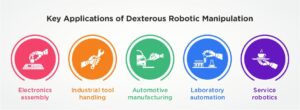
- Electronics assembly: Positioning small components and adjusting their orientation during multi-step assembly.
- Industrial tool handling: Holding and repositioning tools to perform various operations.
- Automotive manufacturing: Handling components that require orientation changes during assembly.
- Laboratory automation: Manipulating small equipment and objects through controlled movement sequences.
- Service robotics: Handling everyday objects in environments where tasks vary from one interaction to the next.
Not every task requires a multi-fingered hand, but complex operations can benefit from additional flexibility.
What Makes Dexterous Manipulation Difficult to Scale?
Developing a robotic hand that performs a demonstration successfully is different from making it work reliably across many tasks.
Control complexity: Coordinating several joints requires the robot to manage many possible movement combinations. This makes planning and execution more demanding.
Mechanical limitations: More joints and actuators can increase a hand’s size, weight, cost, and maintenance requirements. Designers must balance flexibility with practical engineering constraints.
Training requirements: Learning complex movements requires suitable demonstrations, training environments, and repeated testing. Some tasks remain difficult to reproduce consistently.
Differences between hand designs: A movement learned on one robotic hand may not work directly on another. Differences in finger arrangement, joint range, and mechanical structure can require additional training or adaptation.
A 2026 survey in IEEE Robotics & Automation Magazine discusses these challenges, including data collection through simulation, human demonstrations and teleoperation, and the development of imitation-learning and reinforcement-learning methods.
Conclusion
Dexterous robotic manipulation expands what robotic hands can do by enabling coordinated finger movements, object repositioning, and more complex action sequences.
Progress in mechanical design and learning-based control is making these capabilities increasingly practical. As the technology develops, dexterous hands could help robots take on a wider range of assembly, tool-handling, and service tasks that require greater movement flexibility.
The goal is not simply to build a robotic hand that looks like a human hand. It is to develop one that can reliably perform useful, coordinated movements.
For more such information please visit our official website now.
FAQs
Q1. How is dexterous manipulation different from robotic grasping?
Answer: Robotic grasping helps maintain contact with an object. The object stays completely still inside the gripper.
Dexterous manipulation involves a broader range of interactions, allowing a robot to move, adjust, and handle an object in different ways without losing control.
Q2. How does computer vision support dexterous robotic manipulation?
Answer: Computer vision helps robots see and understand the objects around them. It allows them to identify objects, recognize their shapes, and understand where they are placed. This helps robots decide how to reach, pick up, and handle objects correctly.
Related Reads:
Role of Manufacturing in Top Industrial Robotics Applications
Industrial Robot Examples: A new era of Manufacturing!
Must know Digital Twin Applications in Manufacturing!
An Overview of the Pivotal Robot Locomotion Principles


