
ExtraMile by HiTechNectar is an exclusive interview series that combines the latest technologies and expert insights so that you can make better decisions. In each session, we feature top voices from diverse industries to discuss emerging tech advancements.
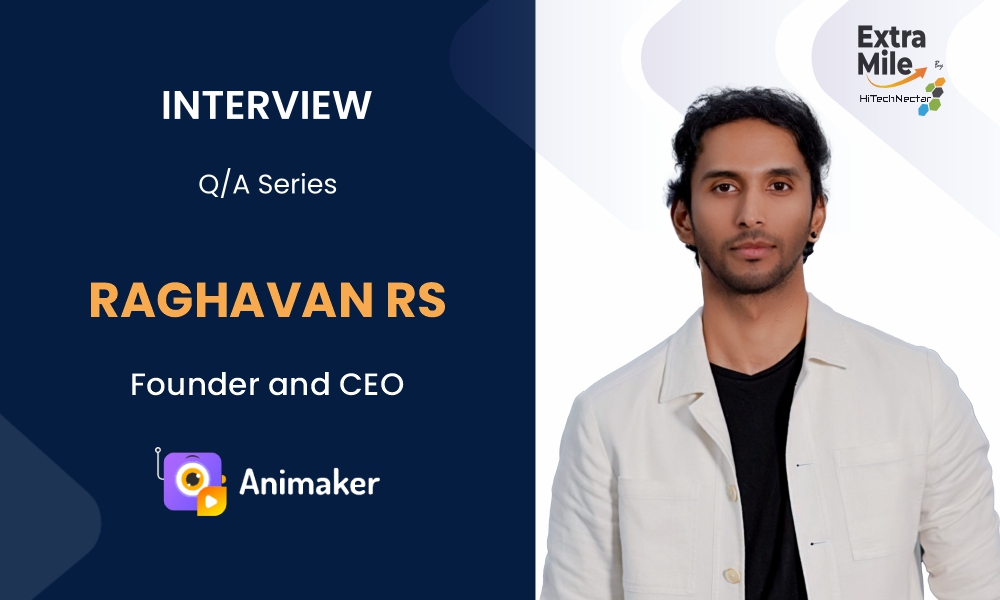
For today’s conversation, we are glad to feature Raghavan RS, Founder and CEO of Animaker, a pioneer of AI-powered creative technology. Animaker supports individuals, educators, enterprises, and marketing teams with professional-quality video creation.
Whether animation or live-action videos, Animaker helps you create them all in just a few simple steps. With over 25 million users, Animaker is one of the leading platforms for AI-powered video creation. Let us understand the firm’s founding story from its founder. Alongside that, let’s discover how AI-powered creativity is changing the way individuals and organizations strategize their marketing plans.
Welcome, Raghavan; it’s a pleasure to host you today!
Q1. You’ve been passionate about technology since your teens. How has the tech world changed over the years, and which innovations have excited you the most?
Raghavan: I’ve been fascinated by technology since my teenage years, and what amazes me most today is not just what is being built, but how fast the world is adopting it.
If you look at the timeline of major breakthroughs, the acceleration is unbelievable. Personal computing began around 1971 with the first microprocessor, but it took nearly two decades to become mainstream. The World Wide Web, invented in 1991, took about 15 years to become truly global. The iPhone, launched in 2007, reshaped human behavior in under five years.
And then came ChatGPT in 2022, which crossed 100 million users in just two months, and became mainstream in less than a year.
That comparison tells us something powerful: the cycle of innovation is shrinking dramatically.
Every new generation of technology is:
- reaching the world faster,
- scaling to billions quicker, and
- changing behavior more deeply than the last.
What once took 20 years now takes 2–3 years, sometimes even weeks.
The innovation that excites me the most today is clearly AI, not just because it’s powerful, but because it’s becoming an “operating layer” for everything – content, education, business workflows, and decision-making. We’re moving from technology being a tool in our hands to becoming a system that works alongside us and soon, acts on our behalf.
And that, I believe, is the most transformative shift we’ve seen in decades.
Q2. Raghavan, it’s been over a decade since you founded Animaker. What inspired you to start the company, and what has your journey been like?
Raghavan: For me, Animaker started with a very simple belief: every human being is a creator.
I’ve always been excited by the idea of making a creator’s life easier. In every person’s head, there are thousands of ideas – ideas that can become an animation, a marketing promo, a training module, a story, or even an entire course. The problem was never imagination. The problem was access.
When I started out, creating a single professional video project could easily take 3-4 weeks. And building a full learning course often took 3-6 months, involving expensive tools, complex production processes, and multiple specialists.
That gap between having an idea and bringing it to life was what frustrated me and that frustration became the inspiration behind Animaker.
When we launched Animaker, the DIY wave was just beginning. And once that mindset took off, something powerful happened: what used to take weeks started happening in days. Creators no longer needed a studio, a big budget, or a large team.
Now, with AI becoming a core part of the workflow, we’ve entered an entirely new era. What once took days can now happen in hours, and what took weeks can now happen in minutes.
The journey has been intense, full of learning, experimentation, and reinvention. But it has also been deeply rewarding because we’re building something that truly empowers people.
At every stage, the mission has stayed the same: help creators turn their ideas into reality faster, simpler, and at a scale that was previously impossible.
Q3. AI is transforming diverse industries. How does AI-powered video creation help content creators stay flexible and meet growing demands?
Raghavan: AI-powered video creation is transforming the industry in a fundamental way: it is shifting the advantage from ‘those who know editing tools’ to ‘those who understand communication, storytelling, and business outcomes’.
Traditionally, video production depended heavily on specialists who knew complex software. But knowing how to operate a tool is not the same as knowing what makes content effective – what drives engagement, learning retention, conversions, or trust.
AI is now removing that execution barrier.
For businesses, this is a major breakthrough because it enables teams to create high-quality video content at scale without being constrained by production cycles, large budgets, or dependency on external agencies. Marketing teams can respond faster to campaigns, L&D teams can build training content more quickly, and product teams can create explainers or onboarding videos without waiting weeks for delivery.
In other words, AI is making video production more agile, closer to how businesses already operate today.
The biggest value AI brings is speed, consistency, and scalability. What used to take days or weeks can now be produced in hours, enabling organizations to keep pace with rapidly changing customer expectations and market trends.
However, the real competitive advantage will come to businesses that combine AI capabilities with strong creative and strategic thinking. The teams that understand both “how to use AI” and “what good content should achieve” will stand out.
In the next phase of the digital economy, video will not just be a marketing asset – it will become a core operational tool for communication, training, sales enablement, and customer engagement. And AI will be the engine that makes it scalable.
Q4. Can you tell us about the Animaker AI Marathon? How is it helping speed up the launch and adoption of new AI tools?
Raghavan: The Animaker AI Marathon is really the outcome of several internal experiments we’ve been running over the last couple of years. As AI has evolved, we realized that software development is becoming increasingly democratized, almost anyone can build and launch something quickly today.
But that also creates a new challenge: when everything is easy to build, it becomes harder to identify what is truly valuable. The differentiator is no longer speed alone, it’s the quality of the idea and the craftsmanship behind execution.
That’s where the Animaker AI Marathon comes in.
It is designed as an innovation sprint, but with a strong focus on depth, detailing, and real-world usefulness, not just launching “yet another AI tool.” Every project that comes out of the Marathon is built with significant research, experimentation, and product thinking, so it’s not just a prototype, it’s a polished experience.
What makes it unique is that we take a slightly brutal but practical approach to innovation. We build fast, but we also validate fast. If a product doesn’t show real traction or impact, we redirect energy to the next opportunity.
In many ways, it’s the opposite of the traditional MVP mindset. Instead of releasing something half-finished, we try to build a high-quality product rapidly and then let the market decide its future.
This approach has helped us speed up both the launch and adoption of new AI tools, because what we release is already designed to be usable, scalable, and relevant from day one.
Q5. What were some of the key challenges you faced while establishing Animaker, and how did you overcome them?
Raghavan: One of the biggest challenges we faced while building Animaker and honestly, one of the biggest challenges for any entrepreneur is this: how do you enable ordinary people to do extraordinary things?
That sounds simple, but it’s incredibly hard in execution.
In the early days, we realized that many products fail not because the technology is weak, but because the product is built for “power users” instead of real users. When a team is filled with highly talented or highly technical people, there is a natural tendency to assume customers think the same way. They end up designing for themselves, not for the everyday creator, marketer, teacher, or business owner who just wants the job done.
For Animaker, the challenge was to build a platform that could deliver professional-quality output, but still feel intuitive enough for someone using it for the first time.
We overcame this by obsessing over simplicity. We focused heavily on user behavior, feedback loops, and product design that removes friction at every step. We treated ease of use as a competitive advantage, not as an afterthought.
Because in my view, great companies don’t win by being complex. They win by making big, powerful things feel simple.
And that philosophy shaped not just our product, but our culture and how we build everything even today.
Q6. With over 15 million users, how do you keep Animaker relevant and useful for such a wide range of needs?
Raghavan: It is over 25M, and it is hard. Honestly, keeping Animaker relevant to such a wide audience is hard. The truth is, we’re not perfectly relevant to all users all the time, and I don’t think any product can be. At that scale, user needs become extremely diverse, and trying to satisfy everyone equally can actually dilute what makes the product valuable.
What we’ve learned is that relevance comes from focus. Our mindset is simple: solve 100% of the problem for a few key personas rather than solving 50% of the problem for everyone. We’re actively working on going deeper into specific workflows – like marketing, education, and content creation so Animaker becomes a core tool, not just a feature-heavy platform. It’s a constant balancing act, but that’s the direction we believe drives long-term adoption and meaningful impact.
Q7. Realism is a big challenge in AI-generated videos. How do you train your models to create more lifelike animations?
Raghavan: Realism in AI-generated video is definitely one of the hardest challenges, but the good news is: it’s improving extremely fast. Its following a Moore’s Law-like curve – every year the quality leap is noticeable. So I have no doubt that AI-generated video will soon match, and in many cases surpass, what most designers can produce manually. It’s not a question of if, it’s a question of when.
That said, our focus is not on trying to build every model or solve every realism problem ourselves. We follow a simple rule: train deeply in the areas we are strong at, and collaborate or integrate with partners where others are better. Instead of chasing perfection across everything, we carefully choose the models that align with our engine and product workflows. We continuously track new research papers in those domains, and we optimize both the model and the training data in parallel because in AI, better data is often as important as better algorithms.
Q8. How has AI boosted creativity for video creators and editors? What do you see as the future of AI in video production?
Raghavan: AI has boosted creativity by removing the biggest bottleneck in video production: execution. Today, creators can generate visuals, voiceovers, animations, and edits faster than ever before. But I think creators should look at AI in a different way. Assume you’ve suddenly hired the world’s best designer. Do you have the right creative thinking to make that talent useful? Because even in filmmaking, you can have an extraordinary cinematographer, but if the story is weak, you’ll never create a blockbuster.
That’s why I believe the real advantage in the future won’t belong to people who simply know how to use tools. It will belong to people who understand design, storytelling, and audience psychology. We also need to stop obsessing over what an average prompter can generate and start focusing on what they still can’t do: refine taste, spot what’s wrong, and elevate average output into extraordinary output. A great parallel is coding.
Today anyone can generate code with AI, but not everyone can read it, debug it, or improve it. Similarly, AI will democratize video creation, but the creators who truly win will be the ones who can differentiate between average and great, and use AI as a multiplier to build something remarkable.
Explore Our Other Insightful Interviews: