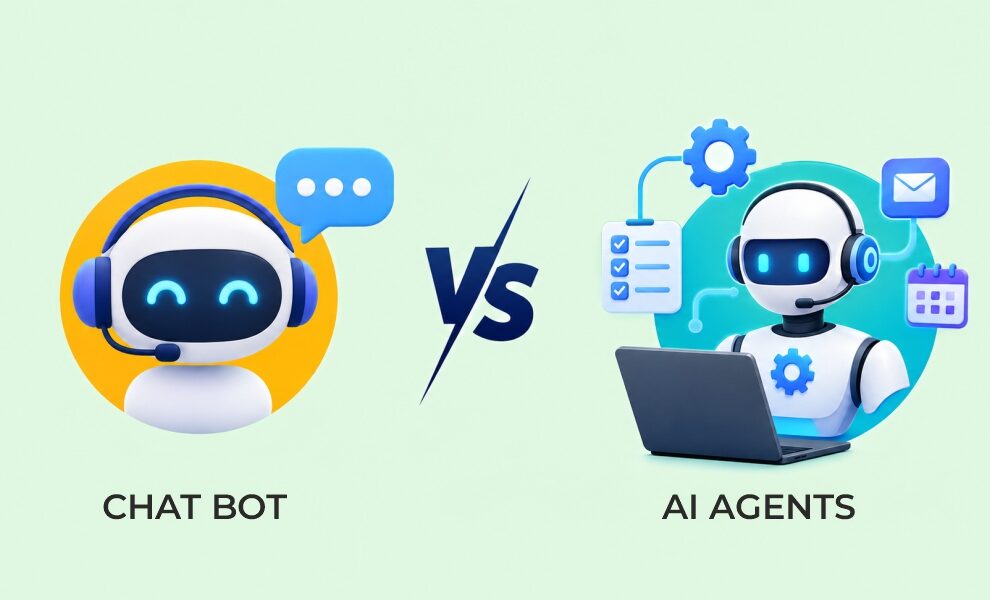
In the world where AI is booming, AI agents vs. chatbots are becoming a common topic of discussion. Chatbots, which have come a long way to answer customers’ questions. Whether in sales, marketing, or IT, a chatbot aims to address several customer needs.
On the other hand, AI agents are a new generation of intelligent automation tools used to complete specific tasks. They are designed to think, plan, and complete multi-step AI reasoning with intelligence and flexibility. The conversation is now shifting from traditional chatbots towards AI agents, that can perform more complex tasks efficiently.
Even though both these AI-powered technologies aim to streamline communication, they come up with certain capabilities, use cases, and more. Get to know the key differences between AI agents and chatbots, alongside their benefits, types, and use cases in this blog. Let’s get started.
What are AI Agents? The Autonomous Digital Worker
An AI agent is an autonomous agent capable of performing complex tasks and making decisions with less human intervention. Unlike traditional chatbots that require the right keyword, an AI agent understands the user’s intent.
Whenever a user assigns a task, it figures out the steps, executes them across the systems, and verifies the output. These autonomous AI agents can integrate with API-driven external tools and systems to automate tasks, retrieve information, and update. They automate complex tasks such as HR, finance, IT, and more.
The AI agents are powered by Large Language Models (LLMs), Machine Learning (ML), and reasoning.
What Makes an AI Agent Stand Out?
- Improves productivity: AI agents help to improve productivity by automating repetitive tasks while handling complex workflows.
- Support business operations: They serve as an asset for supporting entire business operations, not just isolated customer conversations.
- Improved accuracy: Agents can examine output on their own, find issues, and correct errors. This helps to deliver improved accuracy in overall business operations.
- Cut costs: AI agent automation can significantly reduce operational expenses.
- Scalability: One of the key benefits is that AI agents can scale to meet the growing demands of complex tasks.
What is a Chatbot? The Conversational Assistant
A chatbot is basically a conversational tool designed to interact with users and tackle basic inquiries. It uses predefined rules, decision trees, and scripted responses for user interaction. Chatbots are programmed with specific rules or trained on datasets, allowing them to handle predefined tasks or answer questions within a limited scope. Organizations mainly use chatbots for:
- Customer support.
- Order tracking.
- Frequently asked questions.
- Routing support tickets to the right queue.
- Offering self-service for common questions.
Even though chatbots have the same conversational interface as AI agents, they do not understand language in the same way LLMs do.
What Makes Traditional Chatbots Stand Out?
- 24/7 Availability: AI chatbots work around the clock, delivering customer support and resolving queries.
- Increase employee efficiency: Chatbots can help automate repetitive customer queries, thereby enhancing employee efficiency. This way, employees can focus on the tasks that matter most.
- Improved customer engagement: AI chatbots communicate with customers in natural language. By answering FAQs, providing support, and recommending products in real time, chatbots are here to enhance customer satisfaction, loyalty, and improve conversion rates.
Agentic AI vs Traditional Chatbots: Entering the New Generation of AI
Agentic AI vs. chatbot is one of the most commonly used terms today. Agentic AI is a system that can act on its own towards a specific goal. On the other hand, traditional chatbots are generally conversation focused. Thus, Agentic AI is ushering in a major shift, leaving traditional chatbots behind. According to Gartner reports, by 2029, agentic AI will autonomously resolve 80% of common customer service issues without human intervention.
AI Agents vs Chatbots: How are they Different?
Agentic AI and AI both use artificial intelligence to help businesses and individuals. They are designed to understand what we say and take action accordingly. Below is the side-by-side comparison.
Parameter |
AI Agent |
Traditional Chatbots |
| Key message | Achieve a specific goal or complete a particular task |
Respond to users’ questions |
| Technology used | AI/LLM powered. Mainly uses neural network |
Rule-based and scripted flow |
| Context handling | Multi-turn, context-aware conversations |
Limited to single interactions |
| Personalization | Highly personalized actions | Limited scope of personalization |
| Tasks | Complex, multi-step workflows | Limited, simple step workflows |
| Outcome | Delivers a complete piece of work | Delivers an answer |
| Supervision | Can operate autonomously with human checkpoints |
Human involvement depends on the workflow and escalation rules |
When to Use Which Platform?
The explanation below provides an overview of which platform to use when.
- AI Chatbot Use Cases: Answering customer queries. The interaction is conversational, which includes FAQs, support, and more. A human will be involved in acting.
- Agentic AI Use Cases: Completing a multi-step complex workflow. This approach works well when the volume is high. You want outcomes with human review rather than performing every step. Works best for HR portals, ERPs, CRM, and more.
Will AI Agents Replace Chatbots?
AI agents are a significant leap in automation; however, they won’t replace chatbots. When it comes to AI agents vs chatbots, for most companies whose primary objective is to address customer queries and who are on a budget, chatbots are an ideal, cost-effective option. However, with the advancements in AI capabilities, there is an emergence of agentic AI, or AI agents, that can complete tasks autonomously.
AI agents will not completely replace chatbots; rather, these two technologies will coexist. Alongside this, AI agents won’t replace chatbots, but they will surely help improve and work on complex tasks that chatbots failed to do.
Final Lines on AI Agents vs Chatbots!
AI chatbots have been working as a help center, answering customer questions, routing support tickets, and more. However, AI at work has now gone beyond this scenario with AI agents that act as digital workers who think, act, and complete tasks on their own. The shift is creating growing interest in autonomous AI agents that can act on your behalf and enhance enterprise environments.
After all, even though both these platforms are a part of artificial intelligence, they differ in the above aspects mentioned. Hope the blog has cleared your doubts regarding AI agents and chatbots.
Read more informative blog posts about the tech landscape on our website.
FAQs
Q1. In which scenario is a chatbot most suitable?
Answer: A chatbot is ideal for tasks such as customer support, FAQs, simple queries, guiding users through a particular process, and more.
Q2. Can traditional AI chatbots and AI agents work together?
Answer: Yes. Both can work together; effective deployments use a chatbot as a conversational interface, whereas agents serve as the execution engine. The choice between a chatbot and AI agents comes down to context, governance, and outcomes for your business needs.
Recommended For You:
How AI Agents and Assistants Shape Our World Differently
How Does Natural Language Processing (NLP) help Chatbots?