ExtraMile by HiTechNectar is a top-class interview series featuring tech leaders and innovators around the world. We aim to bring expert-driven perspectives to help professionals and learners stay ahead of industry trends.
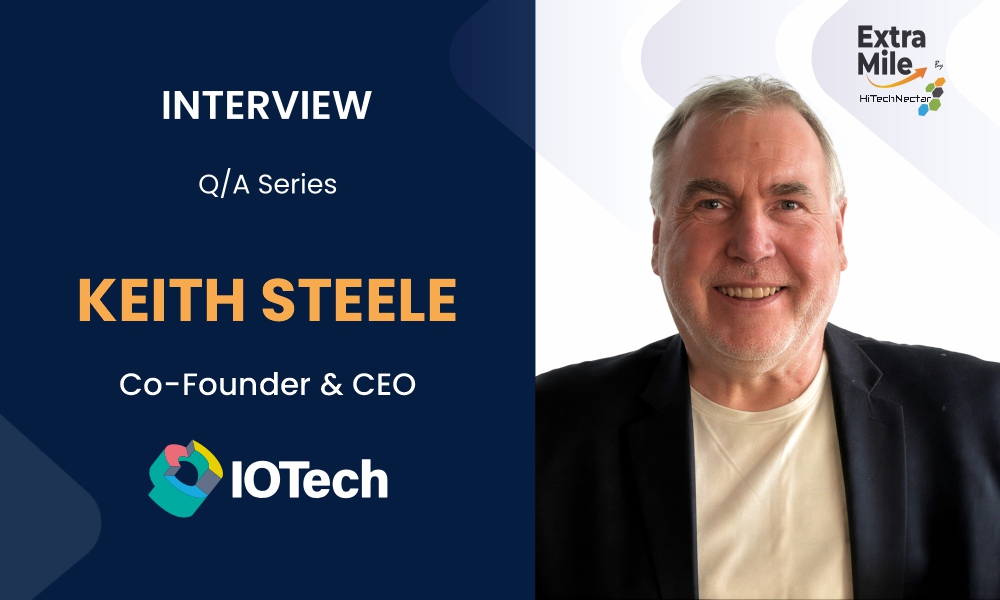
For today’s session, we’re super ecstatic to feature Keith Steele, Co-Founder and CEO of IOTech Systems, a renowned and global leader in edge computing. The firm delivers solutions that allow businesses to deploy AI-driven apps, connect devices, and manage data with confidence.
With over 35 years of experience in building and scaling technology companies, Keith has been instrumental in driving IOTech’s growth into a globally recognized leader in edge computing software and management solutions.
In this insightful session, Keith walks through his career journey and the evolution of edge computing. He further discusses IoTech’s Edge Central platform, edge AI adoption, and the role of edge computing in industrial transformation!
Welcome, Keith; it’s a great pleasure to have you here today!
Q1. You started your career with Texas Instruments and, since then, held dynamic CEO roles at multiple organizations. Could you take us through this growth-driven career journey? How has it evolved?
Keith. Yes, that’s right. My career began at Texas Instruments, working in the early days of real-time and embedded systems. That environment provided a strong technical foundation and exposure to complex engineering challenges.
Over time, my roles expanded through sales and leadership responsibilities, leading to CEO positions within multiple software and technology-focused businesses.
What’s been most striking is not just how my career evolved, but how the industry itself evolved. Earlier in my career, companies were largely focused on delivering standalone products or bespoke solutions. Today, success is increasingly defined by building open, interoperable platforms that can seamlessly be deployed and adapted over time to integrate with diverse partners, devices, and applications, to support long-term digital transformation strategies.
That shift is particularly visible today with the rise of edge AI. As AI models become more operationally critical, the market is clearly moving toward deploying intelligence closer to where data is generated and decisions are made. Latency, resilience, privacy, and bandwidth considerations are making edge-native architectures increasingly essential.
Leading IOTech Systems reflects this broader transition. Our focus is not just on software capabilities, but on enabling a platform that allows organizations to operationalize industrial data and AI at scale.
Q2. You’re exceptional at delivering real-time systems for Fortune 500 companies across business-critical sectors. What leadership and engineering principles are non-negotiable in this regard?
Keith. In mission-critical and high-reliability environments, predictability and consistency are paramount — both in the software we deliver and in the relationships we build with customers.
Across my companies, the non-negotiables have consistently been clear customer requirements, maintaining architectural discipline, and then implementing rigorous testing, QA, and validation processes that are essential for delivering reliable software for industry. Real-time systems tolerate very little ambiguity, which is why IOTech places such a strong emphasis on robustness and performance consistency at every stage.
Equally important are the organizational principles that support our engineering excellence. Transparency, accountability, and cross-functional collaboration are essential. Strong technology alone is never sufficient; our teams must deeply understand operational realities and customer priorities.
Customer success has always been my defining metric. Delivering reliable solutions that integrate with operational workflows ultimately determines the impact and credibility of our businesses.
Q3. Could you share how IOTech’s Edge Central simplifies the creation, deployment, and management of industrial edge systems compared to traditional edge platforms?
Keith. Traditional edge solutions often require significant custom integration — particularly around device connectivity, data acquisition from sensors, and integration with upstream IT and cloud systems. This introduces complexity and frequently leads to long deployment cycles.
Edge Central was designed specifically to address these challenges. By providing a modular, microservices-based platform that standardizes connectivity, data normalization, and secure data delivery to cloud and enterprise IT systems, IOTech enables organizations to significantly reduce engineering overhead.
Instead of repeatedly solving foundational infrastructure problems, customers can focus on delivering operational value and scaling their deployments predictably.
This becomes even more critical as edge AI adoption accelerates. AI systems depend on consistent, high-quality, and contextualized data streams. Edge Central provides the reliable data foundation needed to operationalize AI at the edge and support real-time analytics and autonomous decision-making without adding architectural complexity.
Q4. From your perspective, will 2026 be a tipping point for large-scale AI deployment at the edge? What’s your take on this?
Keith. Yes, we’re approaching a clear inflection point for sure. AI models are becoming more efficient, hardware capabilities continue to improve, and organizations increasingly recognize the limitations of cloud-only strategies.
What we’re seeing at IOTech is a decisive shift from experimentation to operationalization — deploying AI where latency, resilience, and real-time decision-making truly matter.
Rather than asking whether AI belongs at the edge, organizations are now focused on how quickly they can scale these deployments reliably, securely and with actionable, real-time insights.
Q5. Can you share real-world use cases where IOTech Edge Central has helped organizations turn raw industrial data into actionable insights?
Keith. Across IOTech’s customer base, we see consistent patterns of value creation.
In energy, Edge Central supports systems like large-scale Battery Energy Storage Systems (BESS) by providing a site-wide view of all real-time data acquired from the power equipment. This consolidated visibility helps operators make informed decisions, optimize performance, and improve efficiency across the entire site.
In manufacturing, it enables production monitoring, quality analysis, and workflow automation, while integrating diverse OT systems and analytics tools into a single manageable platform.
In building automation, Edge Central presents a common operational view of a building regardless of the underlying Building Management System (BMS) vendor. Facilities teams can monitor, analyze, and act on building data consistently, even in environments with multiple disparate systems.
But in each case, the value comes from transforming fragmented data from a multitude of different OT devices into normalized, contextualized information streams that analytics and AI systems can readily consume to produce actionable insights and operational improvements.
Q6. How does IOTech’s collaboration with OEMs, ISVs, and SIs strengthen the IoT supply chain across several industry verticals? What value does this ecosystem deliver to end-customers?
Keith. Industrial digitalization is inherently collaborative. OEMs provide devices, ISVs deliver analytics, and SIs integrate solutions into operational environments.
IOTech’s platform acts as a unifying layer that reduces integration friction for everyone and enables partners to work together efficiently through a single, interoperable platform.
For end-customers, this means faster deployments, lower risk, and greater architectural flexibility. They can adopt a broad set of compatible technologies and services without vendor lock-in, enabling truly connected and open industrial operations.
Q7. What are the most prominent challenges organizations face when managing and operationalizing industrial data at the edge? Could you list here a few?
Keith. Common challenges include:
- Integrating heterogeneous legacy systems
- Managing distributed infrastructure at scale
- Ensuring security across OT/IT boundaries
- Handling intermittent connectivity
- Maintaining performance under real-time constraints
These challenges are fundamentally about reducing complexity for the user, while providing reliability and operational continuity. Edge Central is designed to address exactly these problems. It delivers a common platform that organizations can leverage to simplify, secure, and scale their edge operations.
Q8. With the launch of IOTech’s new Edge Alarm Service, which industries would benefit from it the most?
Keith. Any sector where timely detection and response are critical will benefit — including manufacturing, energy, utilities, transportation, and building automation.
Alarms are fundamental to safety, efficiency, and regulatory compliance. An edge-native alarm capability enables faster response times, reduced dependency on centralized systems, and improved operational resilience.
Equally important is delivering normalized, contextualized alarms to the operators and systems responsible for acting on them. The Edge Alarm Service ensures that alarms are surfaced to the right personnel or systems in real time, enabling faster, more accurate operational responses. This becomes even more critical as AI and automated decision-making are integrated at the edge.
Q9. Finally, how do you see edge computing, particularly real-time and mission-critical systems, redefine the industrial digital transformation?
Keith. Edge computing is foundational to industrial digital transformation because it aligns intelligence directly with business operations.
Real-time systems at the edge enable faster decisions, greater autonomy, and more resilient architectures. Rather than replacing the cloud, edge computing complements it — allowing analytics, automation, and AI capabilities to operate closer to where data is generated and actions are taken.
As AI adoption accelerates, this architecture becomes even more important. AI delivers the greatest value when it operates within real-world constraints — where latency, context, and immediacy matter. Edge computing provides the environment where intelligence can translate directly into operational outcomes.
Ultimately, industrial transformation is moving from centralized decision-making toward distributed, intelligent systems. The edge is where much of that transformation is now taking place.
Explore Our Other Insightful Interviews: