

Host: Welcome to an all-new episode of ExtraMile by HiTechNectar interview series featuring industry leaders and trendsetters. In every session, we assess innovations impacting diverse industries.
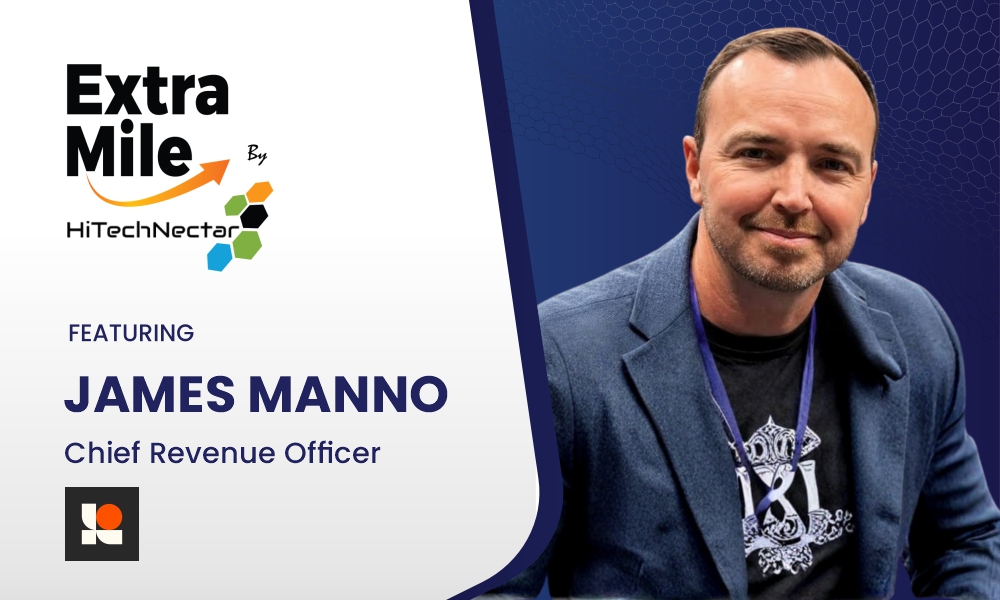
I’m your host, Rittika, and in today’s conversation, we are pleased to feature James Manno, Chief Revenue Officer of Level AI, an AI-powered CX platform. As a leader in customer analytics and insights, the firm analyzes over 10 billion customer interactions yearly. Level AI combines AI with human intelligence to meet the CX needs of businesses. James is a seasoned professional with contributions across GTM, sales, revenue, and others.
He joined Level AI recently in June after leading Qualtrics’ sales strategy for over nine years. So, let’s dive into AI-powered customer intelligence, Level AI’s real-time agent harness architecture, revenue strategies, and more.
Hello James, glad you could join us today.
James: Hey Rittika, thanks for having me. It’s great to be here.
Host: So, you joined Level AI recently after contributing to Qualtrics’ growth for 9 years. What changes are you aiming to bring to Level AI’s global revenue work as its new Chief Revenue Officer?
James: Yeah, great question. So, what excites me about Level AI is that it’s clearly proven that we can win, right? As mentioned in the press release, the company has tripled its strategic enterprise deals over the past year, quickly expanding into new global markets like the UK and Latin America, and continue to push the envelope as it relates to landing large customers, enterprise customers, and just phenomenal logos and partnerships.
So, it’s a testament to the product, the founding team, and the sales organization that’s been executing. So, my job, Rittika, is to build on that momentum and create the infrastructure for the next phase of scale, which I’ve seen at the last two stops in my career. So, I’m investing in pipeline generation as a core competency.
What’s exciting about this market and why I continue to work in it is that there’s so much opportunity because these CX principles, if you will, in the contact center and beyond, are must-have business challenges to solve. So, the team’s done a tremendous job in closing business. Now we’re going to add the muscle to systematically create more of it.
You’re giving every account executive the tools, the training, the expectations to build relationships and open doors. That’s how we create predictable compounded growth. Second, I want to raise the bar on deal execution and how we engage with customers throughout the entire lifecycle.
I believe that sales doesn’t end at the signature, right? It begins there, right? So every deal in our forecast has to be built on honest qualification. Is there a real problem that we can solve with the client? Is there a real decision with a timeline? Are we engaged with the right people?
Do we have the right relationships and trust? And can we genuinely win and deliver, right? So, to have those honest conversations early, take a consultative approach is the principles that I’ve followed my entire career.
And third is helping to operationalize the partner chain. So, continue to build on the strong relationships that we have and create strong co-selling motions because there’s so much opportunity and there’s so many folks that deliver value in the contact center specifically as a jumping off place. And that thread connects my main philosophy and goal is to not just close deals, but to build a customer base where every client is proud and referenceable.
So, where every individual in the project can point to outcomes that they’ve achieved at the personal level and where the partnership creates a measurable value for the collective good of their business. So that’s what sustainable revenue looks like to me.
Host: It sounds like a solid plan and it will be amazing to see how you execute it. So next up, why should organizations measure customer experience and how does AI-driven customer intelligence help in enhancing and measuring customer experience?
James: Yeah, this is important because organizations should measure customer experience because it’s the most reliable leading indicator of retention and revenue growth that they have. It’s not a nice to have. It’s why I can’t leave this market because it’s having such an impact.
It’s an economic signal, right? It’s what’s top of mind for all CEOs. You hear it come out in earnings calls nonstop, right? Across all industries. And when customer experience deteriorates, churn follows. When it improves, expansion follows.
I’ve watched this pattern play out across hundreds of enterprise accounts during my time, and the challenge has always been to measure it completely. But the standard was samples of data sets, right? Surveys was a good example of that.
Post-interactions, lower response rates, decisions being made, you know? So I think that’s where this multi-channel framework has been built. Or a QA team that manually scores a small subset of calls. We see that all the time. But making large, expensive business decisions on a subset of that data is risky, right? And AI-driven customer intelligence, by using Level AI, changes the math entirely, right?
And instead of sampling, you capture and analyze every interaction. Every call, every chat, every ticket. You’re not just extrapolating from a fragment.
You’re reading the whole signal. And you can act on what’s happening now, you know? And this is exciting for CIOs, CTOs, CEOs alike.
So, great question. And these are, you know, there’s a lot of focus on technology within the contact center and what the AI can do. But what I’m really excited is continuing to push the team to think about how that impacts every layer of management, and especially the C-suite.
Because there’s direct hardwire from these principles to their KPIs that they’re measured on every year.
Host: Measuring customer experience, surely offers a clear picture of what an organization is doing right and what it’s doing wrong. And AI is…
James: Sorry. You know, the technology enables, right? And the humans will deliver.
Host: Yeah. So, moving ahead. As you stated, most AI in contact centers still work the old way.
When did you realize the traditional survey model was fundamentally broken? And what would be your approach to fix it?
James: You know, I wouldn’t say that the survey model is broken, per se, right? I’d say it was the best tool that we had for a generation. Now we just have something to build on top of.
You know, spending nearly a decade at Qualtrics, you know, helping enterprise CX organizations build world-class survey and feedback programs was meaningful work that mattered to me, right? It gave companies a structured way to listen to customers for the first time at scale, you know? But as AI evolves, naturally, the market is creating new opportunities.
And I remember working with large, you know, customers in travel hospitality space, and they’d have sophisticated listening programs and channels. But what’s exciting is that having an emphasis in the contact center is where there’s so much telemetry and data that can quickly impact the business, right? And again, it’s those business drivers that are top of mind to so many executives around, you know, ramp times for certain agents, churn turnover, handle time, conversion rates.
I mean, these are, there’s so much savings that’s hidden within the operations and embedded within the contact center. And what’s exciting for me is to be able to take my experience and leverage the contact center as a springboard with that focus and with the AI conversational layer and help evolve the CX methodologies across multiple departments in the organization as a whole. So, you know, that’s where capturing conversations in the moment, right, in an unfiltered structure in a real way, have tremendous amount of value.
That’s what Level AI delivers. Every signal into a single intelligence layer, calls, chats, tickets, surveys, responses, you name it, any channel, reviews to record the customer truth, you know, quality management, coaching, POC, automation that all draws from the same record or same profile. So, we’re not replacing what came before us, essentially, it’s, you know, completing the picture and having a new cutting-edge emphasis on the contact center as a way to help the broader organization.
I mean, these are topics that are near and dear to the hearts of COOs, CEOs, CFOs alike, right? And that’s where I get excited to partner with those folks. And, you know, I’ll add this again, right?
Regardless of how sophisticated the AI becomes, the companies that win in CX will be the ones that pair the intelligence with no genuine care for the customer relationships, right? Data will tell you what’s happening. The human judgment and the empathy will tell you what to do about it and take an action on it.
That’s what the humans need to and expect to rely on these systems to do. And that’s what the best CX organizations that I’ve worked with in my past are doing and outpacing their competition. So, I don’t want to lose sight of that.
Host: Yeah, traditional methods often fail while keeping up with the evolving tech and changing audience behavior. And your approach surely aligns with this changing industry. Level AI uses multiple small, specialized models instead of one massive model. So, why is relying entirely on giant LLMs a trap for software vendors?
James: Yeah, it’s, you know, giant LLMs are extraordinary general-purpose tools and they’ve unlocked capabilities that clearly weren’t possible two years ago. I think it’s fascinating that in a world where the consumer or the individual like us, you know, have expect the prompting generation to be so convenient. It’s only natural to focus and believe that those same expectations are going to be, you know, taken to the business environment, right?
So, the AI boom has obviously created genuine breakthroughs that everyone’s excited about. But Enterprise CX is not a general-purpose prop, right? The vendors that treat it that way will hit a wall, you know?
The challenge is threefold, right? It’s accuracy. It’s a single massive model averaging across billions of parameters that will produce sound outputs that sometimes may be wrong or with domain-specific context.
And in a contact center, you know, subtly wrong means compliance violation. It means things go undetected or agents gets coached on something that they actually did correctly. So, attrition will spike.
The cost of those errors are very real in the contact center. So not just the business, but the individual agent as well whose performance review is based on that score potential, right? So second, I’d say latency and cost.
If you’re running agent assist tools, giving agents live guidance during a customer call, you can’t afford for inputs time or compute cost or routing. You know, every request through a massive model to impact that, right? Small, specialized models tuned for specific tasks respond faster, they cost less, and they perform better on those purpose built tasks, right?
Third is control. Enterprise needs to understand why the AI made a specific decision, especially in regulated industries, right? Specialized models give you transparency, they score compliance, they detect sentiment, again, the heartbeat of the organization, and they identify the real customer issue.
So, you can audit each one. But, you know, with a large, monolithic LLM, for lack of a better term, you know, you can get an output that can’t trace the reasoning in a way that, you know, satisfies an individual industry regulator of compliance. So, what I’m proud of Level AI, and again, why I cannot be more excited to be here, is that our engineering team has made the architectural decision early for purpose-built models for each task orchestrated by a platform that knows when to use which model, right?
And again, this is completely unique to Level AI. And that foresight from Sumit and Ashish and others on the founding team, who have been doing this for almost a decade, way out ahead of these large, monolithic LLMs, as I described it, is one of the reasons, one of the main reasons why I joined, right? I mean, product prowess and applicability and performance is something that I’m sensitive to, and something that I would not take for granted in my next role, right?
So, you know, I’d say this, right, that no matter how good the architecture is, right, we have to make sure that we build trust early with the clients, and then we deliver, and the technology has to work. And that’s what’s really exciting about Level AI, because we’ve proven that at scale.
Host: Absolutely. And Giant LLM surely offers a generalized approach, while a specialized model helps adopt a tailored approach. So that’s why Level AI is doing, which is quite fascinating.
So, moving further, Level AI’s real-time agent harness architecture powers AI for enterprise-grade CX. Which key components make this approach successful?
James: So, I think there’s three, again, stick to this theme here, right? I think there’s three components that matter most. And they reflect decisions that were made by the engineering team, you know, that are generally, I believe, differentiated in the market.
The first is the orchestration layer, right? The ability to route the right AI capability to the right moment in real-time. During a live customer call, an agent might need, like, a knowledge-based retrieval.
The first 30 seconds, a compliance prompt with a two-minute mark and an auto-summary type of thing. The moment the call ends, right? Each one of those tasks require a different model with different latency requirements, and that harnesses and manages the routing.
So, agent experiences are seamless and it’s not disconnected, right? The second is reliability at an enterprise scale, right? Real-time AI in the contact center means processing thousands of concurrent conversations and sub-second response times.
I mean, if the system’s slow, agents will ignore it. If it hallucinates, agent won’t trust it. And if it goes down during peak volume, the entire operation is affected, you know?
And if you think about some of these large EPOs or, you know, large B2C companies, that is not an option, right? So, our engineering team, you know, built this production standard from the beginning, and it’s what differentiates us, right? It’s why customers like, you know, Smartsheet and Empyrean trust us in their live environment, you know?
And the third is the closed feedback, right? Something that, you know, I’ve been working on for many years is it’s the same architecture that powers real-time agent assist, also feeds in QA, coaching, voice and customer analytics. Every interaction that harnesses that training data makes the next interaction better.
That loop, the assist, the measure, the coach, the improve is what turns AI from a feature into a system of continuous improvement. So, there’s a lot there, but, you know, getting a little bit more technical, those are the call-outs I would make.
Host: Yeah. Level AI is certainly advancing reliable AI deployments across enterprise-grade CX. Next up, does customer-led growth genuinely drive enterprise-grade GTM revenue or is just trust or not intent a real differentiator? How is that trust built and sustained?
James: Yeah, this is a question that I feel strongly about and I believe that I’ve carried through my entire career, right? There’s a tremendous excitement around AI right now and rightfully so. The capabilities are real, the potential obviously is enormous, but I’ve watched enough technology cycles to know that companies that win in the long run aren’t the ones always with the most impressive technology.
That’s a key component, clearly, but you need to build deep trust with your customers, right? Technology creates the opening and it’s, again, there’s a lot of focus there and it’s critical and it’s important. And all of those things like development cycles and roadmap and customer advisory boards are all table stakes, right?
But my focus as CRO and working with the go-to-market team is, you know, how building more trust, more credibility and creating those relationships. You know, in the mid-market and SMB, you know, customer-led growth can be driven by product experience alone, right? User tries the product, sees the value, fans, intent isn’t enough.
It can be highly transactional. But in the enterprise, you know, the buying committee has six to 12 people. The deal cycle is six to 12 months, right? I think we see that often depending on the size and depending on the use case, right? And the stakes are high. You know, I talk about this a lot, but making a technology decision in 2026 is scary.
You know, there’s not an opportunity to get it wrong and just have stranded value or shelfware like you could 10 years ago and then just buy the next one, right? People’s livelihoods are on the line and I take that very seriously, right? So, having honesty throughout the sales process, right?
If we can’t solve a customer’s problem, if we say early, hey, listen, you know, this feature isn’t ready, but we’re hearing it at scale and this is a top priority, we’re going to mean it, you know? And if the timeline doesn’t work for a certain customer, we’re going to acknowledge it, right? And, you know, that candor in enterprise sales builds trust, builds credibility.
I mean, there’s an old term that people say, you know, people buy from people they like. Well, yes, but they also buy from people they respect, right? And they trust. And that’s where my focus is. And that’s where I choose to help the most within deal cycles. And, you know, it’s at my core belief, right?
And it goes back to what I was saying about selling through the signature and thinking about long-term success and referenceable clients. You know, I love this question because it is the best sales professionals I’ve seen. This is inherent to them, right?
It’s not something that they learned. This is something that they were raised with, right? Or there’s something within their background or their careers or their families that have built them to have empathy and, you know, to think about helping the client before thinking about how the client will help them.
So, great question. This is one that gets me fired up.
Host: Yeah. So indeed, successful businesses always put their customers first, and that’s what exactly helps in gaining trust. So, moving ahead, the adoption of automated product-led growth models has increased remarkably.
But why does enterprise leadership remain hesitant to implement robust sales governance frameworks? And how does it impact the revenue system?
James: Yes. You know, this is top of mind, being early. I mean, with Level AI, right, you have to strike the right balance, you know?
And sometimes governance, especially in this quick, hot AI world where everybody’s moving faster than ever, right? Governance can feel like friction. And most revenue leaders like myself have spent two decades on thinking about how to remove friction, right?
There’s natural tension between moving fast and moving with discipline, however, right? I think, you know, growth stage companies especially resist governance because they associate it with micromanagement and bureaucracy, right? And I mean, the amount of AI founders that I’ve talked to over the last handful of months, I mean, this is one of the top, you know, top issues that come up for CEO, Founder, CTO.
It’s like, hey, we just raced to X amount of revenue. Now we realize, oh, we need some process around it and maybe some sales leadership, right? So, you know, approval processes, forecasting, deal review cadence, pipeline hygiene standards.
It feels like it’s slowing the team down, you know? And I have empathy for that resistance because I felt it myself, you know? It’s not hard for me to remember what I was like as a young SaaS sales professional, right?
Very focused on my clients and myself and not much else, right? So, when you have talented reps that are closing deals at scale and the instinct is to get out of their way, let them go as one of my old bosses used to say, I’ve also learned that across the last couple of decades that it’s the discipline and speed are opposites, right? Discipline is what creates speed at scale.
And my last company, I think that was the jump off point for going from a multi-hundred million dollar company to going upstream in the enterprise was creating unbelievable rigor and discipline, you know? Even the last person that I worked for was responsible for this and was there from the very beginning. And I saw his career rise because he’s one of the best I’ve seen create the foundation of discipline.
What was amazing is those people that he had an impact on early in their career, they became my best enterprise sellers because they had that muscle and that discipline, that time management, the time blocking, the focus, you know, to uncover every stone, to build their own pipeline. They were outselling the folks that had the most tenure in enterprise sales that were just used to chasing whales. Because again, the sales dynamic in 2026 is so different and the expectations and the trust and the relationships are so much harder to build, right?
So, you know, the best revenue organizations don’t experience governance as an overhead, they experience it as clarity. And when every rep knows exactly what qualifies a deal for each category, when deal reviews have a consistent framework, when pipeline is clean and honest and the entire system moves faster because everyone is working on the same reality, that’s when you start to hit go, right? And start to take that next level.
And governance also protects the customer, right? So, we can, when we’re honest with what’s going on, where the gaps are, the challenges that we may not be addressing, it’s a function that also keeps us accountable to the market. So, great question.
And something I’ll be talking about quite often, I think the next, you know, handful of months.
Host: Robust governance framework surely offers clarity. Last but not least, as a revenue leader, how do you handle the AI’s black box problem? And when do you trust the AI’s data? And when do you overrule it?
James: Practical question. Deal with it every day, it feels like, right? Both as a user of AI tools. You know, I remember, not to date myself, but I mean, I remember being like an email internet native. Now I need to ensure that I’m keeping up and I’m, you know, an AI native as well. So, I use all the tools and they’re phenomenal, specifically certain ones for business process tools and applications.
My framework is pretty simple, right? Trust AI for pattern recognition at scale and trust the humans for judgment in context. You know, I think about immediately, I think about forecasting deal reviews there.
I mean, the reality is there’s no database or prompt that can take away the thousands of deal cycles that I’ve seen. And the ability that I really lean on is to get a sense of how things are going in a cycle and be able to feel like where the gaps are and where the challenges are. And the buyers don’t buy technology that often.
I think that also goes, you know, not seen sometimes. It’s like if you, there’s not too many sophisticated business buyers, procurement, negotiation, sure. But like change management, sophistication on the business side.
No, I mean, for one, you know, a lot of the tools that they use for core infrastructure. I mean, these are projects that take years, you know, applications, right? You can only buy so many.
So, it’s our job to have the experience and help the buyer buy responsibly and help them understand, Hey, these are other pitfalls that I’ve seen. And these are the tools and the ways that you can help evangelize internally. Let me be a partner with you throughout that process.
And in turn, I want to focus on specific outcomes that will help you, will help you in front of your leadership team and will help the business overall. Right. And, you know, that’s where human judgment and that’s where, you know, human interaction within enterprise sales in context matters so much more than a large scale pattern.
Right. So, an AI model might flag a deal, you know, it’s high risk and have like, you know, engagement signals, fewer emails, longer response times, not a recent meeting. I might know the champion just received a promotion in the last 30 day transition.
Communication is slowed, and AI sees that pattern, which is great. It knows the story, but that judgment layer, and I don’t think this gets talked about enough, right. Is, is irreplaceable.
And, you know, I worry sometimes people that maybe have not been in the market for as long as I have may lose sight of that, you know, and I think that’s dangerous, you know, because it could be either extreme, but blindly trusting AI outputs without human review. It’s like a new type of sales rep loan. Well, you know, it’s almost promoting that behavior, which we know can be a bit scary at times, you know, because we need to win together or dismissing the insights because, oh, I know my business and I know the best approach.
It’s finding people. Again, I think that, you know, I’ve heard countless podcasts and articles, you know, sum up this AI boom in a simple way. It’s not going to replace some of these critical roles, but it’s going to allow people who adopt them and leverage them and study them to become the best versions of themselves.
And quite frankly, the people that don’t, you know, may get left behind and that applies to enterprise sales as well. So, it’s something that I’ve incorporated in my interviewing, in my evaluation of talent and something that’s critical as we move forward to be able to win at scale and help clients at scale.
Host: Yeah, totally agreed. AI can surely offer speed and scalability, but human judgment is crucial there. So, thank you, James, for joining us and sharing your perspectives on revenue strategies. Your takeaways on customer experience, AI-driven customer intelligence are operational and worth learning. It’s been surely an informative session. Thank you so much.
James: Thanks for having me. You know, these are all topics that I’m passionate about. So yeah, you got the blood pumping. I appreciate it.
Host: Yeah. And to our viewers, thank you for standing by and accompanying us in today’s exclusive session of ExtraMile by HiTechNectar. We’ll be back with more thought-provoking conversations across tech trends and breakthroughs. Until then, stay tuned.
Explore Our Other Insightful Interviews: