
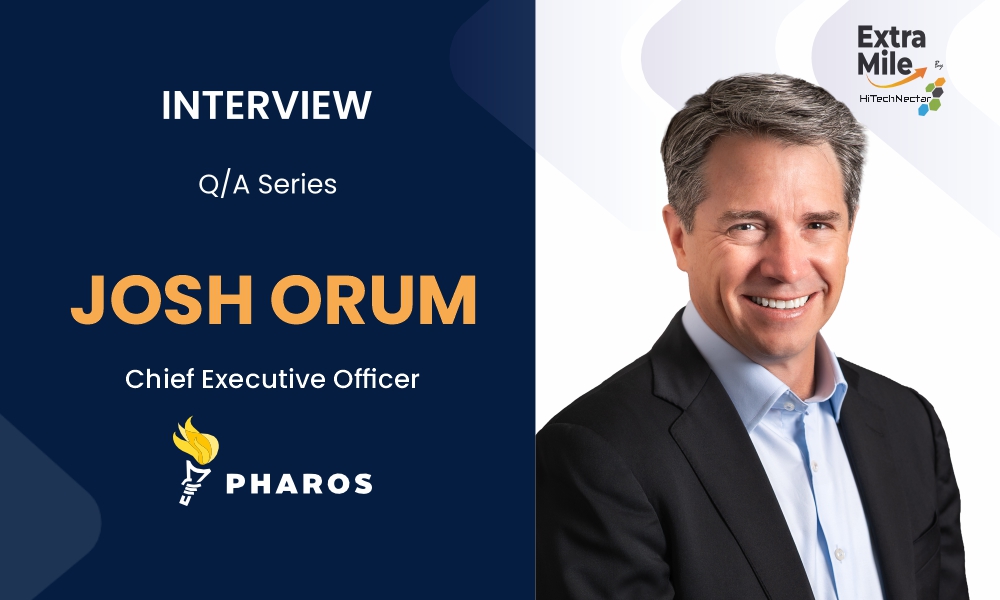
From technical topics to digital transformation and innovation, explore captivating conversations with inspiring industry changemakers through ExtraMile by HiTechNectar. Our interview series aims to empower everyone with tech insights that matter today and beyond.
For our latest conversation, we’re excited to welcome Josh Orum, CEO of Pharos, an enterprise technology company helping organizations modernize how printing is managed, secured, and operated across increasingly complex IT environments.
Our transformative leader today, Josh, brings more than 25 years of experience spanning startups and large enterprises. He focuses on helping IT and operations leaders modernize legacy systems without disrupting reliability. Josh champions the PrintOps movement and is a frequent voice on cloud modernization, operational resilience, and digital employee experience.
In this exclusive conversation, Josh discusses his leadership approach, challenges of modernizing legacy print infrastructures, the business value of enterprise print management, and insights about Pharos Cloud. He also highlights the approach to modernizing enterprise printing, the importance of cloud availability, and, lastly, how organizations can use AI and automation to enhance print operations while maintaining human oversight.
Don’t miss this value-packed conversation.
Dive in now and see how the printing era can be transformed into a secure, managed cloud IT service ideal for the modern workplace.
Q1. You have spent more than 25 years working across startups and large enterprises. How has your leadership approach evolved over the years, and what key principles do you prioritize today as CEO?
Josh. Early in my career, I was close to the work itself: solving the immediate problem, moving quickly, and making sure we delivered. That instinct still matters, and I love to dive into the details, but experience has taught me that leadership is less about having all the answers and more about finding great people and creating the conditions for good answers to emerge.
Today, I committed to two key leadership principles: humility and transparency. Humility to admit that I don’t have all the answers and transparency to create the environment where others can contribute them. These guide me in my interactions with customers, partners, and employees.
Q2. Enterprise IT teams often prioritize visible transformation projects, leaving legacy infrastructure untouched. How do you convince decision-makers to invest in systems that people only notice when they stop working?
Josh. I don’t start by asking leaders to modernize print simply because it’s old. I ask whether the infrastructure is still serving the business or whether it’s quietly consuming time, budget, and talent that could be applied elsewhere. It may appear dependable, but the servers, drivers, and devices behind it can create security gaps with components that are difficult to keep current, insecure connections, or sensitive documents that aren’t released securely. Because print is often managed separately or across various teams, those dependencies and risks can be easy to miss in the broader IT picture.
Once we make them visible, we can connect the work to priorities leaders already care about, like stronger security controls, greater resilience, fewer infrastructure components to maintain, and more IT capacity for strategic work.
We can then compare the status quo with a realistic, phased plan and agree on how to measure progress, whether that’s reducing infrastructure and manual support work, improving visibility, or bringing print into the organization’s security standards. People may not think about print every day, but they notice when it fails. The decision is whether to keep investing in complexity or simplify it and put that capacity to better use.
Q3. Josh, could you share a real customer implementation where modernizing print infrastructure delivered a measurable business outcome? What was the problem before the transformation, what changed, and which result surprised you most?
Josh. A great example where Pharos delivered a meaningful transformation was at one of the nation’s largest healthcare providers. With 30 facilities and more than 50,000 employees, they were looking for better control over office, clinical, production, and externally sourced printing costs. Pharos helped build a demand-based print strategy, used analytics to give the organization visibility into its environment, optimized and standardized the fleet, and introduced employee training and secure print workflows.
The results included a reduction of more than 40% in office print volume, a 55% reduction in device count, and more than $16 million in savings within five years; the project reached positive ROI in less than nine months. What stands out is how the improvements reinforced one another: better visibility supported better decisions, and the changes in fleet and employee behavior produced sustained savings alongside security and privacy improvements.
Q4. Pharos Cloud became available through AWS Marketplace in July 2026, giving organizations another route to procure and deploy its cloud-native print management platform. Beyond simplifying procurement, how could this change the way enterprise IT teams evaluate, deploy, and integrate print infrastructure?
Josh. Marketplace availability can make print easier to evaluate as part of an organization’s existing cloud strategy, rather than as a separate, unfamiliar procurement exercise. It gives teams another route to engage with the platform and can help align purchasing with established cloud governance and procurement processes.
The larger opportunity is a change in perspective. When print is evaluated as a cloud service, IT can ask the same questions it asks of other infrastructure: how it fits the security model, how it will be governed and supported, what operational data is available, and how it connects with existing workflows. Marketplace access doesn’t by itself complete an integration or modernization project, but it can lower friction to starting that broader conversation.
Q5. Pharos has recently been named a Leader in the 2026 IDC MarketScape for Worldwide Print Management Solutions. As the industry turns toward cloud-native platforms, what capability should enterprise buyers prioritize that traditional print management assessments might miss?
Josh. Look beyond whether a product has a cloud option. Ask whether the architecture is genuinely designed for cloud operations, and whether it reduces the infrastructure and administrative dependencies you are trying to leave behind. A hosted version of a legacy model may move the location of the servers without changing the work or risk attached to them.
Buyers should also assess how well print fits into the wider IT environment in regard to things like identity and access controls, security governance, operational visibility, APIs and integrations, and the ability to modernize in phases without losing needed control. The right evaluation asks not only what features are on a checklist, but how the platform will operate as a governed enterprise service over time.
The clearest test of that is availability, which traditional assessments never measure, because in an on-prem deployment uptime is whatever the customer’s own team keeps running. Moving to the cloud shifts that responsibility to the vendor, so buyers should ask for measured availability, not promises. In large environments print supports mission-critical workflows, and an outage reaches thousands of users at once. Pharos has delivered at least 99.999% availability across its cloud environments in each of the last five quarters, even as usage has grown substantially. That is not an accident. Pharos was designed for cloud operations from the start, with no customer-managed servers to patch or scale, and a modern architecture that other vendors’ hosted versions of legacy products may not match. Ask every vendor for the same record.
Q6. Where do you see the biggest differences in how these organizations approach print modernization, and what is one lesson that other industries could learn from the most mature adopters?
Josh. The priorities vary by operating context. In healthcare, the conversation naturally centers on protecting sensitive information, supporting clinical workflows, and maintaining service across a complex network. Financial services organizations tend to emphasize secure handling of documents, branch consistency, governance, and cost visibility. Higher education has a distinctive mix of student and faculty experience, campus scale, mobile access, and cost recovery. Manufacturing and distributed operations often put a premium on continuity and support across sites.
The most mature adopters, modernization is more than just a one-time device refresh. They’re focused on establishing a baseline, making usage and cost visible, bringing the right stakeholders together, and making improvements in measured stages. That discipline travels well across industries: understand the environment before changing it, tie the work to business outcomes, and keep measuring after deployment.
Q7. As print management becomes more data-driven, AI and automation could help organizations identify inefficiencies and anticipate operational problems. Which decisions in print operations are genuinely ready for automation today, and where would enabling control to AI create more risk than value?
Josh. The safest starting point is well-defined, reversible work with clear rules and good data. That includes surfacing usage patterns and anomalies, flagging underused devices or unusual cost trends, and routing routine alerts or service requests into existing IT workflows. Policy-based controls can also reduce waste – for example, applying established rules for secure release or print behavior, provided the rules are transparent and exceptions are handled appropriately.
I would be more cautious about giving AI independent authority over decisions that could interrupt critical workflows, expose sensitive information, change access, or affect regulated records. In those cases, AI should provide evidence and recommendations, while accountable people approve consequential actions. Automation earns trust through narrow scope, auditability, clear permissions, and a reliable way to reverse or escalate—not through autonomy for its own sake. Our focus should be on using operational data and supported integrations to make print more intelligent while keeping governance in human hands.
Explore Our Other Insightful Interviews: