
Transform faster, innovate smarter, and get ready to anticipate the future. Our renowned interview series, ExtraMile by HiTechNectar, is here to bring tech insights forward through conversations with AI pioneers and industry leaders.
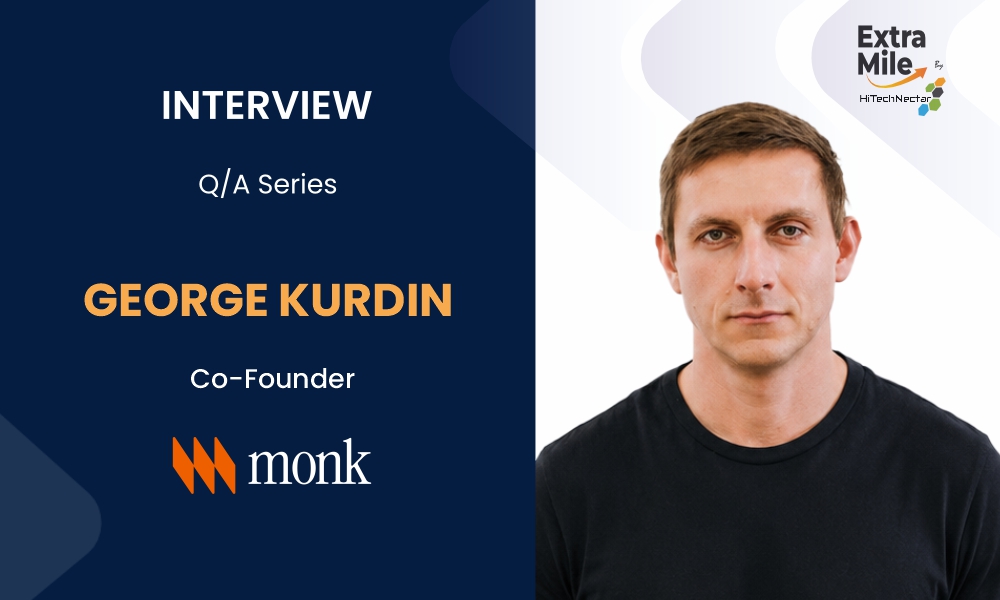
We’re excited to bring you the latest session, featuring George Kurdin, Co-Founder of Monk. The firm is a leading AI-native accounts receivable platform, specializing in collections, cash applications, and forecasting for mid-market and enterprise businesses. Monk manages $2B in receivables today and utilizes a proprietary agent harness purpose-built for AR.
Our featured guest, George, brings experience across diverse sectors, having worked at companies like Streamlabs, Minecraft, and D.E. Shaw. As a Co-Founder at Monk, he is the cornerstone in building Monk into a top-tier finance company.
Let us dive deeper and explore the conversation as George unpacks his vision for building Monk, how AI is reshaping the last mile of receivables, the approach that makes Monk different, and the factors driving DSO reduction.
George also highlights Monk’s focus on AI-native accounts receivable and how the firm is bringing a smarter approach to modern finance operations.
Welcome, George! We’re delighted to have you here with us today!
Q1. Your career has taken you from professional poker to hedge funds, and now fintech. How has each phase shaped your vision towards building Monk?
George. Poker shaped how I think about risk more than anything else. You learn to size a decision based on the odds in front of you, not what your gut wants, and that’s the same lens we put on AR: which accounts need a person, and which don’t. D.E. Shaw was the finance grounding. I was trading and helping manage part of a $60 billion book, and you leave that environment with almost no tolerance for sloppy reconciliation, because at that scale a rounding error can cost an entire relationship. Streamlabs and Minecraft are where I learned to ship product and run a team. Monk draws on all three, we’re a top tier finance company, with principles of excellence, and internally we run like a product company with extreme ownership.
Q2. Many businesses still depend on manual invoice follow-ups and collections. What are the common challenges preventing organizations from modernizing their AI processes?
George. AR isn’t one workflow. It’s billing, customer communication, and cash reconciliation, and most existing software only touches one of the three. Furthermore, most existing software couldn’t act like a human until LLMs emerged. The cost of a mistake is too high for teams to automate without pristine, ai-native software. Real money is on the line. We talked to more than 100 CFOs before we started Monk, and almost none of them told us they lacked tools. They had plenty. But none of the tools were ai-native, so none closed the final mile with their receivables.
Q3. Monk stands as a leading AI-native accounts receivable platform. What makes it unique from traditional AR and finance automation solutions?
George. We didn’t bolt AI onto an existing AR tool. We built the platform around AI from day one. Every model call, whether it’s reading a contract, drafting a message, or matching a payment, runs through deterministic code and is tested against a large set of edge cases before it ever reaches a customer. We also don’t force full automation on day one. Most customers keep a human in the loop for the first few weeks and hand off more as they come to trust our agents.
Q4. Accounts receivable directly impact customer relationships. How do you ensure automation enhances customer experience instead of making collections feel impersonal?
George. We tune each voice and email agent per each customer, to mirror how firm or how patient it is, based on the relationship and the payment history. It isn’t one script for everyone or templatized follow-ups. And there’s always a human a step away. The agent can confirm a detail on a call or over email, but it does not move money or change an invoice on its own. That limit probably does more for the customer experience than any wording we could put in a message.
Q5. Monk has helped customers reduce Days Sales Outstanding (DSO) by an average of 40% while saving time. What are some of the key factors that have made these measurable business outcomes possible?
George. Most of the reduction has nothing to do with better wording. It comes from not letting things slip. An invoice that sits a day before it goes out. A follow-up that never happens. A payment that lands and doesn’t get matched for a week. That is where DSO actually comes from. We close those gaps, and because the agent remembers the full history of an account, nothing gets chased twice or dropped, which is how we achieve 40% DSO reduction for clients at Monk.
Q6. With over $2 billion in receivables managed through Monk, what’s your take on the way AI is transforming accounts receivable and finance operations across industries?
George. What strikes me is that AR still doesn’t have an obvious winner the way code generation has Cursor. There is $10T sitting in unpaid invoices globally. At $2 billion in receivables managed, we see that AI’s value isn’t in replacing anyone’s judgment. It’s in reducing the time between something happening, a contract getting signed, a payment landing, and someone or something acting on it. Close that gap and cash flow becomes predictable in a way it hasn’t been for most finance teams.
Q7. Many finance professionals spend significant time chasing invoices and reconciling payments. How is Monk transforming these traditionally manual processes? What strategies do you integrate?
George. Chasing invoices and reconciling payments are the same problem from two ends: money going out as a request, and money coming back with no context attached. We handle the whole loop. Contracts get read and turned into invoicing terms, collections go out and follow up on their own schedule, and payments get matched back automatically, instead of someone reading a bank statement next to a spreadsheet.
Explore Our Other Insightful Interviews: