Staying ahead of technology is key to success in today’s competitive world. Get ready to explore the strategies, insights, and success stories of the visionary leaders driving the future of tech, exclusively with ExtraMile by HiTechNectar.
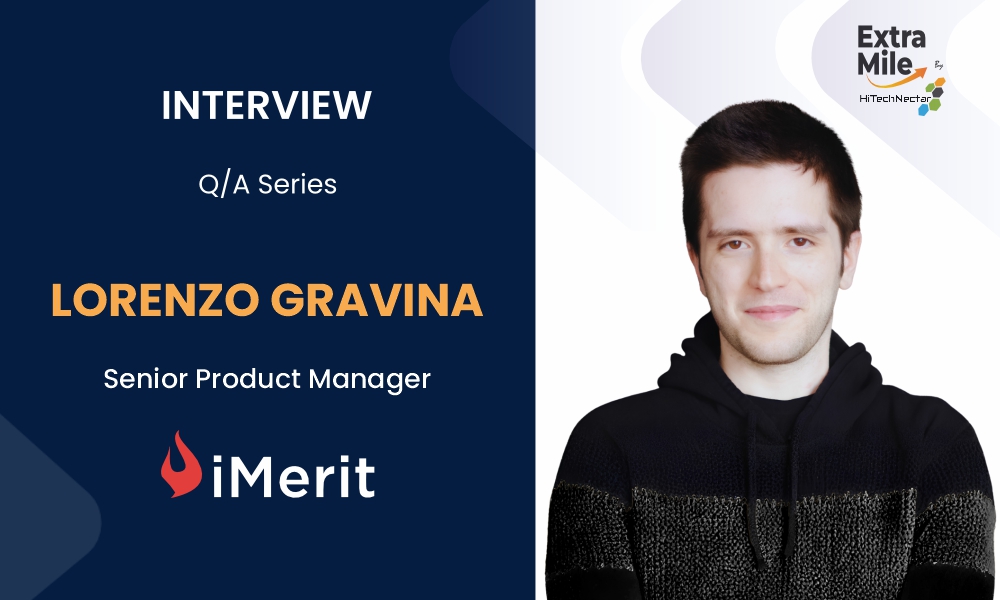
In today’s discussion, we are joined by Lorenzo Gravina, Senior Product Manager at iMerit. The company is a leader in expert data solutions for training, tuning, and evaluating AI, helping frontier AI labs and enterprises build more accurate, reliable, and domain-aware models across industries such as high-tech autonomous mobility, medical AI, and robotics. In June 2026, EXL (NASDAQ: EXLS), a global data and AI company, announced a definitive agreement to acquire iMerit for up to $310 million, recognizing expert-led AI data as the decisive edge in enterprise AI.
In the discussion, Lorenzo Gravina speaks about his work at the intersection of AI, product development, and data-driven systems. At iMerit, he contributes to product initiatives that help organizations operationalize AI through high-quality data workflows and scalable human-in-the-loop processes that enable enterprises to build trustworthy AI applications.
Welcome, Lorenzo! We’re delighted to have you join us!
Q1. Being among the first five hires at Ango AI, you wore hats across documentation, branding, marketing, and strategy. What did building from the ground up teach you that no job description ever could?
Lorenzo. Working at a small startup and building a product from scratch was an experience that defined me and how I work even today, and was, in my opinion, the best way to start one’s career.
In a small team, you learn responsibility. When your entire team is five people, and money is at a premium, you quickly learn that you need to pull your weight, and that if you don’t, the entire team will suffer as a result. This is true in all companies, but in small startups this is especially visible. I learned that when everyone has a clear area of responsibility, each individual, and then the whole team, performs much better and is more satisfied with the work.
Second, you learn that as a product manager, you are really a product “founder”, and must do whatever your product needs, even if it’s something that’s “outside” the normal range of things PMs would do. For example, because we didn’t have a marketer, I stepped in and created our entire marketing presence, including a website, materials, and so on. Because we didn’t have a fixed sales department, I was talking to leads and selling them on our annotation platform, Ango Hub. We didn’t have a documentation writer, so I wrote the docs. And because we initially didn’t have QA engineers, I stepped into that role too, until we plugged that gap. Basically, it taught me to see product management as being holistic, and to have a “founder-like” mentality to tasks. If something needs to be done, step in and do it. Of course, this is not something that can be applied wholesale to larger organizations, but the spirit of it is nonetheless extremely valuable.
It also taught me that growing the team should be done carefully and slowly, and that a person’s attitude matters more than their current level of knowledge. I found that while people learn, they rarely change, so it’s extremely important to make sure that new joiners fit well within the existing team culture, and can raise the team’s level. We have always maintained a small team, and in my opinion, this is a strength.
Finally, of course, you also need some luck. I was extremely lucky to have been part of that small initial group of people who built the company. This isn’t something you can control directly, but it did teach me that being the right person at the right time is very valuable.
Q2. Today, you lead product management for Ango Hub, iMerit’s AI data solutions platform. What’s the core enterprise problem Ango Hub was built to solve, and what makes it the answer over everything else out there?
Lorenzo. When, in late 2020, well before the AI boom, we sat down to define what our data labeling platform Ango Hub would be, we knew then that AI and models were gaining traction, and that the growing number of teams working on AI would need clean, high-quality labeled data at scale to train and create those models. We created Ango Hub precisely to satisfy that need and help AI teams get the annotated data they need.
When we looked at the market at that time, we realized that there were no user-friendly, generalist platforms AI teams could use to convert their raw data into useful model inputs. Most platforms were either extremely specific, targeted at data scientists, or both, which meant they were hard to use and mostly unintuitive. We built Ango Hub not only to ensure AI teams get the data they need, but also to make sure that doing so would be intuitive and easy.
To this day, at iMerit, thousands of individual in-house and customer annotators, and many project managers, solution architects, and other non-technical folks use Ango Hub every day to get work done for our customers, and the reason they are able to do it is because Ango Hub is both powerful and easy to use. This is a key value for us. We often hear from colleagues and customers that they find Ango Hub to be the data labeling platform that is simplest to use, despite being incredibly powerful and driving real revenue wherever it’s used.
Ango Hub has always been a multi-modal platform, and that is one of our key strengths. Ango Hub is used in real projects, in production, in areas such as autonomous vehicles, healthcare, generative AI, LLM training, agriculture, banking, and much, much more. Ango Hub supports nearly every data format our customers might need. Because of this, another key value of Ango Hub is that it can work well for many different use cases, which is key for us at iMerit.
Q3. Human-in-the-loop and experts-in-the-loop systems are pillars of trustworthy AI. How do you design products that combine human expertise alongside automation to improve model performance and reliability?
Lorenzo. When we say that Ango Hub is a platform, the key word there is platform. In my mind, a platform is a place where you let customers decide how they want to work, rather than forcing them towards a predetermined path. We strive for Ango Hub to be as unopinionated as possible.
There is no clear answer regarding how to best blend human expertise with models, because each customer has a unique project, so it’s a matter of determining, together with them and our solution architects, what the best blend is for them, specifically. On Ango Hub, we provide them with a platform: the power to determine, in detail, exactly how they want their project pipeline to look, including where people and models will be and what roles they’ll take.
We do this in two key ways. First, Ango Hub’s projects revolve around the concept of the “Workflow”, which is completely customizable, not only before starting a project but even as a project is running. In the workflow, our SAs, managers, and the customer come together to determine where in the pipeline a model will be placed, and where humans will be placed, and what role they’ll take. For example, we can create a pipeline where a model performs some pre-labeling, then a human performs a visual check, and then another model performs a deeper layer of QA. This is easily possible with our “Workflow” functionality.
Then, we allow all users, including both iMerit and our customers, to extend the functionality of Ango Hub using what we call “Plugins”. You can think of them like browser extensions, but for Ango Hub. Plugins include, among others, any custom model the customer may need. This allows us to craft extremely specific human-model combinations for our customers to make sure we reach their speed, quality, and cost requirements.
Q4. Product management for AI needs collaboration between engineering, data science, and operations teams. How do you align these cross-functional stakeholders around a common product vision?
Lorenzo. My keyword is always awareness. When at least the main stakeholder from each team is fully aware of what the product is trying to achieve, then things fall into place.
While each team may have their own goals and motivations, it’s important that they are also aware of the larger goal. In our case, the goal of the Ango Hub team at iMerit has always been to push toward all three corners of the data annotation “triangle”: making it fast, high-quality, and cost-efficient. I find that everyone in the company now knows this, and as such, their work aligns with this priority.
Of course, in the real world, priorities may change often, but as long as the core decision-making team is kept small and in sync, this can be weathered.
Q5. iMerit covers wide segments, including computer vision, NLP, and content services. Which area do you see driving the highest growth right now, and why?
Lorenzo. While I can’t speak for iMerit as a whole, I’ve always seen it as a company that values long-term thinking. iMerit has the unique advantage of having been in the AI space since 2012, well before the general population knew what “models” were, let alone the entire concept of data for AI. It’s probably one of the few AI data companies to have been around that long.
Having been around this long in such a changing environment means that we are uniquely skilled in our ability to “read the room” and adapt to the market. This is, in my mind, one of the great things about working at iMerit.
Given our long horizon, we were able to see that the past few years have marked the rise and coming of age of Generative AI, a major opportunity for us that we were able to capture thanks to our ability to spin up a global network of incredible expert talent through what we now call Scholars.
If I were to narrow my focus to only the last 12 months, then I’d say that robotics and, in general, Embodied AI has been a topic that’s gained incredible importance lately, and it has been a great source of new projects on Ango Hub and at iMerit. I assume that this is because we’ve all seen what AI can do for us in the virtual realm, but the market is now ready to see how it can help in the physical one, too.
Q6. iMerit blends automation with human expertise across India, Bhutan, the United States, and Europe. How do you design product workflows that get the best of both without compromising speed or quality?
Lorenzo. When setting up dual- or multi-shore projects, there are two key elements at play: the people and the platform. People refers to the human side: finding the right talent, assessing them, training them, onboarding them, and, in general, everything that is not software. The platform is the software platform that allows these people to find one another, work, get paid, and make everything happen. To be successful, you need to solve both. And I think the reason why iMerit is so successful at making this happen is that we were able to solve both the people and the platform question.
As I mentioned above, Ango Hub, along with other internal people-management software that the Ango team develops at iMerit, is set up as a platform where our people can build workflows exactly as they need them. This also includes making sure that dual- or multi-shore projects are set up so that they are high-quality, fast, and economical.
For example, there may be scenarios where, to keep costs manageable but quality high, we may propose that customers perform the bulk of the work in the APAC or SEA region, but with a subsequent layer of review and quality assurance done in the EU or US. Ango Hub was set up from the ground up, thanks to its Workflow designer, to make this happen. Project managers can, for example, set up as many layers of review as they need and assign them to the people they need, so that higher-cost resources are used as sparingly and effectively as possible.
Or, for example, in that type of project, we would not want to use the US or EU experts’ time on fixing errors that we could catch beforehand. So on Ango Hub, we have ways to automatically catch certain types of errors before they go to the expert for review, ensuring that the project is being run as efficiently as possible.
Essentially, it’s about having the right people and the right platform, with the right features and capabilities.
Q7. In the future, what is your long-term product vision for Ango Hub, and what buzzing trends do you believe will shape the state-of-the-art enterprise AI solutions?
Lorenzo. Ango Hub’s goal is to be the fastest, most efficient, and easiest-to-use platform to transform unstructured, raw data into structured, usable, high-quality data points that AI teams can use to develop and train their models. This has been the goal in the past, and I foresee that it will continue to be our goal and product vision deep into the future, too.
The main challenge ahead is making sure that Ango Hub stays up to date with the latest AI data trends. For example, when we first started, generative AI was not at the forefront of the industry, but now it is. In a short time, we developed key generative AI support and features, and now Ango Hub is used in generative AI work for some of the most important AI labs in the world.
It appears that the same is now happening for embodied AI, one of the strongest trends in the past year or so. We are applying the same playbook to ensure our customers can find value in Ango Hub no matter what they are working on.
Q8. Winning across three categories – ethics, infrastructure, and labeling platform at the Financial Express (India) AICONIC Awards is impressive! How does it impact your company’s positioning and go-to-market strategy?
Lorenzo. Winning in three categories at once is meaningful to us because it reflects something we’ve always believed. Three important elements: ethics, infrastructure, and the labeling platform itself are not separate concerns. They are deeply connected, and you can’t really excel at one without the other two.
From a positioning standpoint, this validates the way we have always talked about Ango Hub and iMerit more broadly. We position ourselves as a company that takes responsible AI seriously, that has the infrastructure to back that up at scale, and that has a platform, Ango Hub, capable of turning that responsibility into a real, usable product. Having that recognized across all three areas by an external body is a strong signal to the market that this is how we actually operate.
For go-to-market, I think it gives our sales and marketing teams a concrete, third-party-validated story to tell, especially to enterprise customers who are increasingly asking hard questions about data provenance, annotator working conditions, and responsible AI practices.
Adding that this kind of recognition is a good reminder that the work doesn’t stop here. Awards are a nice milestone, but our job now is to keep pushing forward on all three fronts so that this remains true a year from now, and the year after that.
Explore Our Other Insightful Interviews: