
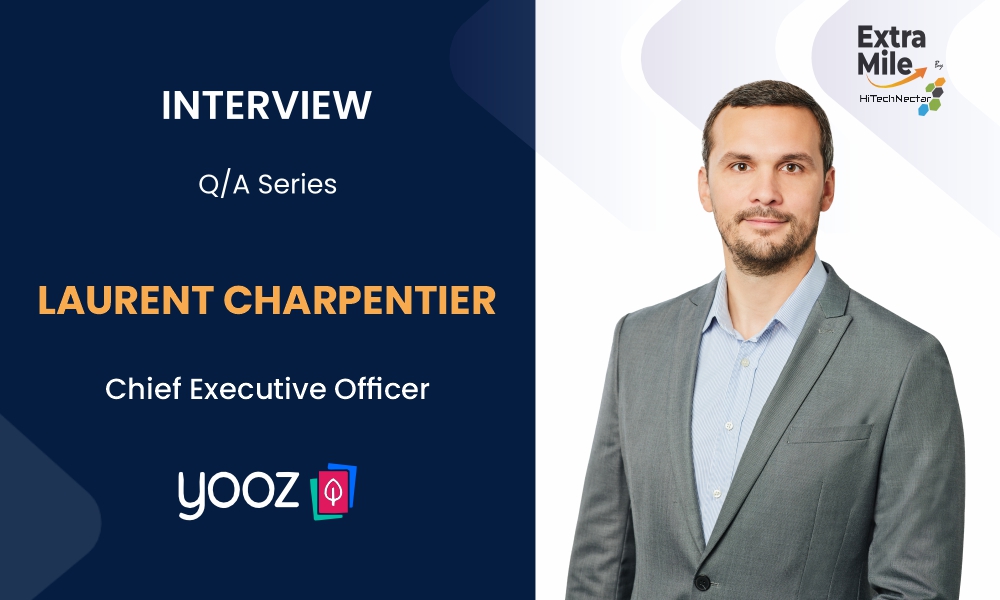
Financial automation is an evolving trend, but organizations often hesitate to adopt it. However, a strategic approach can be beneficial at any time. Welcome to the latest Q&A session of ExtraMile by HiTechNectar, where we assess advanced technologies, business approaches, and key advancements from diverse industries.
In today’s discussion, we are joined by Laurent Charpentier, Chief Executive Officer of Yooz. The firm is a leader in financial automation, empowering over 600,000 users across the globe. Yooz’s AI-powered accounts payable automation bridges the gap between automated financial processes and secure fraud detection. Its prime focuses are ERPs and accounting systems while advancing financial operations.
Laurent is a visionary tech leader who believes in innovation, strategic thinking, and effective team building. He leads Yooz with a vision to position the firm as a frontrunner in financial automation solutions. In the discussion, Laurent will discuss his professional journey, Yooz’s initiatives to strengthen financial controls for companies, the impact of AI-powered accounts payable automation, and more.
Do not miss this session and the opportunity to explore expert takeaways on financial automation.
Hello, Laurent; we are delighted to host you today!
Q1. You moved from a heavy engineering background at MIT to an executive consulting role and eventually became CEO. How have your academics and different roles shaped your professional journey?
Laurent. My engineering background taught me to approach and tackle problems by being hands on, curious, and not giving up. You learn to break down complexity, understand where friction exists and look for practical ways to improve how something works. That way of thinking has stayed with me throughout my career.
My consulting experience helped me apply that mindset in a business context and in relation with large software ecosystems. I worked on technology and process challenges where the goal was not just to design a solution, but to make it useful for the people and teams relying on it. That reinforced a belief I still have today: technology only matters if it solves a real operational problem, a true pain point with the right level of trust.
That perspective carried into my work at Yooz. Early on, I spent a lot of time close to customers, understanding their processes, their constraints and what success actually looked like for them to design their workflows and integration points. That gave me a very practical view of finance automation keeping in mind the ultimate goal which is to help finance teams reduce waste, strengthen control and gain the visibility they need to support and grow the business with more confidence.
Q2. Yooz launched an intelligent Line-Level PO Matching tool to fix itemized discrepancies in April 2026. How does this tool strengthen financial controls for companies, reducing discrepancies and speeding approvals?
Laurent. Line-level PO matching gives finance teams a much clearer way to verify what was ordered or what was received against what was billed. Most invoice issues don’t appear at the header level, but in the details: quantity gaps, price differences, duplicate charges or lines that simply don’t match the purchase order.
Yooz uses proprietary AI to extract and compare invoice lines against complex purchase orders, even across multi-page documents or multiple orders. The system surfaces what matches and flags what needs attention so AP teams don’t have to review every line. It is extremely easy to use as it visually guides you through the exceptions.
That helps companies move faster without giving up control. When you reconcile what was ordered and what was billed down to each item, you reduce the back-and-forth human errors that slow approvals and you create a more defensible record of spend. Teams can spot discrepancies immediately, route exceptions based on discrepancy type or threshold, and keep a clear record of what changed and why. In practice, that results in 80%+ reduction in reconciliation time and 50% faster invoice approvals.
Q3. Yooz 2026 AI in Finance Report shows financial leaders trust AI for forecasting but not data entry. Why are they comfortable guessing the future but terrified to let AI execute the present?
Laurent. I wouldn’t say finance leaders are terrified of AI, but more that they are disciplined about where they apply it and what they want to see to trust it.
Forecasting is a decision-support function. AI can help teams model scenarios, analyze trends and pressure-test assumptions, but people are still making the final judgment. That makes it a more comfortable place to start.
Execution is different. Once AI touches invoice data, vendor records, approvals or payments, the stakes get immediate. A bad field, a missed exception or a duplicate invoice can create real consequences very quickly. It is why it is so important to measure not only the success rate of AI, but also the rate of error and the rate of “no decision” that needs human review.
The 3 are important to build trust which is what finance leaders want, along with governance and clear review paths or explainability before they go deeper. The good news is that adoption is already moving that way. Our research shows two-thirds of finance teams are using or piloting AI, and 10% already have it embedded in core processes. The real value comes when AI sits inside structured workflows that have good data and context, with guardrails and auditability built in.
Q4. What are your views on business collaborations? How will Yooz’s collaboration with Pine Services Group strengthen AI-powered accounts payable automation across ERP businesses?
Laurent. The best collaborations make innovation easier for customers to adopt. Finance teams want something that fits into the systems they already rely on and helps them improve control and efficiency without creating more disruption, not another disconnected tool.
That’s why our partnership with Pine Services Group matters. Pine works with ERP and technology-enabled services businesses across sectors like construction, field services and manufacturing. Those companies often deal with high invoice volume, line level coding or matching, complex approvals and pressure to modernize with AI without replacing their existing systems.
Through this partnership, Yooz brings proprietary AI powering AP automation, fraud prevention, workflow and payment automation with deep ERP connectivity to Pine’s broader network. That gives those organizations a path to best invoice accuracy, shortest cycle times, more visibility across approvals and exceptions and real-time insights into AP spend for better financial decisions.
It also helps more organizations modernize finance operations in a practical way: by building stronger automation and control on top of the systems they already use. This is how they can become focused on higher added value activity to focus on what is important to their core business.
Q5. With AI making invoice fraud and vendor impersonation effortless, are fintech platforms actually winning the security battle or just accelerating the attackers?
Laurent. AI is raising the stakes on both sides. Fraudsters can create more convincing invoices and impersonate vendors more easily than before. That makes old-school manual review far less effective on its own.
Finance teams need systems that can spot anomalies, verify changes and keep a clear audit trail in real time. That’s where YoozProtect AI-powered fraud detection can help detect patterns and surface risks that busy teams might miss, especially when they’re managing large volumes.The issue is control. AI can’t be a standalone black box. It has to sit inside secure workflows that flag suspicious activity before payment, enforce approval rules and give finance leaders visibility and explainability at every step. Human judgment still matters, but people should be focused on the decisions that actually need them.
Q6. As massive ERPs like Sage and Microsoft embed AI directly into their core apps, how does a specialized, third-party platform like Yooz survive?
Laurent. ERP vendors adding AI is good for the market. It educates the market about expectations and gives finance teams more ways to modernize.
AP is one of those areas where the details matter and refined AI for AP specific use cases becomes important. Every company has different approval rules, vendor structures, document formats, exception paths and control requirements. As companies grow, that complexity only increases, especially across multiple entities, locations or systems. That is where Yooz AI automation layer can add real value on top of the ERP that remains the general ledger master record.
Yooz is designed to layer onto existing ERP environments and make them more effective. We bring document intelligence, flexible automated workflows, fraud detection and integration across ERP and DMS environments. Because we focus deeply on this layer of financial operations, we can help companies make more precise improvements that scale with the business, whether they are managing multiple entities, locations, systems or high transaction volumes.
This gives finance teams more value from the ERP systems they already use, adding the intelligence, control and visibility they need to improve the finance function without adding unnecessary complexity.
Q7. AI-powered AP automation has become far more than a trend. How will an AI-driven approach enhance fraud management in the future while strengthening accuracy and reducing human error?
Laurent. AI-driven AP automation helps shift fraud management from reactive cleanup to earlier detection.
In many finance teams, fraud gets caught after the payment is already gone or when an audit uncovers a problem. That’s too late. With YoozProtect AI embedded in their workflow, companies can flag duplicate invoices, unusual amounts, mismatched vendor details but also suspicious forgery, alterations or even deepfake generated invoices that falls outside the usual context.
It can reduce the manual errors that create openings for fraud, too. Missed fields, coding mistakes, lack of purchase request or inconsistent routing may seem small, but when those mistakes are repeated across hundreds or thousands of transactions, they can increase risk, create compliance issues and make it easier for fraudulent activity to go unnoticed.
People still need to make the final call on sensitive issues. What changes is where they spend their time. Instead of reviewing everything, they can focus on the cases that actually deserve attention.
That’s the future of fraud management: automated controls powered by contextual AI leveraging clean historical data through the process, with a human in the loop when needed. As AI capabilities continue to evolve, finance teams will be able to identify risks earlier, respond more quickly and maintain greater confidence in the accuracy of their operations. The result is an automated finance function that can operate with stronger oversight, fewer errors and better protection against fraud while allowing the finance team to become more strategic.
Explore Our Other Insightful Interviews: