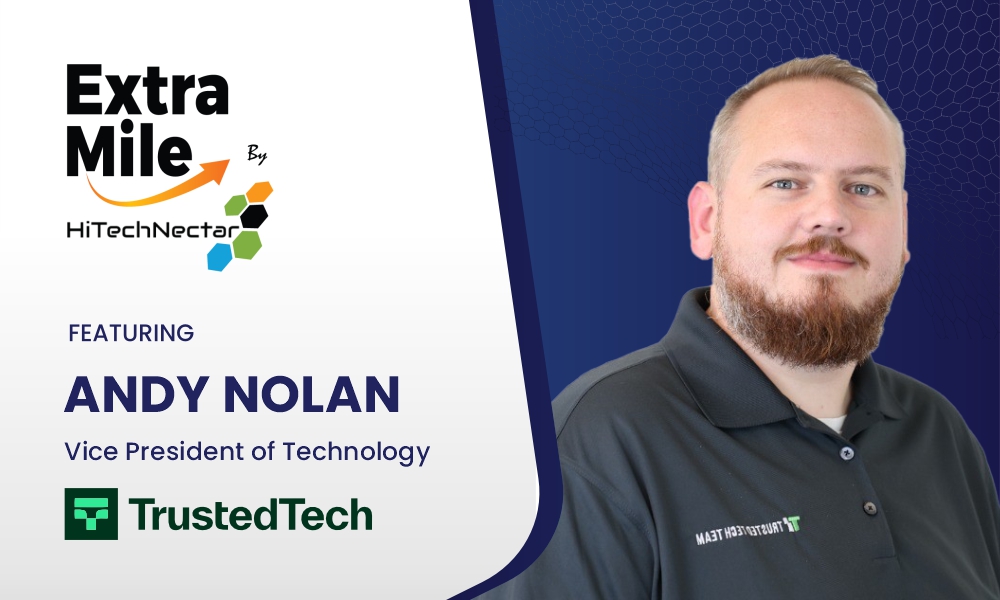

Host: Hello everyone, welcome back to another knowledge-driven episode of ExtraMile by HiTechNectar, where we bring you candid conversations with the visionary leaders reshaping the tech world. I’m your host Rittika, and today we are privileged to have Andy Nolan, the Vice President of Technology at TrustedTech, joining us for this discussion.
TrustedTech is a leading Microsoft Cloud solution provider specializing in Microsoft Cloud Services, Microsoft perpetual licensing, and Microsoft support services for medium and enterprise-level businesses.
Our guest Andy is a tech enthusiast with a community-driven approach. He leads the tech initiatives in the organization while empowering TrustedTech’s operations across data and analytics, CRM, AI, and platform engineering. In this conversation, we will dive into Andy’s professional journey, TrustedTech’s approach to AI and data governance, other architecture best practices, TrustedTech’s mission, and more.
So, great to have you here, Andy.
Andy: Absolutely, happy to be here.
Host: So, your career began as a service desktop engineer and has grown into your current role as VP of Technology. What were the key turning points in your career path and what lessons have shaped your leadership approach today?
Andy: I think key turning points throughout my career has largely been around knowing, as a progressive just regular desktop support, assisting users over time, moved from sort of like larger and larger scale problems. And I think the key turning points for me were really following like the first, moving from like what were local computers to hosted environments, so hosted exchange, VMware Horizon, that sort of thing. And then the key shift to being in the cloud, so the Azure virtual desktops of the world, that sort of thing.
Been able to really just be on the more on the leading edge of those changes through my time, very in the beginning as a support person, seeing what organizations were using and trying to support customers and clients the best way that I could. Kept on that leading edge and has served me pretty well. And I think that overall, like really the most major thing from 20 years ago to now, I never really stopped being the person who fixes things.
It’s just the scale has changed as I’ve progressed through my career. And I think that’s probably the biggest takeaway is that as long as you’re focused on fixing and providing good outcomes for the people that you’re working for, whether that employees or for a customer that has an issue in the moment, you’re focused on that. I think everything else will follow.
Host: That’s truly an inspiring journey. Thank you, Andy, for that. So let’s move ahead.
At TrustedTech, you are driving the internal MCP server architecture that exposes CRM, billing, and operational data to LLM workflows. So, what is your roadmap for ensuring data access control and auditability while LLMs are querying sensitive revenue or billing data?
Andy: So being the MCP servers are defined by the spec itself, is treated as the USB-C for enterprise AI. Obviously, that unlocks everything and billing data and lots of concerns around that and how to keep the governance in place. It’s always going to be least privileged when scoping the connectors.
Common failing, I think, is the need for expediency. And the easy path is to just hook something up and have it connected to everything and let it run. Obviously, it’s not the way to go.
So least privileged scoping for connector, treat those tool outputs, whatever comes out of there as untrusted input because of prompt injection concerns. That’s basically today’s new phishing audit logging on every tool that’s being called. And then really, ultimately, human in the loop confirmation gates on anything that sends data anywhere or anything that gets written or updating something.
That’s really it. So, you can automate the majority of the workflow but just have a human as the final gating confirmation to just be really sure. Starting with those three, four things, that’s how we’re securing this, where humans are in the loop, but we really are getting it.
Permissions granularized at the onset is really the key thing, key takeaway there.
Host: Totally agreed. And this is surely a valuable approach to governance. So, on that point, we will move to the next one.
You bring deep experience in designing Azure environments. What are the important considerations when architecting a secure, scalable, and cost-efficient Azure solution for an enterprise?
Andy: Well, Microsoft does a really good job with their cloud framework. So there’s sort of like a cloud adoption framework if you’re early in your cycle. And then as you’re working through that and a more mature organization, there’s the well architected framework, the WAF.
These are blueprints from Microsoft that really lay the groundwork for like, or rather what the gold standard is and the expectation for like the best, the most secure systems. And so always referencing best practices during deployment, planning, really the most important. Additionally, though, as you mentioned cost, because that is of course a concern and unmitigated deployments and growth, and it can lead to some really, really high spend.
So, we always want to keep an eye on that where possible. And that’s really something that will come with the maturity of your organization. If you have a FinOps team, if you don’t, definitely worth exploring, depending on your size, because there is a lot of A, someone to keep an eye on these things and manage these costs, work with the finance department, FP&A people for planning and analysis and road mapping.
But also as well, someone to be keeping an eye on these things and keep everybody honest. Different business units, different projects and whatnot, things come and go, and we don’t always clean up after ourselves. And that can lead to some runaway spend in Azure as well.
So, two things, making good use of the tools and the documentation that Microsoft already has because they are really designing the products and giving us the roadmap of what right looks like. And then also leveraging people and tools and processes internally for FinOps to just keep everybody honest.
Host: That’s a truly balanced approach, I must say. So, let’s proceed further. TrustedTech holds all six Microsoft solution partner designations.
How do you ensure that your engineering teams maintain that level of technical excellence while staying ahead with Microsoft’s rapidly advancing cloud technologies?
Andy: So it helps that we’re a Microsoft managed partner. So, we have frequent engagement with Microsoft. We make sure that we attend every webinar, every event, everything that we possibly can.
And ultimately, we just keep our folks incentivized and encouraged to stay on top of these things. The solutions designations, it’s sort of two parts to be able to get the result. First part is demonstrated that we have customers that are using these services.
They are paying us for those. And then we deploy those services on behalf of Microsoft. But also, the second part is that we have to demonstrate that our folks are well credentialed.
They have their certifications. And so that’s where the incentive part comes in for our employees. You know, we want to, we make sure we pay for their exams.
We give them the training that they need, the time to be able to research and stay on the leading edge of these products from Microsoft. Obviously, there’s a gigantic push around Copilot and agentic AI and Azure Foundry. And so, we are always wanting to make sure that every single person that is going to be able to talk to a customer is going to know what the, what those things are and how they can answer those questions for anybody that needs assistance with these things.
Or even if they just need to have a conversation, ask about the products available. And so, we just make sure our people are well equipped both with time and the training resources to get to where they need to be.
Host: Truly an impressive approach to align with the technical excellence of Microsoft. So next up, TrustedTech’s mission is to give IT professional confidence in their Microsoft investments. How would you use technology automation or AI to enhance customer experience throughout the licensing deployment and support lifecycle?
Andy: So we always want to make sure that there’s, with the variety of licensing opportunities or options that exist that Microsoft provides. And with all of the most recent reshuffling, Microsoft did a price increase July 1st and something that we took great interest in was ensuring that our customers understood it wasn’t just a price increase. This was to align where Microsoft are moving different items inside of the products around.
And so we’re leveraging AI internally to be able to find what are the most optimal configurations for customers, especially with these sort of package changes where different SKUs or different products maybe have moved and are rehomed into different SKUs. And then also as well, being able to deliver to customers at any kind of like any juncture where we’re having a conversation with them, their licensing is coming up for renewal, or even if there are larger Microsoft offerings, like the recent E7 deployments, for example, or co-pilot and business premium packages, we’re able to work with our customers, get a full assessment in place, understand how they are using what they have today. And we can develop a much more optimal solution for how they are allocating their licenses, who they’re being allocated to.
And if we can make some shuffles along the way that results in our customers saving money, that’s the ultimate goal. That’s really how we are able to achieve it with AI and the usage and data that we can derive from a customer’s environment.
Host: It clearly shows a blend of how tech and customer experience go hand in hand. Approaching further, with SQL Server 2016 reaching the end of extended support, how would you help an organization to evaluate whether to upgrade to SQL Server 2022, 2025, migrate to Azure SQL, or use extended security updates? And what are the key factors driving that decision?
Andy: Couple of factors there. What the plan and the roadmap is for that organization as far as infrastructure goes, because really the licensing, it’s a license or rather the modernization of this. So moving from a 2016 end of support to the newer 2022 or beyond licenses that are still supported.
That is a licensing decision just as much as a technical one, because there are options in Azure with SQL database itself or with managed instances. Microsoft has a lot of licensing mechanisms that give people a roadmap and a path to be able to get to the cloud. And those things are able to have licensing can be really converted into an operational cost, operational expense, rather than just the amount of licensing spend upfront.
But also as well, it depends on what their landscape is internally. Is it a data center that they’re co-located in? Do they have things on site?
So it’s really just assess first of all, and then from there, right size. Do you have too much, too little? Is it right already?
And then moving and deciding Azure SQL, Azure managed instance. It’s really a whole sort of planning phase that’s required in discovery. But that first step assess what you’ve got and let’s have a conversation about where you want to go, because the implications are either a capital expense to be able to maintain what you have or be able to move that into the cloud and modernize other items of infrastructure along the way as well.
It really just starts with the assessment piece.
Host: I must say structure decision making is unignorable in this regard and TrustedTech excels in for that. So, taking the conversation ahead, TrustedTech helps customers prepare for AI adoption. What are the key technologies and governance practices should organizations put into practice before implementing AI solutions like Microsoft Copilot?
Andy: So I think first of all, we’ve done a couple of different engagements where opened the question or really just gave us a little bit of pause as to like how companies are using AI. And then that led to some research that we have with shadow AI people deploying and using AI outside of whatever corporate bounds that existed. And so the most important takeaway there was like the leaders were the ones that were really going around these guardrails.
So the people that put them in place went ahead and just ignored them and did their own thing. And so, the first part of this, I think is really just standing the intended use case and the landscape of data that you have. We want to avoid any hurdles around the adoption and the usage.
Users will always find a way as our research showed. And then the second part of this as well, that was a surprise to me was the amount of businesses that we had surveyed where they don’t or rather the employees stated it was like about 25% of employees surveyed actually had some formal training in the use of AI. And as we’ve done many AI assessments and engagements, when those companies have popped up where they have had formal training, the quality of interactions with those users when it comes to training and adoption is just so much higher.
They’re really becoming more effective a lot sooner with using these tools. And so I think that taking advantage of a little bit of a metered approach with training, get everybody on the same page, what the expectations are really understanding and doing an assessment internally of the business state where you want to go, what the expectation is. That I think is going to be the most optimal solution for a positive outcome for people.
Without that, you can spend a lot of money and have mixed results.
Host: That’s a valuable approach while adopting AI for business growth. So, moving on to the last one for today, how do you think Microsoft’s licensing model and cloud solution provider program will advance in the upcoming years and what opportunities or challenges could this create for TrustedTech?
Andy: So, Microsoft is putting more trust in partners to handle the entire ecosystem and go further up the organizational sizes. Historically, Microsoft had wanted to have enterprise agreements for many, many organizations of a certain size. Over the last few years, we’ve seen that shrinking and Microsoft has been moving the relationship out of their direct engagement and moving them to partners.
And so, because of that, Microsoft has also substantially ramped up their requirements and expectations of partners. And so, I think that TrustedTech is in a unique position to succeed because we have a lot of skilled personnel. We have established relationships with Microsoft for a Microsoft managed partner.
There are quite a few program changes. We recently announced our unified support for partners relationship with Microsoft. We’re one of the, again, bleeding edge organizations that are selected by Microsoft to be a part of this.
And so, we’re able to keep pushing that forward and delivering for our customers and also being a good partner with Microsoft as well. And I think that where we are positioned to succeed is just being able to just keep delivering excellent service to and value to our customers and prep them for AI and whatever else is coming in the technology space.
Host: Yeah, that’s a clear vision for the road ahead. And that’s a wrap. Andy, thank you for joining us today.
This was indeed an insightful conversation. Your approach to explaining every concept was impactful. Your take on tech leadership, AI governance, and Microsoft Cloud solutions will be the best takeaway for anyone striving to level up in the IT or cloud services industry.
Thank you so much.
Andy: Absolutely. Thank you so much for having me. It was great chatting with you.
Host: And now it’s time to thank our audience for tuning in to ExtraMile by HiTechNectar. We appreciate you joining us and learning from leaders who are making a real difference. We’ll catch you in the next episode with another leader transforming tomorrow’s tech.
Until then, stay tuned.