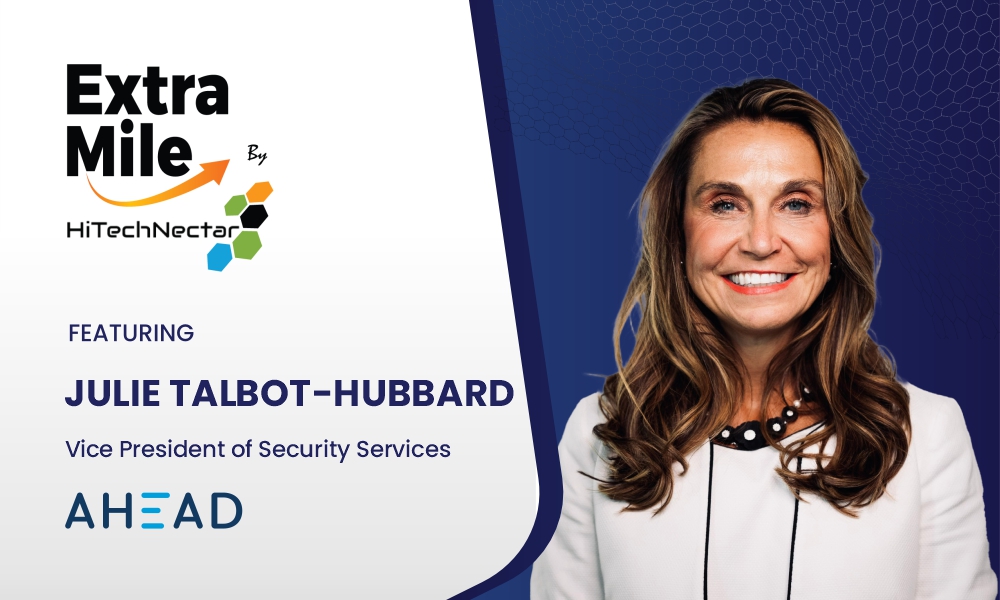

Host: Hello techies, welcome back to another exclusive episode of ExtraMile by HiTechNectar, the top-rated interview series featuring industry pioneers around the world. Our aim is to empower the audience through real insights on what’s trending and shaping the future of tech. I’m your host, Rittika, and for today’s conversation we are discussing cybersecurity, AI readiness and what it takes to lead.
Let’s welcome our speaker Julie Talbot-Hubbard, Vice President of Security Services at AHEAD, a company that’s accelerating strategy into execution by engineering integrated solutions across infrastructure, applications, data and security.
She comes with more than two decades of experience across financial services, healthcare, and technology to build security programs that allow growth rather than preventing attacks. Today we will dive into Julie’s journey through cybersecurity leadership, benefits of AI-driven penetration testing, take on leadership principles, what AI readiness actually looks like and human expertise evolving with AI-powered tools.
So great to have you with us today, Julie. Welcome.
Julie: Thank you, I’m excited to be here with you today.
Host: So, let’s dive in.
Your career spans over two decades across financial services, healthcare and technology to build security programs that enable business growth. Could you elaborate on your journey and the experiences that have shaped your approach to cybersecurity leadership?
Julie: Yeah, so my career I’ve got a unique blend of both serving as a practitioner across large enterprise organizations and later my career transitioning into more of an operator of a security business where we’re actually designing security solutions to help protect and manage risk for global Fortune 500 clients. When I look back at my career, a few key experiences that have shaped my leadership in cybersecurity and also taught me just key things to really kind of remember every day as I operate. Early in my career I spent the first 10 years at a large financial global institution, one of the largest in the world.
And one of my first roles was really helping them design their business continuity disaster recovery plans to really help maintain business operations during crisis. And I still remember the day where I was actually a week or two long where I was managing a crisis event for the organization, really ensuring check clearing for their clients. So the clients one can maintain confidence in the company but also have access to their funds.
So that was one thing when I look back that many years ago, it really taught me the importance of resilience and really to stay calm under pressure. And so that’s something I think as you really grow your career. And as I have, I faced many crisis events, but also cyber-attacks and even helping clients manage through those.And so always remembering like there’s always going to be tomorrow and like staying calm under pressure. The other one, I would say a key one that I always kind of remember, and I also share with my teams is really curiosity and really staying curious. And you think about just how technology’s evolved where I have seen it evolve in my career and what we’re seeing kind of now on this new AI frontier. If you stay curious and you kind of lean into the technology changes, I mean, you know, that’s something again, where you’re going to stay current, but you think about those bad actors as well, if you’re in security, you’ve got to always stay that step ahead. So wanting to stay curious, help your team stay curious and really lean into the change management is really critical. And I learned early on in my career.
Host: That was an incredible and inspiring journey, I must say, Julie. So, moving on to the next question for the day, you have received numerous industry recognitions, including Cybersecurity Women of the Year and Cyber 25 Women of Impact 2025, Cybersecurity Excellence Award and more. Which achievement has been most personally meaningful for you and why?
Julie: Throughout my career, again, I look back at all the different awards or recognitions, and there was one that really sticks out to me, and it dates way back to 2010. And it was an Information Security Executive of the Year Award. A few reasons that stands out.
One, that was prior to me becoming Chief Information Security Officer, which was kind of my first big goal in my career that I set out for myself. This award, we submitted more of our projects, our work and our work with our team. And there were a group of judges that were my peers across the industry.
And so one, just being able to be recognized by my peers in that. And then also for me personally, that was one thing where one that really gave me more confidence and assurance on what I was doing with my career and my teams and what we accomplished to take my career really to the next level.
Host: Your achievements reflect your dedication and compassion toward the industry. So let’s focus on an important point. AHEAD emphasizes turning strategy into execution through integrated infrastructure, applications, data, and security.
How do you help organizations turn technology strategies into real-world outcomes using AI?
Julie: So today we engage with organizations, and I think different organizations are in different phases of their AI adoption. And we’re able to really help organizations, whether it be on infrastructure, as just looking at what hardware, what infrastructure they need, and how to deploy that. But also working alongside the business and IT, kind of forming that, bringing them together to identify those use cases, and then helping them to deploy their AI use cases aligned with an ROI.
And that’s something that I’ve seen over the last six months to a year, organizations that are further advanced, they may be leaning in, but if they’re not able to really produce and achieve and get that adoption on the ROI, some of those AI projects, what we’re seeing is really stop or slow down. So, we’re helping organizations today really develop AI hubs, helping them through their assisted development, refactoring legacy code. So really helping them modernize not just their code, but also on their infrastructure, helping them size and build that as well.
AI adoption perspective, what we’re doing, we’re also able to put really design security in, and we’re able to bring our team of experts really across, whether it be AI consulting, our infrastructure team that’s also specialized in that, but also our security organization together to really ensure that that AI development is also done in a secure way.
Host: That’s a practical change. Really, thank you for that. So, let’s move further.
AHEAD has recently partnered with Tenzai to deliver AI-driven penetration testing. What are the significant benefits that AI brings to penetration testing as compared to traditional approaches?
Julie: So, I would say one of the largest changes we’re seeing right now just in our industry is really speed and velocity. And I look at that from two forms. One, the speed of which organizations are having to adopt technology, and that’s, again, through automation and AI and many other use cases.
But then also how bad hackers now also have access to those same frontier models and AI, and how they’re able to leverage that to really increase their speed and really automate the reconnaissance and exploit development and testing within, it used to take, what, weeks, months, years. Now they’re doing it within minutes and days. And so with that, when I look at really just how can you leverage AI more in that penetration testing, the biggest thing is really on speed and frequency.
And where organizations in the past have really relied on once-a-year tests, and that kind of gave them the full view, really, of their estate in terms of the vulnerabilities across. And that was good enough from a compliance perspective, but also with the changes we’re seeing now, again, with just software development, with agentic AI, and as well as just infrastructure deployment and everything else, those tests need to be more frequent to really manage that risk exposure across your environment. Second one is really on scale.
And you think about what human-led penetration testing, again, there’s still a need for that. But being able to really test an organization’s estate from on-prem cloud applications, like everything, again, AI really enables you to scale that across your environment. And the last, kind of the big third part that I look at too is, and I would say we’re still seeing integration, but it’s really around, when you think about, if you’re quickly, if you’re able to identify those vulnerabilities very quickly, and you need to right now, the second big piece of that is going to be the remediation.
And so how are we able then to take that AI pen test, those results, and integrate that really into, it could be a CI/CD pipeline, or the software development lifecycle, but we need to be able to remediate those findings quicker to really reduce that risk exposure for organizations. And I see the Gen2 pen testing as a way to really help organizations address that scale and velocity to really manage risk across their environments.
Host: AI surely streamlines and offers speed in every stage of penetration testing. Moving on to the next question, you have led global teams of more than 500 professionals. What leadership principles have helped you build high-performing teams?
Julie: I go back to just the leadership principles that I’ve used in both my practitioner roles, but also leading large services organizations. One, I always really kind of frame up that we’re one team, and have everybody really organized around objectives, principles, and outcomes that we’re working together as a team is really critical. And ensuring there’s that collaboration across the teams that I lead, but also as the leader of the organization, ensuring that I’m also using that same collaboration across with my peers, because I think that’s really important as a leader.
You’ve got to set the example of that. As I build out my teams, I also am looking for the different talents that we need to be successful. And again, that one team is also having the team embrace each other’s superpowers and the talents they bring, which again, I think as you grow in your career, that’s sometimes challenging for others.
I see it. We’ve got to really work as one team. Second one is really accountability.
And that’s something that I really instill within my leaders across my organization. But I also do it with autonomy. I want to work with them to really set vision, strategy, and objectives with them, but then also let them go and execute.
And a piece of that, then the third would be really around the servant leadership. And so that’s something also where once we set that objective and that strategy, and we’re working towards those outcomes, I really want my leaders to really own the outcomes and the execution, be accountable for that. But also I’ll be there to really help remove blockers and enable the team to be success.
I’m a leader where again, I want to inspire the team, but also help them succeed and see they’re capable of and help them achieve that.
Host: That’s how you scale people, which is often tougher than scaling tech, I guess. So taking the discussion further, AHEAD was recognized as Everpure America’s Partner of the Year for enabling scalable infrastructure modernization. From your perspective, what emerging infrastructure trends will define the next generation of enterprise IT?
Julie: So I would start with, again, we talked a lot about genetic AI, but again, I think that’s really shaping how infrastructure is going to operate in the future, just infrastructure, but it goes into security as well. So I would say one, we’ve talked a little bit about automation with AI, but we’re seeing that now with infrastructure as code, policy as code, we’re developing identity as code. And so again, like how are we implementing just that continuous, you know, from an AI perspective to ensure that we’re designing things in a secure way?
What I foresee in the coming, I would say hopefully a year, two years, not quicker, but really also how does organizations implement that continuous resilience automation? So how are we proactively designing our applications, infrastructure, integrating resilience into that operational lifecycle? Another core area is really around just hardware.
If you look about just the compute and what’s going to be needed going forward, and you think we talked a little bit about this AI power crisis we’re seeing and really around direct to chip liquid cooling, all of those, again, just changes. And in fact, at my career, and I think it hasn’t been many years ago when we were all focused on just data centers, and how are we becoming more green? And now we’re kind of going to the reverse on that, complete doing 180 on really looking at the compute power and what we need to decide there.
The last piece I would just talk about more is around security-first infrastructure. I talked a little bit about automation with AI and infrastructure as code, but there’s also where I see where from a cybersecurity perspective that we’re moving beyond the whole detection response on that, but how are we proactively designing defenses in the infrastructure? And it could be these automated kill switches.
It could be, how do we actually segregate and take things off the network when we’re seeing it? But I see that also kind of coming in the not so distant future, which is the velocity and speed we’re seeing with AI adoption.
Host: That’s great. You just gave a holistic view into where enterprise IT is heading next. So moving ahead, while many organizations are investing heavily in AI, very few are AI ready.
What are the biggest obstacles faced when preparing their infrastructure for data and AI adoption?
Julie: I would start with data and really around this data foundational issues. I’ve held many roles in my career that really around were data infrastructure, data governance for organizations. And I see those issues that I’ve spent my career trying to remediate across organizations still being there.
And many, many times I think that’s just based on growth of organizations M&A, and there’s just still so many fragmented data silos across. And so that data isn’t really clean. And so, you know, be able to leverage that data from an AI perspective; you need to really have, have that data from a governance perspective, ownership, all of those things.
Another area that I think is holding organizations back is really around security governance and compliance. And so, again, I mentioned being curious earlier on, but we’re all charting new territories. And so I think on that, from a security perspective, there’s still a lot of unknowns and organizations are leaning in to figure out how do we really securely deploy agents?
How do we have that kind of that disability against over the estate on what AI is being used across the organization and how are we monitoring kind of those use cases and governing that across? Another one is around just regulatory compliance. You know, that’s something that’s still really emerging in this area.
I’ve always said in my career that from a compliance perspective, because I’ve worked in many highly regulated industries that, you know, compliance really lags in many areas because you’ve got a lot of innovation happening from a technology perspective and many of the regulators in compliance, like they’re waiting to see really what the impact is going to be because everybody’s learning so quickly. And so I think from an AI perspective today, there’s still really an unknown and organizations are adopting AI very quickly.
And that’s why I said, getting at least a visibility now and starting to put the governance in place may not be exactly what it’s going to be in two years, but you’ve got to start somewhere. And then the next few pieces is really around, I would say, skill gaps. And so that’s something across the organizations today where, again, because this technology is moving so quickly, organizations have to operate both their, I call legacy infrastructure, which again is something that was built maybe six months ago.
So they’ve got to have that skill, but they’ve also got to, these individuals, sometimes the same individuals have to be leaning in to really learn kind of how to operate in this new mode with AI. And then the last one I would say is around change, just change management resistance. And again, I go back to my curious component going on and like leaning in to change.
Individuals, again, we talked about people, technology early on, but that’s something where individuals sometimes they are a little more change resistance because they don’t, there’s fear part of that, but it’s also, how’s this going to work in the environment and how am I going to be part of it? And I think there’s a lot of that going on across organizations today, knowing the outcome they have to deliver to their clients.
Host: So, security, compliance, governance, and appropriate skillset. So, these are priorities of successful AI adoption, but they are still being the major challenges for organizations. So, we move on to the last question for the day.
As AI becomes highly integrated into cybersecurity operations, how do you see the role of human security professionals evolving alongside AI powered tools?
Julie: So, as you know, I always say you’ve got to use AI, use for good and bad, just like any technology. But what we’re already seeing today, we’ve been really implementing AI across our security operations center. And I look at it just again, from the context that it’s bringing, it’s really allowing our security analysts really to become much more, as they provide higher value to our clients.
Again, it’s just more because they’re getting the context from AI and the enrichment. And again, if I look at how AI is moving so quickly, and from a security perspective, that’s going to just drive a lot more work, if you think about from a tactical operational piece. So, I’m looking, thinking more of human roles are going to be moving more from that reactive operator to more of that strategic thought leader and proactive overseer.
So, we talk a little bit about the pen testing, the agentic pen testing. And then you asked me in the rapid fire question around kind of the AI enabled security or the human oversight. And I said both.
And so I think, in the next two, three years, we’re going to see really, again, AI being infused across organizations and environments, and individuals using that to really, be able to really kind of be more of that strategic decision maker across leveraging AI for the routine task across what we security operations, it could be compliance, but really humans are going to be validating the AI findings, ensuring more of that governance compliance. And again, making that critical decision making.
Leveraging AI, again, if there’s a live attack, even like what are there things that we can automate from like removing things from the network, taking access away, AI is going to give us the ability to make those decisions in a much rapid, quicker way. But I still think that humans like we’re still going to have to really be able to make that final decision. Again, levels of impact.
Host: Yeah, surely, I totally agree. And AI has become just more than a trend today. And for its growth and progression, human oversight is unignorable.
So that’s a wrap, Julie. This was indeed a power-packed conversation. Thank you for being with us and sharing valuable insights right from your journey of building security programs across industries to helping enterprises turn AI goals into real execution.
Your valuable insights are our knowledge push for leaders and security professionals around. Thank you so much.
Julie: Thank you.
Host: And that’s a wrap on today’s discussion. We thank you all for tuning into this episode of ExtraMile by HiTechNectar. Your support matters the most to us.
So, stay tuned with us for the next interview in line with another transformative leader pushing boundaries in AI and tech space!
Explore Our Other Insightful Interviews: