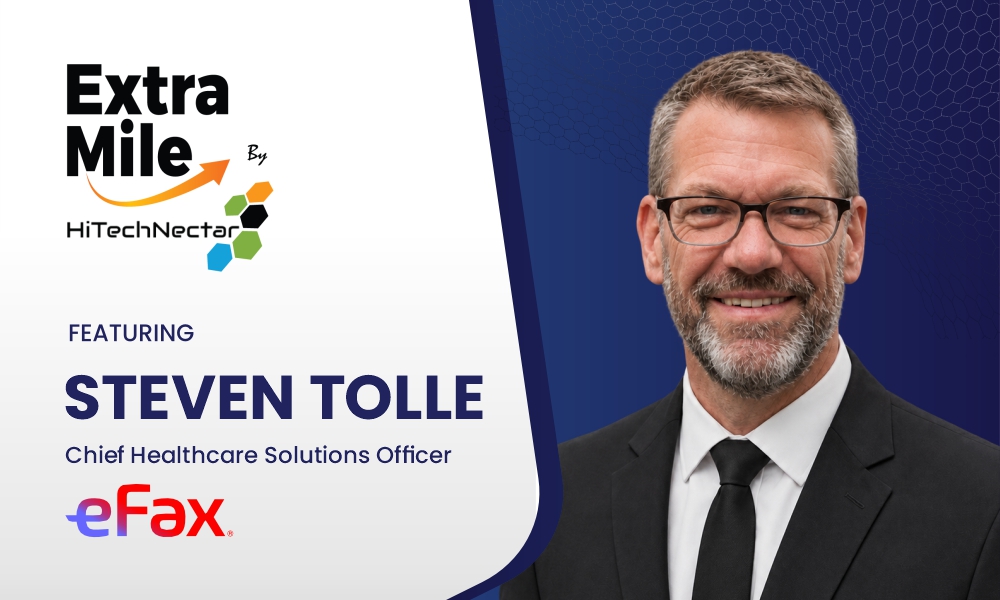

Host: Hey everyone, welcome to the brand-new episode of ExtraMile by HiTechNectar, where the most meaningful discussions in the tech happen. Each episode features thought provoking conversation with industry experts, innovators and change makers around the world. I’m your host Mohit and today we are here to discover what it takes to modernize healthcare communication in the world where critical information still moves by fax.
So, for this episode, we are joined by Steven Tolle, Chief Healthcare Solutions Officer at eFax, a brand of Consensus Cloud Solution. eFax is one of the world’s largest and best-known providers of digital cloud fax technology. The firm has evolved to be a trusted provider of advanced solutions that automate critical workflows, enable secure data exchange, maximize operational efficiencies, and leverage AI to extract and transfer unstructured data. Our guest for the day, Steven, has an extraordinary career with 30 plus years of building scaling and transforming healthcare technology. His work sits at the intersection of AI, document intelligence, workflow orchestration, and healthcare data exchange.
In this conversation, we’ll go through Steven’s career journey, the lessons learned along the way, how generative AI is transforming healthcare interoperability, the role of security and compliance in cloud fax adoption, and the future of AI powered document intelligence. Steven, it’s a pleasure to have you here. Welcome to today’s discussion.
Steven: Thank you. I’m really happy to be here.
Host: So, Steven, your first question is you have led CSO and CPO role at IBM Watson Health, Optum, Allscripts and Merge at all different stages and scales. How do you prioritize product innovation over strategic direction and what does Consensus Cloud Solution need most from your leadership today?
Steven: You know, any company, regardless of size or status, has different priorities at any given time. And so, I’ve always used this concept of what’s the North Star, right? What’s guiding you at that moment in time as a business and then everything has to flow down from that.
So, when I was at Merge, it was because we had acquired six companies in a couple of years and we had to streamline the product portfolio. That was the priority and you had to hold on to customers at the same time. So that was the North Star there, right?
When we were at IBM Watson Health, it was about how do we convince an industry that was always open to new technology, radiology has always been open to embracing new technology. How do we convince them to use AI? And we were able to launch one of the first AI-based products in that space.
So, it really comes down to where are you as a company? What is your priority? And then how do you flow downstream from that?
And that changes. And you’ve got to be willing to reevaluate it on a quarterly basis. Obviously, as a public company, we focus on hitting our numbers that we forecast to the street.
That’s a very important metric of success for the business. But we’re also focused on how do we grow our network and make it more valuable. So, the biggest thing I can do for eFax right now is bring focus to our AI-based product portfolio.
We have been working on intelligent document processing for a few years and it was time to really mature that effort and turn it into a solution sale. Healthcare buyers buy solutions. They don’t want to buy widgets.
They don’t want to buy tech. They want to buy solutions that have proven results. And so we’ve been reworking the product portfolio to focus on solutions targeted at specific segments, solving problems that people know they have and they’re willing to spend money to solve.
That’s really focus has been the word of the day since I arrived six months ago.
Host: So, heading to the next question for the day, with 30 plus years of building, scaling and transforming healthcare technology companies, what has been the biggest lesson learned from your remarkable career journey?
Steven: I mentioned earlier timing. You know, the reality is product market fit is the thing that a lot of companies really struggle with. I’ve seen this in the companies where I worked.
I spent four years as a professional venture capitalist, and I saw that a lot of companies that were asking for money. And it comes down to market timing. And do you know whether you’re offering a product that the market will buy?
There’s some industries where it makes sense to be an evangelist, where you’re out trying to convince the market that they have a problem. That’s a really hard stage for a company to be in. So, I really focus on how do you know you have product market fit?
How many customers have you talked to? Because the answer you’re looking for is not in the room you’re in. You’ve got to go out and talk to the market, understand what problems do they have that they’re willing to spend really precious money on solving.
And there are real problems. Things like fatigue, burnout, administrative burden, referral leakage is an enormous problem that has not gotten any better over the last 10 years, even though more technology has been brought to the table, more interoperability has been happening and still referral leakage hasn’t really gotten much better. So, it comes down to market timing, I think is the biggest thing I’ve learned in my career.
Host: 30 long years of experience is indeed a great lesson for leaders across healthcare technology. You have gone through it all. On that note, let’s take a look at how technology is shaping healthcare today.
As Chief Healthcare Solutions Officer at Consensus Cloud Solution, how are you leveraging generative AI to transform healthcare interoperability and clinical document workflows?
Steven: When you think about what eFax is, it’s a network, right? It’s a network that covers over 60,000 points of presence, which are our customers. A lot of that is healthcare and we’re moving unstructured documents around.
And so about 80% of data in healthcare is locked in an unstructured document. Could be a progress note, could be a lab result, could be a radiology report. Very little healthcare data is actually discrete granular data like a digital lab result.
And so, we have this enormous network and we’re connected to some of the top tier tech platforms in healthcare. And we’re moving mission critical documents that are referral, they’re prior auth, they’re claims attachments, they’re discharge summaries, transition care, denials, right? And so, what we’re doing is we’re taking that network, we’re using generative AI to first understand what is the document?
What kind of document are we looking at? We’re using a LOINC criteria actually to standardize how do we classify the document we’re looking at? Is it a radiology report or is it a pizza menu, right?
It’s important to know the difference. But then we can read the document and identify important information. So, is it an urgent request?
Is it marked stat? Who’s the patient? Who’s the referring physician?
What’s the working diagnosis? If it’s a cancer referral, we might read that inbound fax that could be 80 pages long and we could identify, oh, they mentioned a biopsy, but we don’t see a pathology report. So, we should probably flag that there’s a pathology report somewhere that they want to go get.
So that’s what we’re using generative AI for. But then beyond the initial document intake, we recently acquired a company called DocHealth and we’ve built out a platform on technology stack that can orchestrate the workflow using AI agents. And that automation of the administrative workflow, I think is going to be critical for a lot of healthcare players.
Host: That’s a valuable perspective, Steven. Agreed with your take. Let’s go ahead now.
Healthcare still relies on fax for exchanging critical information. How is eFax modernizing this effective communication channel without changing the existing clinical workflows?
Steven: I’m a big fan of standards. My last company was a clinical trial startup that used the FHIR standard to pull structured information out of EHRs for clinical trials data capture. And, you know, we’ve made huge advancements in this country in the last decade with first the meaningful use and the adoption of electronic health records.
But then, of course, that’s 20 years now. And then, of course, we’ve seen the FHIR standard mature. We’ve seen new implementation guides get developed and mature.
And we’re seeing usage of FHIR. Unfortunately, we’re also starting to see this divide in the country where you’ve got the health systems that can afford to deploy technology. And then you’ve got everyone else.
You’ve got 45% of the physicians in the country that are still independent. You’ve got post-acute facilities like nursing homes or rehab facilities or home care that didn’t get meaningful use money. And so, they’re almost all manual.
They are investing in some technology. But, you know, they’ve got to see a return on their investment because no one’s helping them pay for it. So, you’ve got this divide happening.
And so, where I’m focused is what if we could take these documents, extract the information we need out of those documents, and then pass a digital transaction, maybe a FHIR payload, maybe an X12 transaction to whoever needs to get it next to streamline the administrative hassles that we see. First, of course, there are transcription errors. If you’re typing in something from a document, you’re going to make a mistake.
That’s normal. But beyond that, it’s the time. It’s the delay that I think is the biggest issue.
30% to 40% of our health care spend in the U.S. is all about administrative overhead. So, you know, when we think about how to modernize, where to go, it’s serving that segment of the industry that is not going to adopt new standard because they can’t afford to. And so how do we let them continue to use fax or digital fax?
And then we route the transaction in a standardized way so that we can actually streamline care. That’s where we’re going. And that’s the goal long term for the eFax network.
Host: That was an amazing take. Modernizing without disrupting the way care teams work is what makes adoption simple. So, carrying on, security and compliance are the key factors to eFax value proposition.
What is the impact of certifications like HITRUST and HIPAA compliance and encryption on the helping companies adopt cloud fax solutions?
Steven: Well, you know, these are table stakes. You’ve got to be HIPAA compliant. You’ve got to have SOC 2.
You’re going to have to have high trust. These are things that large health systems are certainly looking for a variety of reasons. One, because it’s mandated.
Two, because they’re worried about things like cybersecurity threats. And so, these are table stakes in health care. And I think even if you look at the federal segment, it gets even progressively more difficult when you’ve got FedRAMP requirements that we’re looking at for this product line we’re talking about.
So, you have to invest. It is a lot of administrative overhead, actually, to take on some of these standards, but it’s worth it in the long run. So, any tech company in health care, if they’re not pursuing these standards, they’re not going to be successful.
Host: Exactly, Steven. Trust is the cornerstone of cloud adoption in healthcare and compliance is what builds it effectively. Moving to an important point, many organizations view fax as an outdated technology.
What’s your perspective on this perception? And why do you believe cloud fax continues to play a critical role in regulated industries?
Steven: It comes down to economics at the end of the day. So, if you think about what actually goes across as a fax, you know, if you look at specialty referrals, 400 million imaging referrals a year, a lot of those get faxed. The reports, a lot of those reports get faxed back to the provider that sent a patient in for imaging. If you look at just a referral in gene space and you look at the city of Chicago, if you wanted to connect the 23,000 ordering physicians in that metro area to the imaging providers in the metro area, and you wanted to have an HL7 interface for every provider, which is a bit unrealistic.
So, it costs about $9 billion to spend all that money, right? So, if you try to replicate what fax provides, which is high reliability, you can send a document anywhere it needs to go at any time without having to pre-build an interface. If you try to replicate that with FHIR or HL7 interfaces, it’s cost prohibitive.
So the economics are you have to send about a thousand patients a year to an imaging center for you to be valuable enough for them to spend money on a digital interface. So that’s why fax is persistent. The other reason fax is persistent is workflow realities.
So, when a provider orders a medication or a high cost procedure and an insurance company or a benefits manager says, I need proof that this patient needs that drug or has failed on a previous therapy, the attachment that has to go to the benefit manager is almost always faxed. Yes, there’s a portal. Yes, the physician could go to five or six or 10 different portals or upload that information.
They’re not going to do that. They’re going to fax it. So, one of the reasons it’s so persistent is this administrative need to send proof that a patient needs a procedure that could be high cost.
And then transitions of care. When you’ve got patients going out of the hospital, going to a facility that may not have an electronic health record, their record’s going to go along for the ride as a document. And that happens a lot.
So, these referrals, the attachments, and then discharge summary.
Host: That was a clear explanation, Steven. Simply looking beyond the perception and at the real value CloudFax delivers to regulated industries is a fresh way to see it.
Taking this conversation further, what innovation can customers expect from eFax and AI-powered document intelligence as organizations continue their digital transformation journeys?
Steven: We’ve been working for the last six months on a new product offering that is going to get launched here in the next couple of weeks. Generative AI to process these documents. How do we then use our workflow platform to get rid of the spreadsheets and the post-it notes that are all being used in physician offices around the country to track referrals?
You know, physicians do about 40 prior auths a week, spending about 13 hours managing that. They could actually see 60 patients in the same amount of time, right? So, if you think about how much time and money we’re spending chasing paper, most EHRs, my teams in my career, we built five different electronic health records.
Very few of them are built to manage what has to happen before and after a patient visit. They’re really focused on the visit and documenting the visit and doing orders. But chasing the paperwork for an inbound referral or knowing whether a patient actually went somewhere that you sent them, these are things that EHRs were never really designed to do.
So, a lot of teams use spreadsheets and paper. And so, our platform, which is called Harmony, allows a care team to keep track of what’s going on with these patients. And it sets tasks.
And we have automation so that we can go look for information that’s missing for a particular patient. So, in the future, I see a lot of AI agents designed to go query for missing information to understand what’s in a document, what’s missing. If you think about an oncology patient, it takes about three weeks on average in this country for your first oncology visit as a cancer patient.
The challenge is that every week that care is delayed, your mortality rate goes up somewhere between 1.2 and 3%. So, these are real big issues. And so, in that time that you’re waiting to get in to see an oncologist, there are prior offs that have to happen.
There are labs that have to get done. There are records that have to show up from wherever you came from. And that just takes time.
So, what I’m trying to do is put in place a platform that can cut the time so that we can actually solve some of these problems and stop losing the referrals. You know, about 29% of all referrals don’t ever get scheduled. Half of all referrals never happen.
And so, as a specialty practice, this is revenue you’re losing. But more importantly, it’s patient care that’s not happening. And so, what happens?
Patient care gets delayed. Patients get sicker. They cost more.
And of course, worst case scenario, you’ve got death that could have been potentially prevented. So, these are problems we’re trying to solve. And it’s really how do we get rid of this administrative burden so that physicians and their staff can actually practice medicine and have better quality of work life?
Host: Steven, that’s really exciting to hear what’s next for the eFax customers. Intelligent automation is the way ahead. Heading to the last question for the day.
Healthcare interoperability has been talked about for years. What’s generally different at this time? And after the current regulations are implemented, what do you think will be the next challenge for healthcare organizations?
Steven: I think what’s different is we’ve got standards that are now very clearly identified as the go forward standards. So, the FHIR standard has been anointed by the government as this is where we’re going to go. So, I think that’s good. You’ve got real practical adoption of FHIR, which is good. The challenge we’re going to have, again, is that we have this divide of people who can afford it and people who can’t. So how do we build a bridge?
How do we help providers and their team comply with these new standards, but also not cause them to spend huge amounts of money they don’t have? So that’s really the goal. Embrace the standards, make it possible.
I think it’s been largely a bipartisan effort. Republicans and Democrats have been embracing the need for no surprises, the need for administrative simplification and standardization. So, I think that’s all positive.
But we’ve got more work to do to make sure that the folks that don’t have the money to spend can still participate and follow the rules around these new standards that are coming.
Host: That was really a solid point to close for the day, Steven. So, on that note, let’s wrap up for the day. Steven, it was an absolute pleasure for you being here on ExtraMile.
It was indeed a great conversation. We got to know you better with inspiring story and now how far you have come helping organizations exchange critical information scalely and intelligently. This is a must-listen for healthcare leaders and tech professionals looking to embrace digital transformation, innovation and interoperability on a global scale. Thank you for joining us.
Steven: Thank you very much. I enjoyed it.
Host: So here we come to the end of the discussion of ExtraMile by HiTechNectar. We thank everyone who tuned in and, of course, gained valuable insights. Join us in upcoming episodes for discussion, insights and perspectives from knowledgeable names in the tech.
Until then, keep learning, keep growing, and reach new heights with ExtraMile.
Explore Our Other Insightful Interviews: